Have one like this?
Upload a photo for a free check of what yours may be worth.
Lot description
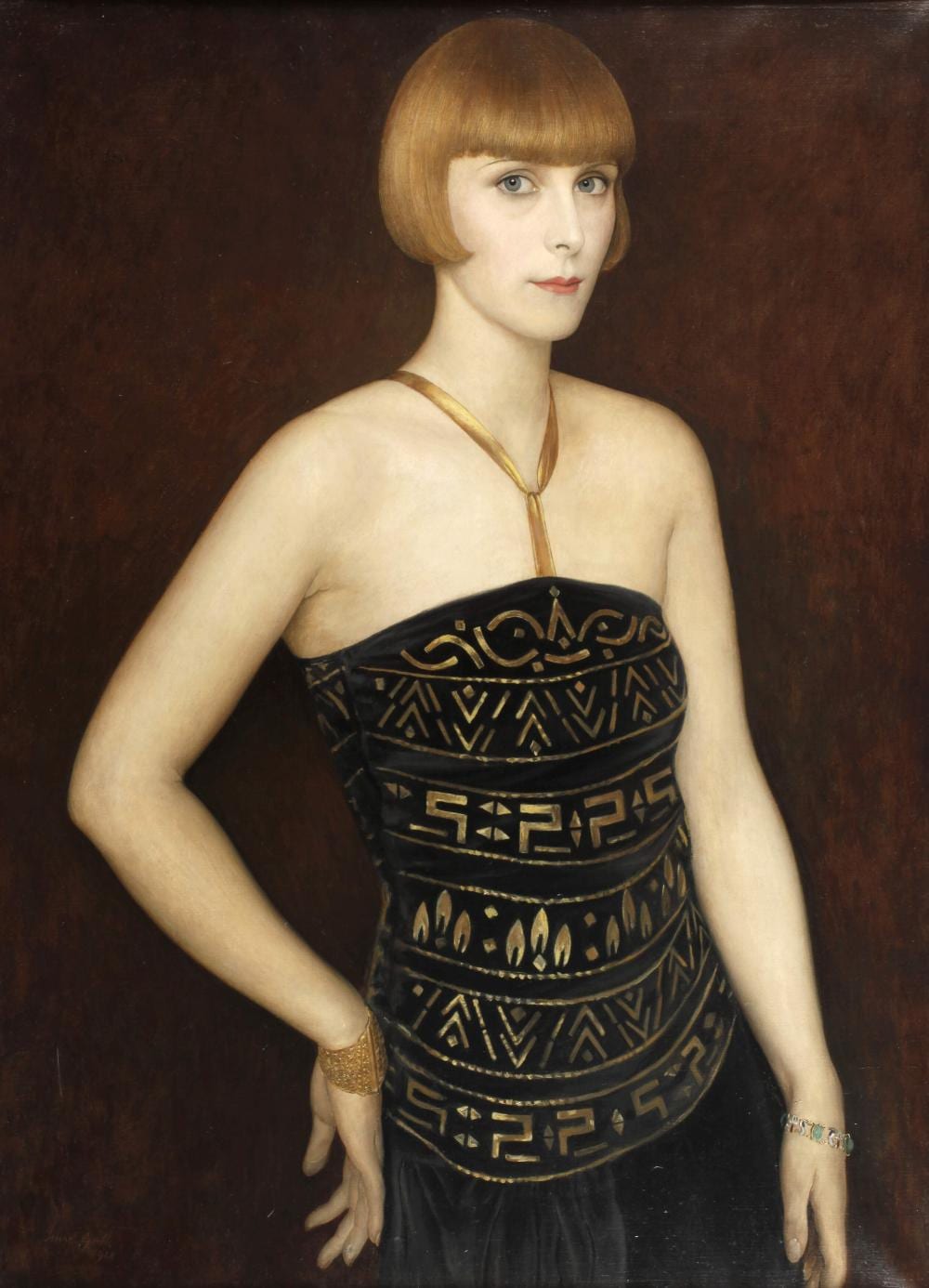
Imre Góth, Neusachliches Damenportrait ikonographisches Bildnis einer schlanken blonden Dame mit Pagenschnitt (auch Bubikopf bzw. Garçonne-Haarschnitt) und elegantem schulterfreien Kleid des Art déco, stolz trägt die junge Frau ihren seinerzeit gewagten wie angesagten Haarschnitt, ihre schmal gezupften Augenbrauen, den modischen Schmuck und ihre, die weibliche Figur in dezenter Erotik unterstreichende Mode, als Zeichen des neuen weiblichen Selbstbewusstseins zur Schau – ihr direkt zum Betrachter gerichteter Blick verrät Anmut und Zurückhaltung, in den "Goldenen Zwanzigern" zählte Imre Goth zu einem der begehrtesten Portraitisten der Berliner Oberschicht, der aus ärmsten Verhältnissen stammende Künstler verdingte sich bei verschiedensten, meist avantgardistischen Zeitschriften unter anderem des Berliner Ullstein-Verlags, welche als Vorreiter des Art déco und der "Neuen Sachlichkeit" die maßgeblichen Protegés dieser neuen Kunst- und Lebensauffassung waren, die sämtliche Lebensbereiche wie auch die Geschlechterrollen neu definierte, neben Christian Schad, Walther Essenther, Tamara de Lempicka, der Wiener Gesellschaftsfotografin d’Ora (eigentlich Dora Kallmus) und Martin Munkacsi lieferte Imre Goth Titelbilder und Beiträge für diese Illustrierten, vor allem die Darstellung von Film- und Theaterschauspielerinnen machten ihn berühmt, so erschienen 1928 und 1929 unterschiedliche Portraits von Lilian Harvey auf den Titelseiten von "Scherl's Magazin" und der Münchner Zeitschrift "Jugend", vorliegendes Portrait, welches zu den herausragendsten Werken der Berliner Zeit Goths zählen dürfte, hat große Ähnlichkeit mit dem ungarischen Stummfilm-Star Maria Corda (1898 Diemrich bis 1976 Thônex), welche in den 1920er Jahren in Berlin mehrere Filme drehte, das Bildnis gelangte nach dem 2. Weltkrieg in die Sammlung des ungarischen jüdischen Autors, Verlegers, Psychoanalytikers, Kunstsammlers und Mitbegründers der "Art Basel" Carl Laszlo (eigentlich Károly László, 1923 Pécs bis 2013 Basel), der als Holocaustüberlebender, Lebenskünstler und Exzentriker nach Basel emigrierte und hier in seiner Villa am Sonnenweg ein Privatmuseum einrichtete, die Sammlung wurde 2016 durch das Auktionshaus Hampel in München versteigert, wie der Auktionskatalog anhand authentischer Fotos zeigt, hing das Gemälde von Imre Goth an prominenter Stelle in der Villa Laszlos, feinst lasierende, partiell gering pastose neusachliche Malerei in delikater Farbigkeit, Öl auf Leinwand, links unten signiert und datiert "Imre Goth 1928", rückseitig auf dem Keilrahmen undeutliche (Zahlen-)Annotationen und neuere Aufkleber wie "Keret Megrendelve +", gering restauriert, minimale Altersspuren, Malgrund etwas wellig, im prächtigen Vergolderrahmen (Kratzer) gefasst, Falzmaße ca. 102 x 76 cm. Info: vorliegendes Porträt gehörte im Jahr 1928 zur engeren Auswahl von 26 aus 365 Einsendungen der von Fritz Erler angeführten Jury für den Georg-Schicht-Preis um „Das schönste deutsche Frauenportrait 1928“, in diese Auswahl schafften es neben dem Preisträger Willy Jaeckel unter anderem auch Lotte Laserstein, Eugen Spiro oder Paul Matthias Padua, die Werke der engeren Auswahl, darunter Goths Werk, wurden in Form einer Wanderausstellung im Deutschen Reich präsentiert, die nach der Erstpräsentation bei Gurlitt in Berlin am 25. November 1928 in neun deutschen Städten gezeigt wurde, vom 24.1.1929 in Weimar bis zuletzt im November 1929 in Hamburg, vgl. Susanne Meyer-Büser, Das schönste deutsche Frauenportrait. Tendenzen der Bildnismalerei in der Weimarer Republik, Abb. 12., hier bezeichnet mit „Verbleib unbekannt“; vgl. auch der zeitgenössische Katalog der Wanderausstellung: „Georg Schicht Preis für das schönste Frauenportät 1928, wir danken Herrn Ludwig Sedlmaier für freundliche Hinweise. Künstlerinfo: auch Emmerich Goth, ungarischer jüdischer Maler, Zeichner, Illustrator, Karikaturist und Erfinder (1893 Szeged in Ungarn bis 1982 London), studierte an der Akademie Budapest, ab ca. 1918 weitergebildet bei Arthur Kampf in Berlin, wurde hier in den 1920er und Anfang 1930er Jahren zu einem begehrten Portraitisten der High Society, schuf Portraits von Theater- und Filmstars wie Lilian Harvey und Politikern wie Hermann Göring, zunächst tätig in Berlin, lieferte Beiträge für die Münchner "Jugend", die Berliner Zeitschrift "Scherl’s Magazin", die Zeitschrift "Der Querschnitt – Das Magazin der aktuellen Ewigkeitswerte" des zum Ullstein-Verlag gehörenden Propyläen-Verlag und die progressiven Zeitschriften "UHU" und "Die Dame. Illustrierte Mode-Zeitschrift" des Berliner Ullstein-Verlags, vertreten auf diversen Ausstellungen, unter anderem 1925 der Großen Berliner Kunstausstellung im Landes-Ausstellungsgebäude, beschickte 1935 Ausstellungen in Birmingham und emigrierte nach positiven Kritiken und dem Zerwürfnis mit Göring nach England, hier im Winter 1941–42 als "feindlicher Exilant" Internierung auf der Isle of Man, nach dem 2. Weltkrieg vor allem als Werbegraphiker für die britische Filmindustrie tätig und Produzent von Werbefilmen, lebte in Farley Green/Surrey und London, Quelle: Vollmer, Saur "Bio-Bibliographisches Künstlerlexikon", Dressler, "The dictionary of British Artists 1880–1940" und Internet. Imre Góth, New Objectivity Portrait of a Lady Iconographic portrait of a slender blonde lady with a pageboy cut (also known as a bob or garçonne haircut) and an elegant off-the-shoulder Art Deco dress. Garçonne haircut) and elegant off-the-shoulder Art Deco dress, the young woman proudly shows off her then daring and fashionable haircut, her narrowly plucked eyebrows, the fashionable jewellery and her fashion, which underlines the female figure in discreet eroticism, as a sign of the new female self-confidence - her gaze directed directly at the viewer betrays grace and restraint, In the "Golden Twenties", Imre Goth was one of the most sought-after portraitists of Berlin's upper class; the artist, who came from the poorest of backgrounds, was employed by a wide variety of mostly avant-garde magazines, including the Berlin publishing house Ullstein-Verlag, which, as pioneers of Art Deco and "New Objectivity", were the main protégés of this new approach to art and life, In addition to Christian Schad, Walther Essenther, Tamara de Lempicka, the Viennese society photographer d'Ora (actually Dora Kallmus) and Martin Munkacsi, Imre Goth provided cover pictures and contributions for these magazines, and it was above all his depictions of film and theatre actresses that made him famous, In 1928 and 1929, various portraits of Lilian Harvey appeared on the covers of "Scherl's Magazin" and the Munich magazine "Jugend"; this portrait, which is probably one of the most outstanding works of Goth's Berlin period, bears a close resemblance to the Hungarian silent film star Maria Corda (1898 Diemrich - 1976 Thônex), who shot several films in Berlin in the 1920s. The portrait became part of the collection of the Hungarian Jewish author, publisher, psychoanalyst, art collector and co-founder of "Art Basel" Carl Laszlo (actually Károly László, 1923 Pécs - 2013 Basel), who emigrated to Basel as a Holocaust survivor, artist and eccentric and set up a private museum in his villa on Sonnenweg; the collection was auctioned off by the Hampel auction house in Munich in 2016, as the auction catalogue shows with the help of authentic photos, the painting by Imre Goth hung in a prominent position in the Villa Laszlos, finely glazed, partially slightly impastoed New Objectivity painting in delicate colours, oil on canvas, signed and dated "Imre Goth 1928" at the bottom left, indistinct (numerical) annotations and newer labels such as "Keret Megrendelve +" on the stretcher verso, minor restoration, minimal traces of age, the painting ground somewhat wavy, mounted in a magnificent gilded frame (scratches), inner dimensions approx. 102 x 76 cm. Info: this portrait was one of the 26 shortlisted out of 365 submissions by the jury led by Fritz Erler for the Georg Schicht Prize for “The Most Beautiful German Portrait of a Woman 1928” in 1928. In addition to the winner Willy Jaeckel, Lotte Laserstein, Eugen Spiro and Paul Matthias Padua were also included in this selection. The works on the shortlist, including Goth’s work, were presented in the form of a traveling exhibition in the German Reich. After its initial presentation at Gurlitt’s in Berlin on November 25, 1928, it was shown in nine German cities, from January 24, 1929 in Weimar until November 1929 in Hamburg. See Susanne Meyer-Büser, “The Most Beautiful German Portrait of a Woman: Trends in Portrait Painting in the Weimar Republic,” fig. 12, here labeled “Whereabouts unknown.” See also the contemporary catalogue of the travelling exhibition: “Georg Schicht Prize for the most beautiful portrait of a woman 1928, we thank Mr Ludwig Sedlmaier for kind advice. Artist info: also Emmerich Goth, Hungarian Jewish painter, draughtsman, illustrator, caricaturist and inventor (1893 Szeged in Hungary to 1982 London), studied at the Budapest Academy, from ca. 1918, further training with Arthur Kampf in Berlin, became a sought-after portraitist of high society in the 1920s and early 1930s, created portraits of theatre and film stars such as Lilian Harvey and politicians such as Hermann Göring, initially active in Berlin, contributed to the Munich "Jugend", the Berlin magazine "Scherl's Magazin", the magazine "Der Querschnitt - Das Magazin der aktuellen Ewigkeitswerte" published by Propyläen-Verlag, part of the Ullstein publishing house, and the progressive magazines "UHU" and "Die Dame. Illustrierte Mode-Zeitschrift" published by Ullstein Verlag in Berlin, represented at various exhibitions, including the Great Berlin Art Exhibition in the Landes-Ausstellungsgebäude in 1925, organised exhibitions in Birmingham in 1935 and emigrated to England after positive reviews and a rift with Göring, where he was interned on the Isle of Man as an "enemy exile" in the winter of 1941-42. After the Second World War, he mainly worked as a commercial artist for the British film industry and produced advertising films, lived in Farley Green/Surrey and London, source: Vollmer, Saur "Bio-Bibliographisches Künstlerlexikon", Dressler, "The dictionary of British Artists 1880-1940" and Internet.