Have one like this?
Upload a photo for a free check of what yours may be worth.
Lot description
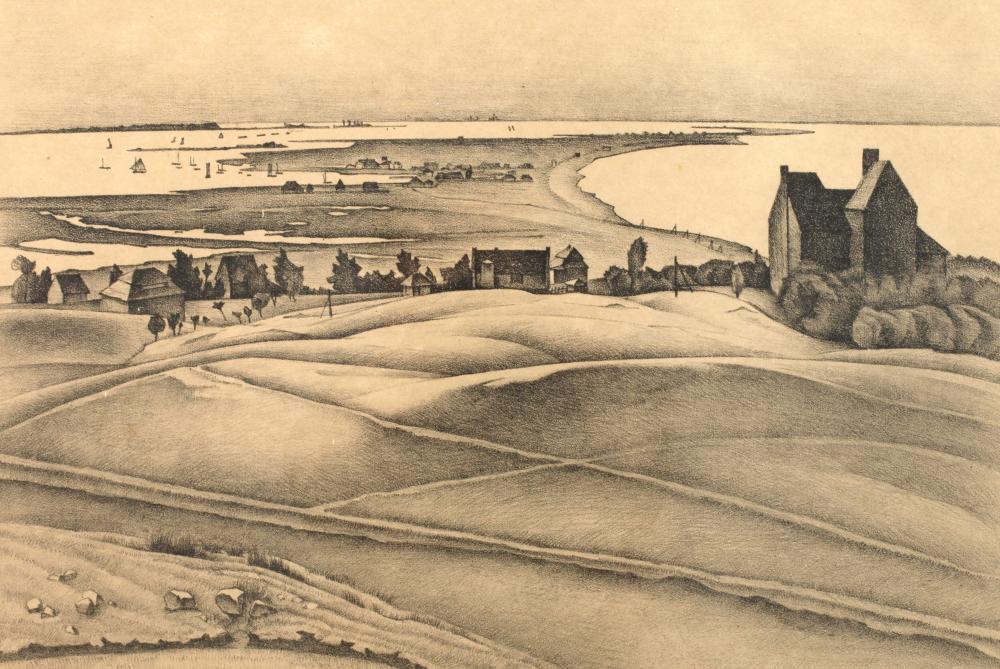
Alexander Kanoldt, "Hiddensee I" Blick von einer leichten Anhöhe über die Insel mit verstreuten Häusern und zahlreichen Booten auf der Ostsee, schöner differenzierter Druck, Werksverzeichnis Amman L28, Kreidelithographie, unter der Darstellung in Blei rechts signiert, nummeriert und datiert "Kanoldt, XXVIII 1927" sowie links betitelt "Hiddensee I", gleichmäßig gebräunt, unter Passepartout und hinter Glas gerahmt, Darstellungsmaße ca. 30,5 x 46 cm. Künstlerinfo: dt. Maler und Graphiker (1881 Karlsruhe bis 1939 Berlin), erster Unterricht bei Vater Edmund Kanoldt, 1899–1904 Schüler der Kunstgewerbeschule Karlsruhe, parallel 1901–04 Studium an der Karlsruher Akademie bei Ernst Schurth und Friedrich Fehr, 1906–09 Meisterschüler von Friedrich Fehr, anschließend Übersiedlung nach München, Bekanntschaft mit Adolf Erbslöh, 1909 mit Marianne von Werefkin, Gabriele Münter, Wassily Kandinsky und Alexej von Jawlensky Gründung der Neuen Künstlervereinigung München (1909–12), aus der sich 1911 der "Blaue Reiter" abspaltet, Mitglied der Neuen Münchner Sezession, 1913 Studienreise nach Italien, Tirol und der Schweiz, 1914–18 Reserveoffizier im 1. Weltkrieg, 1924 in Italien, entwickelte mit Georg Schrimpf eine magisch-realistische Variante der Neuen Sachlichkeit, 1925 Teilnahme an der Ausstellung Neue Sachlichkeit in Mannheim, 1925–31 Professor an der Akademie Breslau, ab 1927 Gründungsmitglied der Badischen Sezession, 1931 Rückkehr und Betrieb einer Malschule in Garmisch, 1933 Albrecht-Dürer-Preis, ab 1932 Mitglied der Münchner Künstlergruppe "Die Sieben", 1932 Eintritt in die NSDAP, 1933 Ernennung zum Professor und Direktor der Berliner Kunsthochschule und Senator an der Preußischen Akademie der Künste, 1936 Niederlegung der Professur aus gesundheitlichen Gründen, Mitglied im Deutschen Künstlerbund Weimar, im Deutschen Werkbund, im Künstlerbund Schlesien und im Reichsverband bildender Künstler Deutschlands, Quelle: Thieme-Becker, Vollmer, Saur "Bio-Bibliographisches Künstlerlexikon", Müller-Singer, Bruckmann "Münchner Maler des 19./20. Jh.", Mülfarth, Dressler und Wikipedia. Alexander Kanoldt, "Hiddensee I" View from a slight hill over the island with scattered houses and numerous boats on the Baltic Sea, beautiful differentiated print, catalogue raisonné Amman L28, chalk lithograph, signed, numbered and dated "Kanoldt, XXVIII 1927" in pencil below the image on the right and titled "Hiddensee I" on the left, evenly browned, matted and framed behind glass, dimensions approx. 30.5 x 46 cm. Artist info: German painter and graphic artist. Painter and graphic artist (1881 Karlsruhe - 1939 Berlin), first lessons with his father Edmund Kanoldt, 1899-1904 pupil at the Kunstgewerbeschule Karlsruhe, parallel 1901-04 studies at the Karlsruhe Academy under Ernst Schurth and Friedrich Fehr, 1906-09 master student of Friedrich Fehr, then moved to Munich, Acquaintance with Adolf Erbslöh, 1909 with Marianne von Werefkin, Gabriele Münter, Wassily Kandinsky and Alexej von Jawlensky foundation of the Neue Künstlervereinigung München (1909-12), from which the "Blaue Reiter" split off in 1911, member of the Neue Münchner Sezession, 1913 study trip to Italy, Tyrol and Switzerland, 1914-18 reserve officer in the First World War, 1924 in Italy, 1924 in Italy, 1924 in the USA. World War I, 1924 in Italy, developed a magical-realist variant of New Objectivity with Georg Schrimpf, 1925 took part in the New Objectivity exhibition in Mannheim, 1925-31 professor at the Breslau Academy, from 1927 founding member of the Baden Secession, 1931 returned and ran a painting school in Garmisch, 1933 Albrecht Dürer Prize, from 1932 member of the Munich artists' group "Die Sieben", 1932 joined the NSDAP, 1933 appointed professor and director of the Berlin Art Academy and senator at the Prussian Academy of Arts, 1936 resigned his professorship for health reasons, member of the Deutscher Künstlerbund Weimar, the Deutscher Werkbund, the Künstlerbund Schlesien and the Re