Lot description
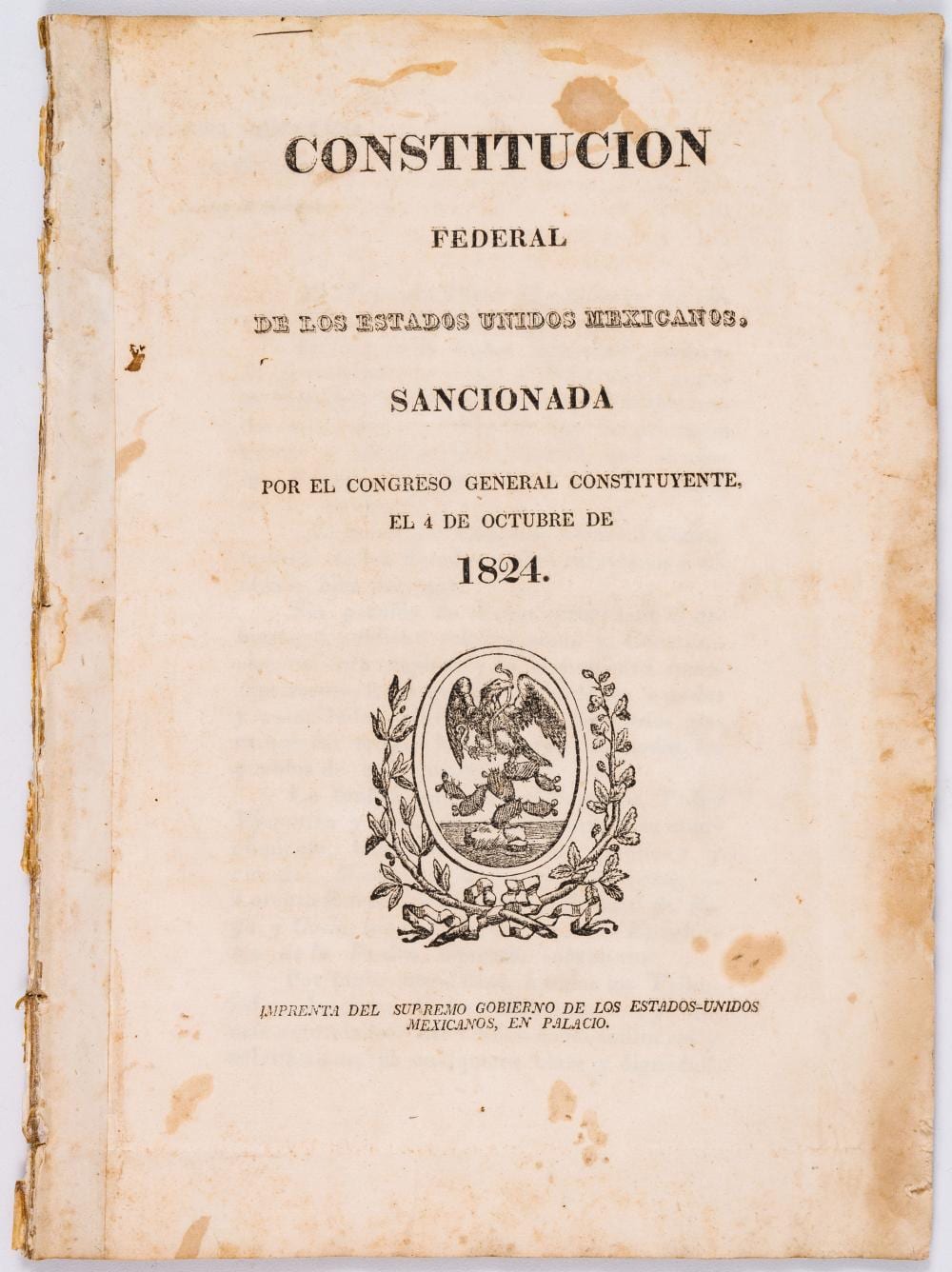
Federal Constitution of the United Mexican States. Sectioned. General Constituent Congress of October 4, 1824. Mexico: Printed by the Supreme Government of the United Mexican States, 1824. 2 + 28 + 2 pp. | 27.5 x 17.5 cm, hardcover. First edition of the Federal Constitution of the United Mexican States of 1824, which came into force on July 30 following the fall of Agustín de Iturbide’s First Empire. The new Constitution established a federal representative republic, adopting the name "United Mexican States" and recognizing Catholicism as the sole official religion. Congress began its discussions on April 1, approved the Constitution on October 3, and published it on October 5. It remained in effect until 1835 and was restored in 1846 by José Mariano Salas. In 1847, reforms were published that temporarily reinstated it until 1853. Its federal model was influenced by Spanish liberalism, the Independence movement, Bourbon reforms, the vast territorial expanse, and the lack of communication infrastructure. Central states operated as administrative decentralization, while peripheral states adopted more radical or moderate forms of federalism. (Palau 59642). Provenance: Archive of the Samper Madrid family.--------------------Constitución federal de los Estados Unidos Mexicanos. Seccionada. El Congreso General Constituyente del 4 de octubre de 1824 s.a México: Imprenta del Supremo Gobierno de los Estados-Unidos Mexicanos, 1824. 2 + 28 + 2 pp. pp. . 27.5 x 17.5 cm, Pasta dura. Primera edición de la Constitución Federal de los Estados Unidos Mexicanos de 1824, que entró en vigor el 30 de julio tras la caída del Primer Imperio de Agustín de Iturbide. La nueva Carta Magna estableció una república federal representativa, adoptando el nombre de Estados Unidos Mexicanos y reconociendo al catolicismo como única religión oficial. El Congreso inició su discusión el 1.º de abril, aprobándola el 3 de octubre y publicándola el día 5. Estuvo vigente hasta 1835, y fue restaurada en 1846 por José Mariano Salas. En 1847 se publicaron reformas que la reestablecieron temporalmente hasta 1853. Su modelo federal respondió a la influencia del liberalismo español, la Independencia, las reformas borbónicas, la extensión territorial y la falta de comunicaciones. Los estados centrales funcionaron como descentralización administrativa, mientras que los periféricos adoptaron formas de federalismo más radicales o moderadas. (Palau 59642) Procedencia: archivo de la familia Samper Madrid. 1 Pieza(s)