Have one like this?
Upload a photo for a free check of what yours may be worth.
Lot description
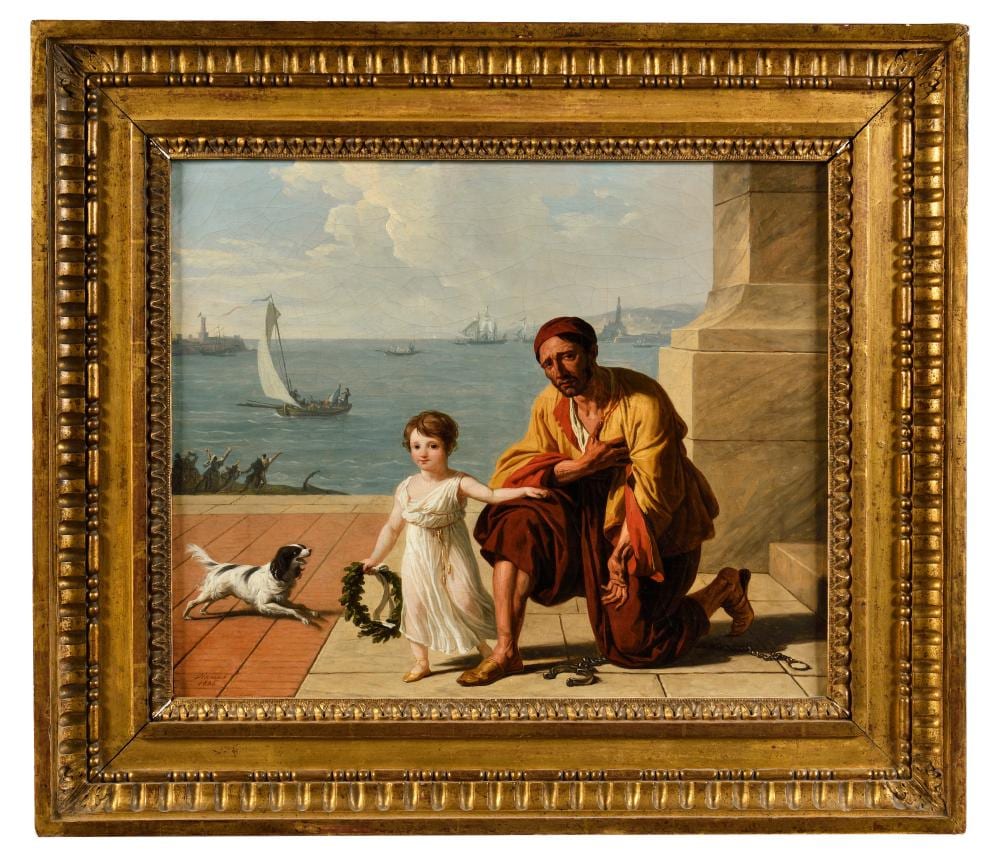
François André VINCENT (Paris 1746 - 1816) Allegory of the liberation of the slaves of Algiers by Jérôme Bonaparte Canvas Height : 37,5 cm Width: 45.5 cm Wood and gilded stucco frame Signed and dated lower left "Vincent / 1806"; autograph inscriptions on reverse of original canvas. "Appartenant à Mlle Me Gabrielle / Capet. Vincent. 1806" Provenance: - Given to Marie-Gabrielle Capet by Vincent ; - Anonymous sale, Carcassonne (Me Deleau), May 29, 2010 ; - Talabardon et Gautier, Paris, 2011; - Collection Comte et Comtesse Charles-André Colonna Walewski, Geneva. Exhibition: - François-André Vincent, Tours, Musée des Beaux-Arts, October 18, 2013 to January 19, 2014. Bibliography: - J.-P. Cuzin, Vincent entre Fragonard et David, Paris, 2013, n° 636 Although he had not exhibited since 1801, Vincent presented a large painting at the Salon of 1806, which does not appear in the booklet but is described by Chaussard: "A charming picture, composed of two figures as large as life, representing a Child relieving a Slave, hatched from his easy and practiced brush; it is executed with his usual vigor" (note 1). At the age of sixty and weakened by illness, François-André Vincent was composing less. This painting is one of his last known works, and stands out for its theme. Our painting is a reduction of this work created for Jérôme Bonaparte (fig. 1) (note 2). The subject refers to the mission entrusted to his younger brother by Napoleon I in 1805. Since 1802, an agreement between the dey of Algiers and Napoleon had protected citizens of the French and Italian republics, who could not be taken as slaves; those of the Republic of Genoa were still treated by pirates according to barbarian customs. In 1805, the annexation of Genoa to the Empire prompted Napoleon to take bold action; in July, during a visit to Genoa, he wrote to Jérôme, at the head of a squadron in the Ligurian port: "My brother [...], the aim of your mission is to remove all the slaves, Genoese, Italian and French, who are in the Algiers bagnes." Setting sail at the beginning of August, Jérôme triumphantly returned to Genoa on August 31, with two hundred and thirty-one slaves on board (note 3). The transaction cost 450,000 francs. By embarking on a slave repurchase policy, Napoleon was following in the footsteps of Louis XIV. In the 18th century, one of the functions of the Knights of Malta had been to travel the coasts of Africa to buy back Christian slaves. In 1815, Admiral Sidney Smith, Bonaparte's former adversary at Saint Jean d'Acre, founded the Société des antipirates in Paris, which later became the Société des chevaliers libérateurs des esclaves blancs en Afrique, with the aim of putting an end to the enslavement of victims of piracy in the Barbary states. It is this event that Vincent's painting celebrates, and we don't know whether it was commissioned as a gift for Jerome, or by Jerome himself. Our little painting shows virtually no variation from the Kassel picture. The two figures, standing on the quay as if on a theatrical stage, symbolize this liberation of the slaves. The scene takes place on their return to Italy, the country from which most of these men originated. In the background, we see the harbor of Genoa and a boat bringing the prisoners ashore, awaited by their families. The composition of the painting, a veritable exvoto, combines allegorical language with the most realistic details: the shackle marks on the man's ankles, the tattoo on his forearm, the expression on his face. The girl holds a crown of oak leaves, a symbol of power and justice, tied with a ribbon that, in the large Kassel painting, bears the inscription La Riconoscenza a Girolamo Bonaparte (Recognition of Jerome Bonaparte). Does she symbolize this recognition, or is she the daughter of the freed prisoner? As for the little dog that runs over, it represents the loyalty that prisoners owe to their liberator. Vincent must have been particularly attached to this composition to have kept this reduction, which he gave to Marie-Gabrielle Capet, who stayed with him after the death of his wife, Adélaïde Labille-Guiard. [ATTENTION description truncated by Drouot - Full details to be found in the catalog]. Temporary import The buyer will be required to pay import duties, i.e. 5.5% in addition to the hammer price, unless the item is immediately re-exported outside the European Union.