Lot description
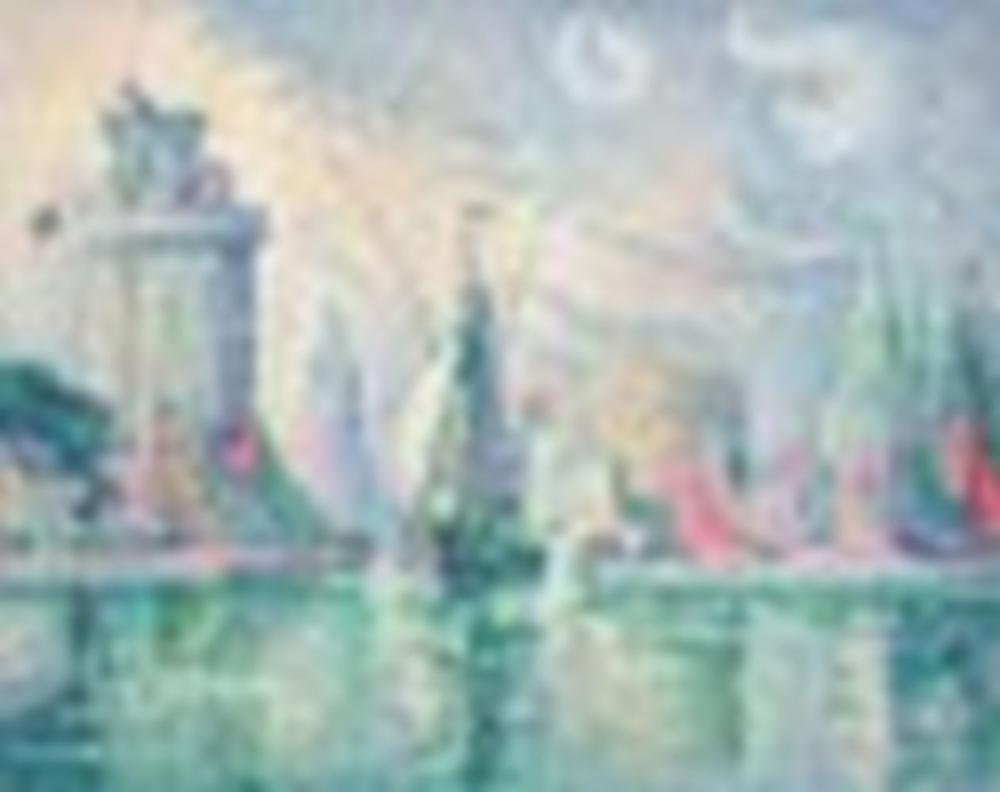
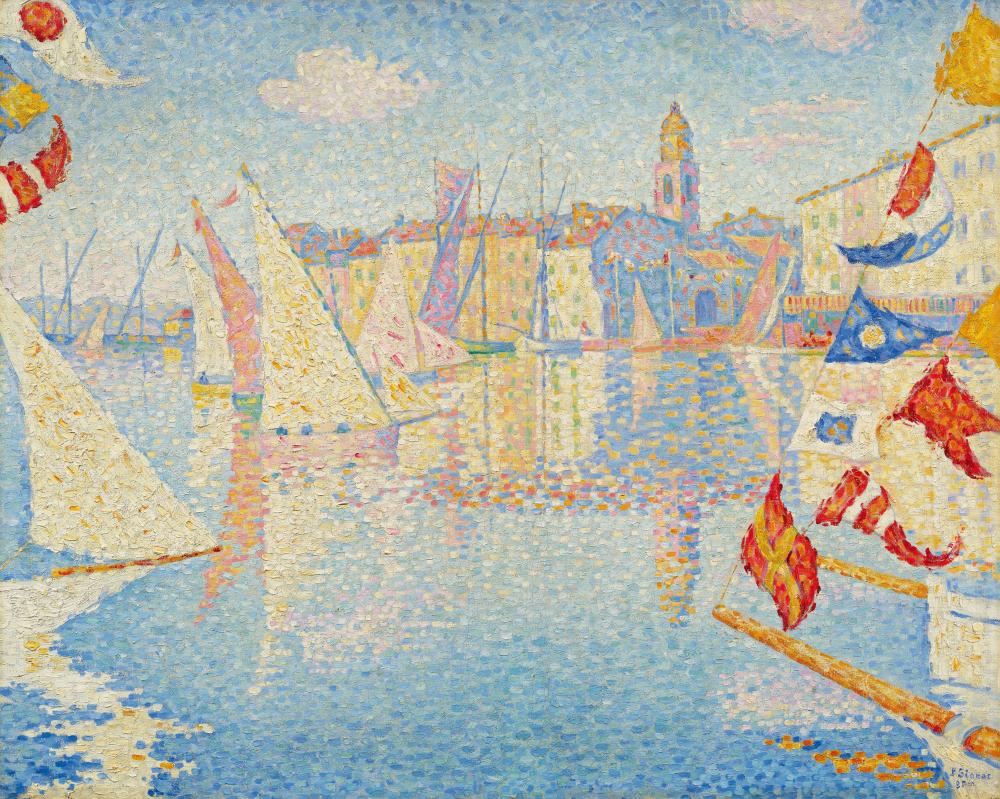
PAUL SIGNAC (1863 Paris 1935) Saint-Tropez, port en fête. 1895. Oil on canvas. Signed and dated lower right: P. Signac / 95. Entitled verso on the stretcher: Port en fête – Saint-Tropez. 65.5 × 81 cm. Certificate: Marina Ferretti-Bocquillon, Paris, 29.4.2025. Provenance: - The artist's studio. - Arsène Alexandre, Paris, acquired in 1902 directly from the artist. - Sale Galerie Georges Petit, vente A. Alexandre, Paris, 18./19.5.1903, Lot 60. - F. Féneon, Paris, acquired at the above auction, until 1912. - With Galerie Bernheim-Jeune & Cie, Paris. - Private collection, Munich, acquired in 1912 at the above gallery (original receipt available). - Private collection, Germany, by descent. Exhibited: - Paris 1895, Salon de l'Art Nouveau, Galerie Siegfried Bing, 28.12.1895–Jan 1896, no. 179. - Paris 1896, Exposition de la Société des Artistes Indépendants, Palais des Arts Libéraux, 9.4.–26.5.1896, no. 1056. - Paris 1902, Exposition d'œuvres de Paul Signac, Galerie de l'Art Nouveau (Siegfried Bing), 2.6.1902, no. 9 ("Bateaux pavoisés"). - Brussels 1904, Exposition des Peintres Impressionnistes, La Libre Esthétique, 25.2.–29.3.1904, no. 151 ("Bateaux pavoisés"). - Paris 1907, Paul Signac, Galerie Bernheim-Jeune, 21.1.–2.2.1907, no. 20 ("Saint-Tropez. Matin de fête"; with ill of the sketch). - Troyes 1909, Société Artistique de l'Aube, no. 265. - London 1910, Manet and the Post-Impressionists, Grafton Galleries, 8.11.1910–15.1.1911, no. 57. Literature: - Françoise Cachin: Catalogue raisonné de l'œuvre peint, Paris 2000, p. 220, no. 276 (with ill. of the sketch). - Gustave Kahn: Les petites expositions. M. Paul Signac, in: Le Petit Bleu de Paris, 3.6.1902, p. 3. - Laertes: La quinzaine artistique, in: La Dépêche de Toulouse, 12.6.1902, p. 1. - Edmond Pilon: Paul Signac (chez Bing), in: Aujourd'hui, June–July 1902, p. 85. - L'Écho de France, 2.3.1904. - G. Denoinville: Sensations d'art (2ème série), in: Voltaire, 2.3.1904, p. 3. - Société artistique de l'Aube, in: Le Petit Troyen, 9.10.1909. - J.-C. Holl: La jeune peinture contemporaine, Paris 1912, p. 77. - Marina Ferretti-Bocquillon: Paul Signac au temps d'harmonie 1895–1913, in: Signac et la libération de la couleur, Münster 1996, p. 65. Our thanks to Marina Ferretti and Charlotte Cachin for their assistance in cataloguing this work. In "Saint-Tropez, port en fête", Paul Signac conjures up in a pointillist style a dreamlike view of the port at Saint-Tropez, festively decorated with signal flags and sails vibrating in the light on the canvas. In the background the town with its famous bell tower is visible. The picture captivates with a harmoniously coordinated palette of varying shades of blue, into which white, pink and a few contrasting red-yellow tones are deliberately incorporated, breathing a joyful vibrancy into the work. The perspective suggests that the scene could have been viewed from a boat, which catapults the viewer into the middle of the gentle waters in the harbor. The painting was created in 1895 and is one of the earliest large-format works of this creative period. Born in Paris and remaining there until the early 1890s, Paul Signac turned entirely to painting at the age of only 18 after breaking off his studies in architecture. His encounter with Claude Monet and Georges Seurat in 1884 during the preparations for the first "Salon des Artistes Indépendants" was formative for the artist, who was largely self-taught. While he admired Monet's atmospheric style of painting, Seurat's constructive, science-based work is more aligned with his own perspective. A deep friendship and a fruitful artistic exchange followed, which ultimately led to the later work identified as Neo-Impressionism. Seurat and Signac reinterpret classical Impressionism by replacing the lively, spontaneous brushwork of the Impressionists with a new, more systematic approach. It is a painting process that aims at structure and stability. They do not seek the fleeting impression, but strive for a scientifically sound understanding of color and light. Both Signac and Seurat are passionate about researching the effects of color based on the physics of light and the principles of perception. They are convinced that a precise combination of pure color dots, pointillism, can result in a matchless visual brilliancy. In his seminal work "D'Eugène Delacroix au néo-impressionnisme" (1899), Signac formulated this goal as a "complete harmony of the work”, achieved through the balanced interplay of contrast, shading and luminosity. After the early death of his close friend and companion Georges Seurat in 1891, Paul Signac sought escape from the Paris art world. The exhaustion that caught up with him after years of intensive work and commitment to Neo-Impressionism, together with the grief over Seurat's death, led to a decision that was to have a lasting impact on his art: he left Paris and went south by sailboat in the spring of 1892. The journey was at once a retreat and a quest – inspired by the travel literature of Guy de Maupassant, who described the Mediterranean as a place of peace, beauty and rest. Signac sailed his yacht "Olympia" through France's waterways to the Mediterranean coast and finally reached Saint-Tropez – at that time a small, quiet fishing village, far away from the noise and hectic pace of the big city. He encounters the village as a revelation. In a letter to his mother, Signac writes glowingly of his new home: a simple cottage in the midst of pine trees and roses, with a view of the glittering sea and its own anchorage. The surroundings – the light, the colors, the unspoiled nature – not only offer him relaxation, but also become a source of artistic inspiration. "Happiness – that's what I've just discovered," he writes. Saint-Tropez becomes his home and the center of his creative work, a place where he develops his pointillist style: more intense colors, bathed in more light, freer in composition. The Mediterranean becomes for him not only a motif, but also a metaphor – for harmony, openness and inner peace. The present work exemplifies Signac's sophisticated technique along with his devotion to the beauty of Saint-Tropez and is a wonderful instance of his early output in which Signac has already found his own, unmistakable signature. Although Seurat's influence is still noticeable, the freer individual style that ultimately leads to Signac's explosively colorful late works is already evident here. Although the painting is listed in Cachin’s catalogue raisonné, it appears there without an illustration, as the Signac Archive was previously only aware of a small ink sketch of the composition (cf. fig. 1). This newly rediscovered final version of the painting thus represents a major new discovery: the work was last mentioned publicly in 1912 when it was sold by the Parisian gallery Bernheim-Jeune to a prominent Munich collector. Through business trips to Berlin, Paris, and Belgium, he had established connections within important art circles. He began collecting early on, focusing on French Romantics, Impressionists, and also German Expressionists. Today, several works originally from his collection are housed in public museums, such as the Leopold Museum in Vienna or the Neue Pinakothek in Munich. The Signac painting remained in his private possession after its purchase from Bernheim-Jeune and was never published or exhibited publicly. It has remained in private ownership until now and is being presented publicly for the first time in over 110 years. ------------------------------------------------- PAUL SIGNAC (1863 Paris 1935) Saint-Tropez, port en fête. 1895. Öl auf Leinwand. Unten rechts signiert und datiert: P. Signac / 95. Verso auf dem Keilrahmen betitelt: Port en fête – Saint-Tropez. 65,5 × 81 cm. Gutachten: Marina Ferretti-Bocquillon, Paris, 29.4.2025. Provenienz: - Künstleratelier. - Arsène Alexandre, Paris, 1902 direkt vom Künstler erhalten. - Auktion Galerie Georges Petit, vente A. Alexandre, Paris, 18./19.5.1903, Los 60. - F. Féneon, Paris, an obiger Auktion erworben, bis 1912. - Galerie Bernheim-Jeune & Cie, Paris. - Privatsammlung München, 1912 in obiger Galerie erworben (Originalrechnung vorhanden). - Privatsammlung Deutschland, durch Erbschaft erhalten. Ausstellungen: - Paris 1895, Salon de l'Art Nouveau, Galerie Siegfried Bing, 28.12.1895–Januar 1896, Nr. 179. - Paris 1896, Exposition de la Société des Artistes Indépendants, Palais des Arts Libéraux, 9.4.–26.5.1896, Nr. 1056. - Paris 1902, Exposition d'œuvres de Paul Signac, Galerie de l'Art Nouveau (Siegfried Bing), 2.6.1902, Nr. 9 (Titel: "Bateaux pavoisés"). - Brüssel 1904, Exposition des Peintres Impressionnistes, La Libre Esthétique, 25.2.–29.3.1904, Nr. 151 (Titel "Bateaux pavoisés"). - Paris 1907, Paul Signac, Galerie Bernheim-Jeune, 21.1.–2.2.1907, Nr. 20 (Titel: "Saint-Tropez. Matin de fête"; mit Abb. der Skizze). - Troyes 1909, Société Artistique de l'Aube, Nr. 265. - London 1910, Manet and the Post-Impressionists, Grafton Galleries, 8.11.1910–15.1.1911, Nr. 57. Literatur: - Françoise Cachin: Catalogue raisonné de l'œuvre peint, Paris 2000, S. 220, Nr. 276 (mit Abb. der Skizze). - Gustave Kahn: Les petites expositions. M. Paul Signac, in: Le Petit Bleu de Paris, 3.6.1902, S. 3. - Laertes: La quinzaine artistique, in: La Dépêche de Toulouse, 12.6.1902, S. 1. - Edmond Pilon: Paul Signac (chez Bing), in: Aujourd'hui, Juni–Juli 1902, S. 85. - L'Écho de France, 2.3.1904. - G. Denoinville: Sensations d'art (2ème série), in: Voltaire, 2.3.1904, S. 3. - Société artistique de l'Aube, in: Le Petit Troyen, 9.10.1909. - J.-C. Holl: La jeune peinture contemporaine, Paris 1912, S. 77. - Marina Ferretti-Bocquillon: Paul Signac au temps d'harmonie 1895–1913, in: Signac et la libération de la couleur, Münster 1996, S. 65. Wir danken Marina Ferretti und Charlotte Cachin für die Unterstützung bei der Katalogisierung dieses Werks. In pointilistischer Manier zaubert Paul Signac in "Saint-Tropez, port en fête" eine traumhafte Ansicht des festlich geschmückten Hafens von Saint-Tropez mit knallbunten Flaggen und im Licht vibrierenden Segeln auf die Leinwand. Im Hintergrund ist das Städtchen mit seinem berühmten Glockenturm zu sehen. Die Darstellung besticht durch eine harmonisch abgestimmte Farbgebung verschiedener Blautöne, in die gezielt Weiss, Rosa und ein paar kontrastreiche Rot-Gelbtöne eingearbeitet sind, die dem Werk eine freudige Lebendigkeit einhauchen. Die Perspektive lässt erahnen, dass die Ansicht auf einem Boot entstanden sein könnte und katapultiert die Betrachtenden mitten ins sanfte Gewässer des Hafens hinein. Das Gemälde entsteht im Jahr 1895 und gehört zu den frühesten grossformatigen Arbeiten dieser Schaffensperiode. In Paris geboren und bis in die frühen 1890er-Jahre auch dort sesshaft, wendet sich Paul Signac im Alter von nur 18 Jahren nach einem abgebrochenen Architekturstudium vollständig der Malerei zu. Die Begegnung mit Claude Monet und Georges Seurat im Jahr 1884 bei der Organisation des ersten "Salon des Artistes Indépendants" ist für den weitgehend autodidaktisch ausgebildeten Künstler prägend. Während er Monets atmosphärische Malweise bewundert, entspricht das konstruktive, wissenschaftlich basierte Arbeiten Seurats stärker seiner eigenen Auffassung. Es folgt eine tiefe Freundschaft und ein fruchtbarer künstlerischer Austausch, der schliesslich in die später als Neo-Impressionismus bezeichnete Malerei mündet. Seurat und Signac interpretieren den klassischen Impressionismus neu, indem die lebhafte, spontane Pinselführung der Impressionisten durch einen neuen, systematischeren Ansatz abgelöst wird. Ein Malprozess, der auf Struktur und Dauerhaftigkeit abzielt. Sie suchen nicht nur den flüchtigen Eindruck, sondern streben nach einem wissenschaftlich fundierten Verständnis von Farbe und Licht. Sowohl Signac als auch Seurat widmen sich mit grosser Leidenschaft der Erforschung farblicher Wirkungen, die auf den physikalischen Gesetzen des Lichts und den Prinzipien der Wahrnehmung beruhen. Sie sind überzeugt, dass die gezielte Kombination reiner Farbpunkte, der Pointillismus, eine besondere optische Lebendigkeit erzeugen kann. In seiner wegweisenden Schrift "D’Eugène Delacroix au néo-impressionnisme" (1899) formuliert Signac dieses Ziel als eine "vollständige Harmonie des Werkes“, die durch das ausgewogene Zusammenspiel von Kontrast, Schattierung und Leuchtkraft erreicht wird. Nach dem frühen Tod seines Weggefährten Georges Seurat im Jahr 1891 sucht Paul Signac Abstand vom Pariser Kunstbetrieb. Die Erschöpfung, die ihn nach Jahren intensiver Arbeit und unablässigen Engagements für den Neo-Impressionismus einholt, und die Trauer wegen des Hinschieds Seurats mündet in einem Entschluss, der seine Kunst nachhaltig prägen sollte: Er verlässt Paris und macht sich im Frühjahr 1892 per Segelboot auf den Weg gen Süden. Die Reise ist zugleich ein Rückzug und eine Suche – inspiriert unter anderem durch die Reiseliteratur von Guy de Maupassant, der das Mittelmeer als Ort der Stille, Schönheit und Erholung beschreibt. Signac segelt mit seiner Yacht "Olympia" durch Frankreichs Wasserwege bis zur Mittelmeerküste und erreicht schliesslich Saint-Tropez, damals ein kleines, ruhiges Fischerdorf, weit entfernt vom Lärm und der Hektik der Grossstadt. Das Örtchen trifft ihn wie eine Offenbarung. In einem Brief an seine Mutter schreibt Signac begeistert von seinem neuen Zuhause: ein einfaches Häuschen inmitten von Pinien und Rosen, mit Blick auf das glitzernde Meer und eigenem Ankerplatz. Die Umgebung – das Licht, die Farben, die unberührte Natur – bietet ihm nicht nur Erholung, sondern wird zur künstlerischen Inspirationsquelle. "Glück – das ist es, was ich gerade entdeckt habe", schreibt er. Saint-Tropez wird zu seinem Zuhause und zum Zentrum seines Schaffens, zu einem Ort, an dem er seinen pointillistischen Stil weiterentwickelt: farbintensiver, lichtdurchfluteter, freier in der Komposition. Das vorliegende Werk "Saint-Tropez, port en fête" vereint exemplarisch Signacs ausgefeilte Technik mit seiner Hingabe für die Schönheit Saint-Tropez' und ist ein wunderbares Beispiel eines frühen Werks, wo Signac bereits zu seiner eigenen, unverkennbaren Handschrift gefunden hat. Zwar ist der Einfluss Seurats noch spürbar, doch zeigt sich hier bereits jener freiere, individuelle Stil, der schliesslich zu Signacs farbexplosiven Spätwerken führt. Das Gemälde ist im Werkverzeichnis von Cachin zwar aufgeführt, jedoch ohne Abbildung, da es dem Signac-Archiv bislang nur in Form einer kleinen Tusche-Skizze bekannt war (vgl. Abb. 1). Die nun wiederentdeckte endgültige Fassung des Gemäldes stellt somit eine bedeutende Neuentdeckung dar: Das Werk wurde zuletzt 1912 öffentlich erwähnt, als es von der Pariser Galerie Bernheim-Jeune an einen bekannten Münchner Sammler verkauft wurde, der durch geschäftliche Aufenthalte in Berlin, Paris und Belgien Kontakte zu wichtigen Kunstkreisen knüpfte. Bereits früh sammelte er französische Romantiker, Impressionisten sowie auch deutsche Expressionisten. Heute befinden sich mehrere Werke, die ursprünglich aus seiner Sammlung stammen, in öffentlichen Museen wie dem Leopold Museum in Wien oder der neuen Pinakothek in München. Das Gemälde von Signac behielt er seit dem Kauf bei Bernheim-Jeune in seinem Privatbesitz und zeigte es weder in Publikationen noch machte es der Öffentlichkeit in Ausstellungen zugänglich. Das Gemälde blieb bis heute in privatem Besitz und wird nun, nach über 110 Jahren, erstmals wieder öffentlich präsentiert.