Have one like this?
Upload a photo for a free check of what yours may be worth.
Lot description
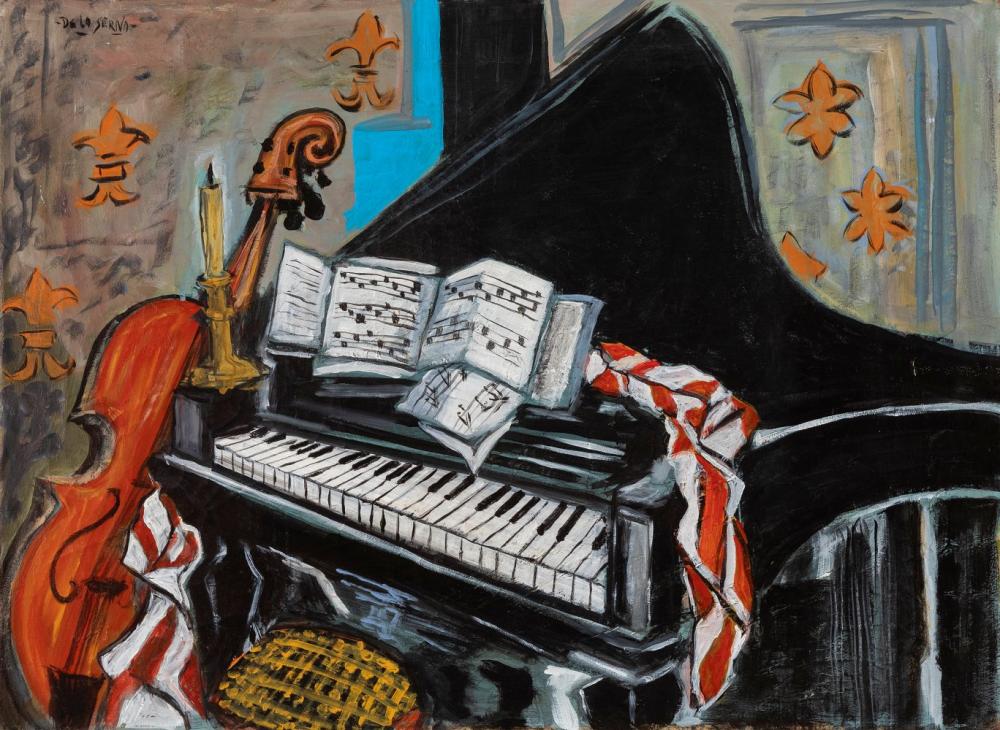
ISMAEL GONZÁLEZ DE LA SERNA (Guadix, Granada, 1898 - Paris, 1968). "Piano and cello". Oil on canvas. Signed in the upper left corner. Attached certificate issued by Sam Benady. Measurements: 60 x 81 cm; 80 x 100 cm (frame). Ismael González de la Serna begins his art studies in Granada and concludes them in Madrid, in the School of Fine Arts of San Fernando. In his early years he developed an eclectic pictorial style, which draws from impressionist, symbolist and modernist sources. One of the first examples of his youthful language can be found in the illustrations he made for his childhood friend Federico García Lorca, in what would be his first book, "Impresiones y paisajes" (1918). That same year, Ismael de la Serna held his first exhibition in Granada, and shortly afterwards he presented his works at the Ateneo de Madrid. In 1921 he moved to Paris in order to broaden his artistic horizons, joining the circles of the School of Paris. Among his Parisian friends was Pablo Picasso, who influenced his work but was, above all, the protector of the painter from Granada. De la Serna's style was, in this period, permeable to the influences of the avant-garde, mainly cubism and expressionism, which he worked in a very personal way. Likewise, the initial influence of impressionism was always evident in his work. The year 1927 marked the beginning of a period of strong projection of his work, which began with the solo exhibition that the painter held at the influential Parisian gallery of Paul Guillaume. This exhibition was followed by many others, both in Paris and in Berlin, Brussels, Copenhagen, Granada and Mexico. In 1928 he was commissioned by the director of "Cahiers d'Art", Christian Zervos, to illustrate a special edition of twenty sonnets by Góngora. The key to his recognition is to be found in his sensual reading of the forms of cubism, based on the relevance of a drawing of sinuous and highly decorative lines, combined with strong chromatic hallmarks. With a marked spatial sense and without ever abandoning figuration, De la Serna mainly represented still lifes, where he accentuated the sensory side of his painting with metaphorical sensory references, such as music, fruit or open windows. He also worked on landscapes and portraits. After inaugurating with a solo exhibition the activities of the Association of Iberian Artists in Madrid in 1932, the painter embarked on new paths of plastic experimentation that would lead, after the Second World War, to a more schematic and simplified painting, close to contemporary abstract solutions. Ismael de la Serna is represented in the Patio Herreriano Museum in Valladolid, the Reina Sofía Museum in Madrid, the Fine Arts Museums of Granada and Seville, the ARTIUM in Vitoria, the Popular Museum of Contemporary Art in Vilafamés and the Museum of Modern Art in Paris, among many others.