Have one like this?
Upload a photo for a free check of what yours may be worth.
Lot description
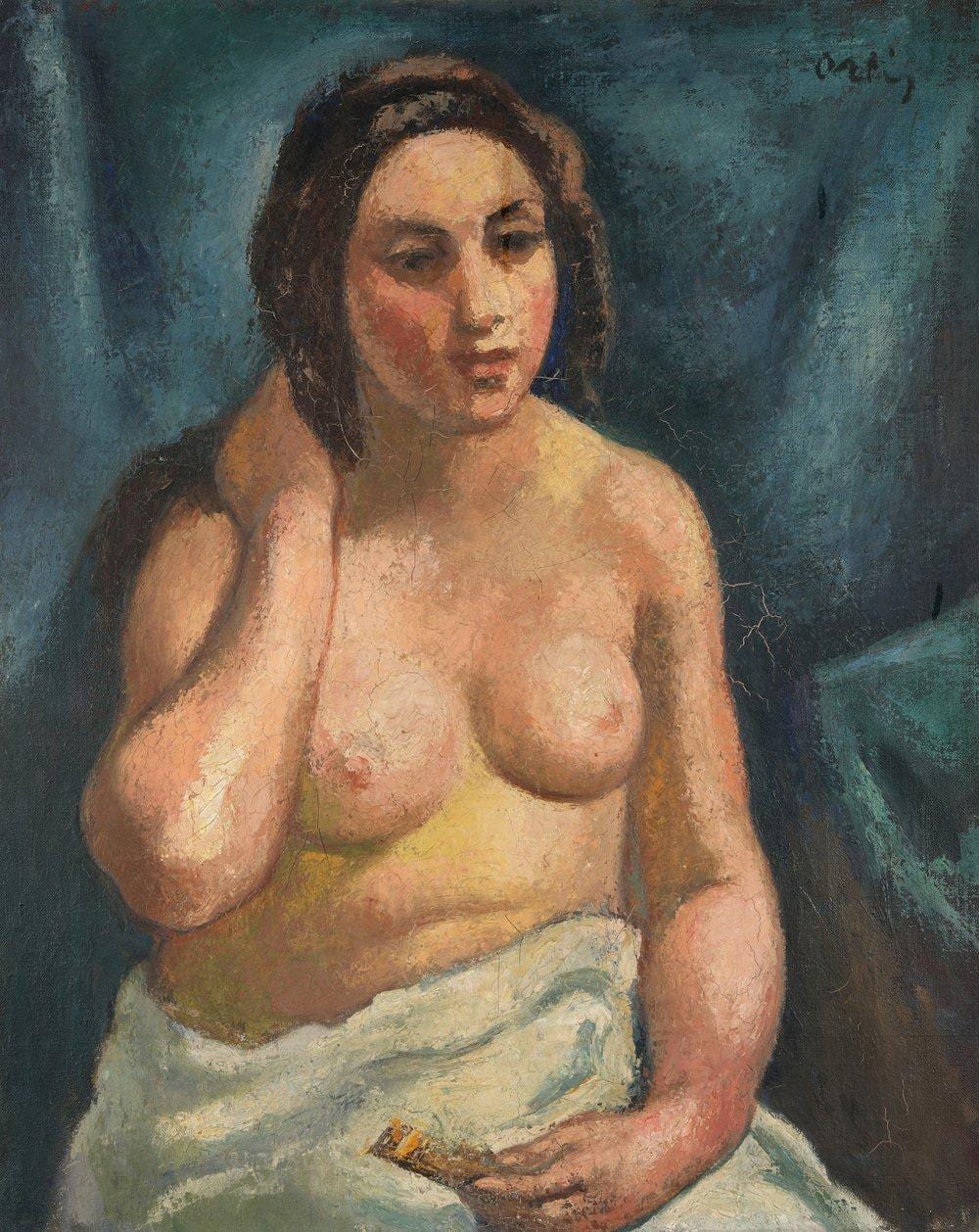
MANUEL ORTIZ DE ZÁRATE (Como, Italy, 1887 - Los Angeles, USA, 1946). "Semi-nude woman". Oil on canvas. Signed in the upper right corner. It presents craquelures. Measurements: 73 x 60 cm. The work in tender could have been made during the 20's, when Manuel Ortiz took up residence in Paris, where his painting ended up immersing in the language of the avant-garde. We see a female partial nude captured from life, through a synthetic language, with energetic and well controlled strokes, which seeks above all to capture the volumetry and geometric play, while maintaining descriptive details that avoid the loss of realism. The woman shows the viewer only her naked torso, since the rest of her body is covered by a white cloth. She brings her right hand to her long hair in a display of coquetry. A Chilean painter and member of the Montparnasse Artistic Group, Ortiz de Zárate developed most of his career in Europe and was, together with his brother Julio, one of the most outstanding members of the Chilean pictorial avant-garde during the first third of the 20th century. Son of the composer Eleodoro Ortiz de Zárate, Manuel began his artistic training in Chile with one of the country's best painters, Pedro Lira. He later studied for a short time at the School of Fine Arts in Santiago, but at the age of eighteen he embarked for Europe; after many vicissitudes he settled in Rome, where he obtained a place to study at the Academy of Fine Arts and earned his living as a portrait painter. During the second decade of the new century he took part in the Official Salon of Santiago de Chile, being awarded the third medal in 1911 and the second in 1913 and 1916. In 1923 he was in Chile when, together with his brother Luis, Henriette Petit, Luis Vargas Rosas and José Perotti, among others, he participated in the founding of the Montparnasse Group, thus giving life to the first movement that renewed Chilean painting in tune with the new artistic tendencies of the 20th century. In the 1920s he took up residence in Paris, where his painting became immersed in the language of the avant-garde. Ortiz de Zárate participated during these years in the competitions and exhibitions organized by the various Parisian salons, being distinguished with medals in 1922, 1926, 1927 and 1928. Although he made frequent trips to Chile, he did not leave Paris until the year of his death. He is currently represented in the Museo Nacional de Bellas Artes de Chile, the Pinacoteca de la Universidad de Concepción, the Museo de Arte Contemporáneo de la Universidad de Chile and the Colección Banco Sudamericano in Santiago.