Have one like this? Check yours freeOr have an appraiser value it
Lot description
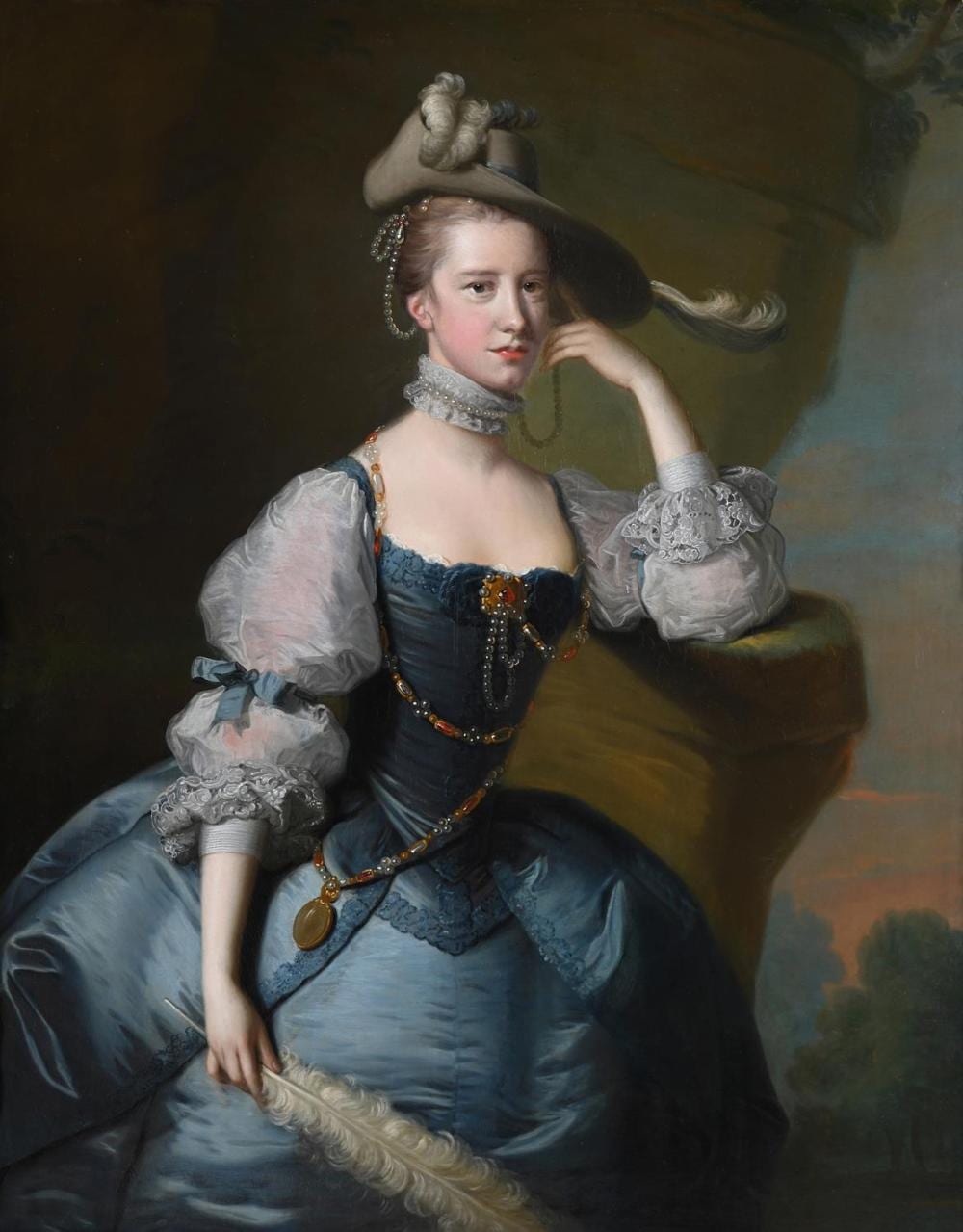
THOMAS HUDSON (BRITISH 1701 - 1779)PORTRAIT OF CATHERINE 'KITTY' JERVIS (1733-1756), MRS. JEREMIAH SMITHOil on canvas127 x 101.6cm (50 x 40 in.)In a period eighteen century swept and pierced, carved and gilded framePainted circa 1755.Provenance: The sitter's brother, Admiral of the Fleet John Jervis, 1st Earl of St Vincent (1735-1823), Meaford Hall, Staffordshireremoved from Meaford Hall when the house was sold in 1943by descent to Edward Swynfen Parker-JervisExhibited: Birmingham, City Museum and Art Gallery, Exhibition of Treasures from Midland Homes, 2nd November - 2nd December 1938 (lent by Mr Robert St Vincent Parker-Jervis)Catherine Margaret Jervis, known to her family as Kitty, was the second daughter of Swynfen Jervis (1700-1771) of Meaford Hall, near Stone, Staffordshire and his wife Elizabeth Parker, daughter of George Parker of Park Hall. Both of Kitty's parents came from long-established Staffordshire gentry families; the Jervises had been established in the county since the days of Edward III (reg.1327-77). Swynfen Jervis practised as a lawyer, becoming Counsel to the Admiralty and Auditor to Greenwich Hospital; the family divided their time between Greenwich and their estates.On 18th March 1755 Kitty married at St Alphege, Greenwich a Staffordshire neighbour, Jeremiah Smith of Great Fenton Hall, which was situated eight miles north of Meaford. This portrait was probably made around the time of her marriage. Thomas Hudson was clearly the portraitist of choice for the family: he painted Jeremiah Smith, by then High Sheriff of Staffordshire, in 1762 (Staffordshire County Buildings, Stafford). The Smiths were prominent landowners in Great Fenton, today a suburb of Stoke-on-Trent. By the mid-eighteenth century the area was becoming part of the heartland of the Industrial Revolution, with ceramic producers that would later bear famous names such as Spode, Copeland and Minton. The country was rich in ironstone and coal, essential for the firing of the kilns. Jeremiah Smith obtained mining rights in Fenton which were developed by his descendants. By 1840, a land 'once the pure and peaceful domicile of [the owners'] ancestry [was] but now the black and noisy seat of Cyclopean labours'.Naturally, no hint of this gradual industrialisation is apparent in Hudson's portrait of Kitty Jervis. She is portrayed leaning against a rock with a woodland sunrise beyond. Her elegant, broad-brimmed hat, which gives her a dashing air, puffed sleeves and the feather in her hand are inspired by a Rubens portrait then thought to be of his wife, but which probably depicts his sister-in-law, Susanna Fourment (Gulbenkian Museum, Lisbon). It was acquired by Sir Robert Walpole and hung in the Van Dyck Drawing Room at Houghton, but was well known from James McArdell's mezzotint after it. The Rubens portrait sparked a vogue for painting ladies in 'van Dyck' dress, much employed by Hudson in the 1730s and 40s, as well as the use of van Dyck dress in masquerade costumes. Horace Walpole wrote to his friend Horace Mann in 1742 of seeing at the Duchess of Norfolk's masquerade 'quantities of pretty Vandykes, and all kinds of old pictures walked out of their frames' (1). Kitty's costume is a charming fantasy, a hybrid of 'van Dyck' dress and mid-eighteenth century high fashion. The lace choker at her throat is in contemporary vogue, as is her jewellery. A locket probably containing a likeness of her husband is strung from the rubies and pearls at her waist. Hudson repeated this model, down to the rocky background and soft blue silk dress, in a full-length portrait of Mary Bertie, Duchess of Ancaster and Kesteven, painted in 1757 (Grimsthorpe Castle, Lincolnshire). The same format is employed in a portrait of Lady Oxenden (Art Gallery of New South Wales), recently reattributed to Hudson's pupil Joseph Wright of Derby. Sadly, Kitty's marriage was short-lived: she died giving birth to her son Charles in 1756. Her portrait was inherited by her younger brother John Jervis (1735-1823), whose brilliant naval career led to his creation as 1st Earl of St Vincent for his victory over the French at Cape St Vincent on 14th February 1797, an action which also brought Captain Horatio Nelson to prominence. A just, well-loved and reforming officer, Jervis crowned his career as Admiral of the Fleet. Kitty's painting remained at Meaford Hall until the house was sold in 1943 and has descended in the Parker-Jervis family.1) Quoted in London, The Iveagh Bequest, Kenwood, Thomas Hudson 1701-1779, 1979, exh. cat. by Ellen Miles, under n. 15