Have one like this? Check yours freeOr have an appraiser value it
Lot description
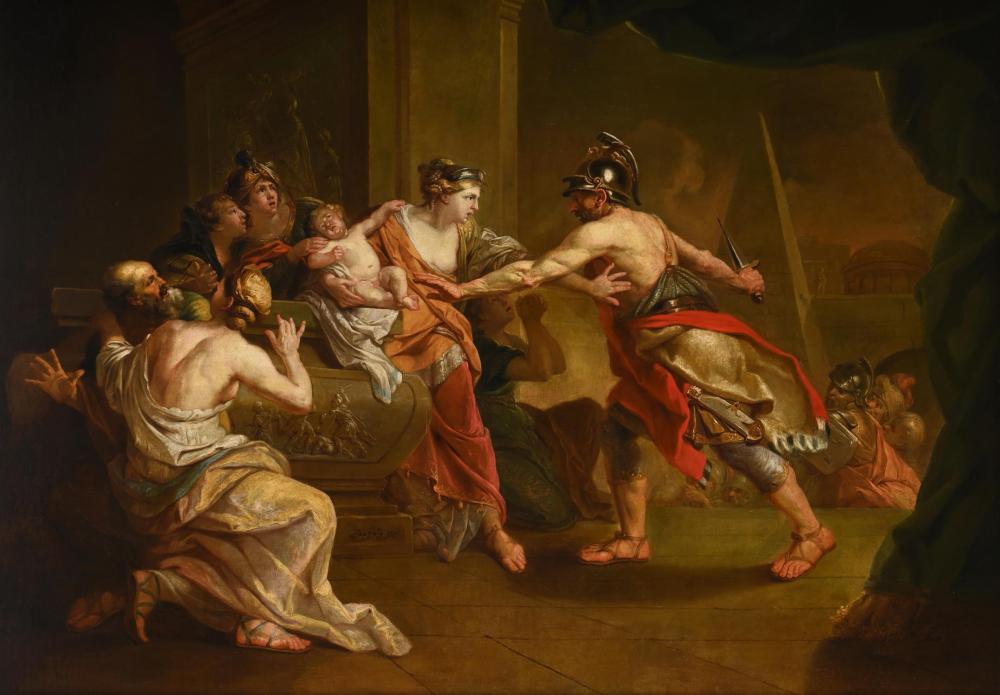
JOHANN ZOFFANY (BRITISH 1733 - 1810)ULYSSES SEIZING ASTYANAX FROM ANDROMACHEOil on canvasSigned (to base of sarcophagus)125 x 173.5cm (49 x 68¼ in.)Provenance:Private Collection, New YorkThe owner's sale, Christie's, London, The Property of a Gentleman, 18 November 1988, lot 100Private Collection, UK, acquired from the above after salePrivate Collection, UK, acquired from the above in July 1994Simon C. Dickinson Ltd., London, where acquired by the present ownerLiterature:M. Webster, Johann Zoffany 1733 - 1810, New Haven and London, 2011, pp. 38-40, no. 36 (illus. p. 38)Although best known for his elegant society portraits, German-born Johann Zoffany was also a talented painter of history scenes, and, according to scholar Mary Webster, this depiction of Ulysses Seizing Astyanax from Andromache is one of the most ambitious and successful of its kind in Zoffany's oeuvre.' (written communication, 1989). Webster further observes: 'In this essay in classical baroque, Zoffany appears to have taken Poussin as his principal model rather than the exuberant baroque of the Venetians.' (M. Webster, op. cit., p. 40). This composition is signed with the German spelling of Zoffany's name, and can be compared with another early work, Venus Bringing Arms to Aeneas. It depicts a scene from the Trojan War, in which the Greek warrior Ulysses (or Odysseus), having sacked Troy, searches among the ruins for the infant he is afraid might one day avenge the death of his father Hector. Andromache, mother of Hector and wife of King Priam of Troy, has hidden the child in Hector's sarcophagus, but Ulysses wrests him from her and hurls him from the walls of the city. Johann Zoffany was born near Frankfurt in 1733 and later settled in England. He acquired much of his training in Rome, where he lived and worked from 1750-57, becoming a favourite portraitist among the British Grand Tourists visiting the city. After moving to London in 1760, Zoffany was befriended by the popular actor David Garrick, and his entry into society was assured. Zoffany was introduced to George II, who commissioned a portrait and was so pleased with the result that he nominated Zoffany to the newly established Royal Academy in 1769.