Lot description
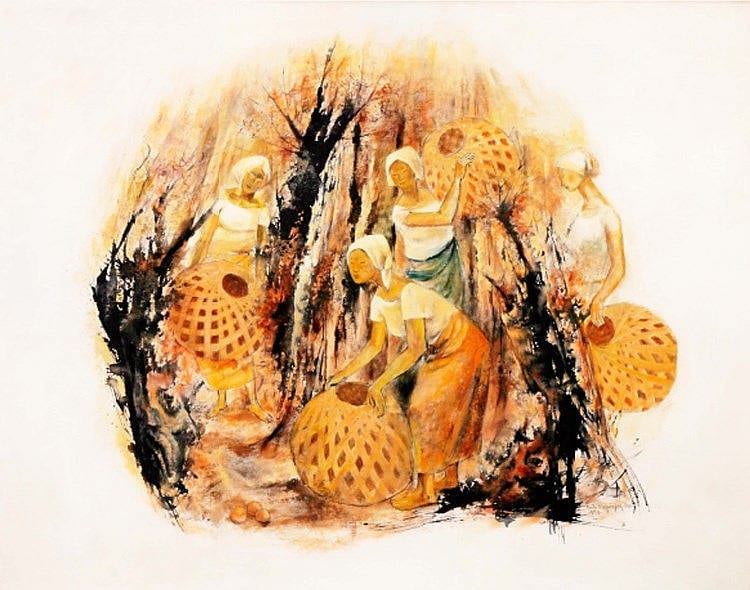
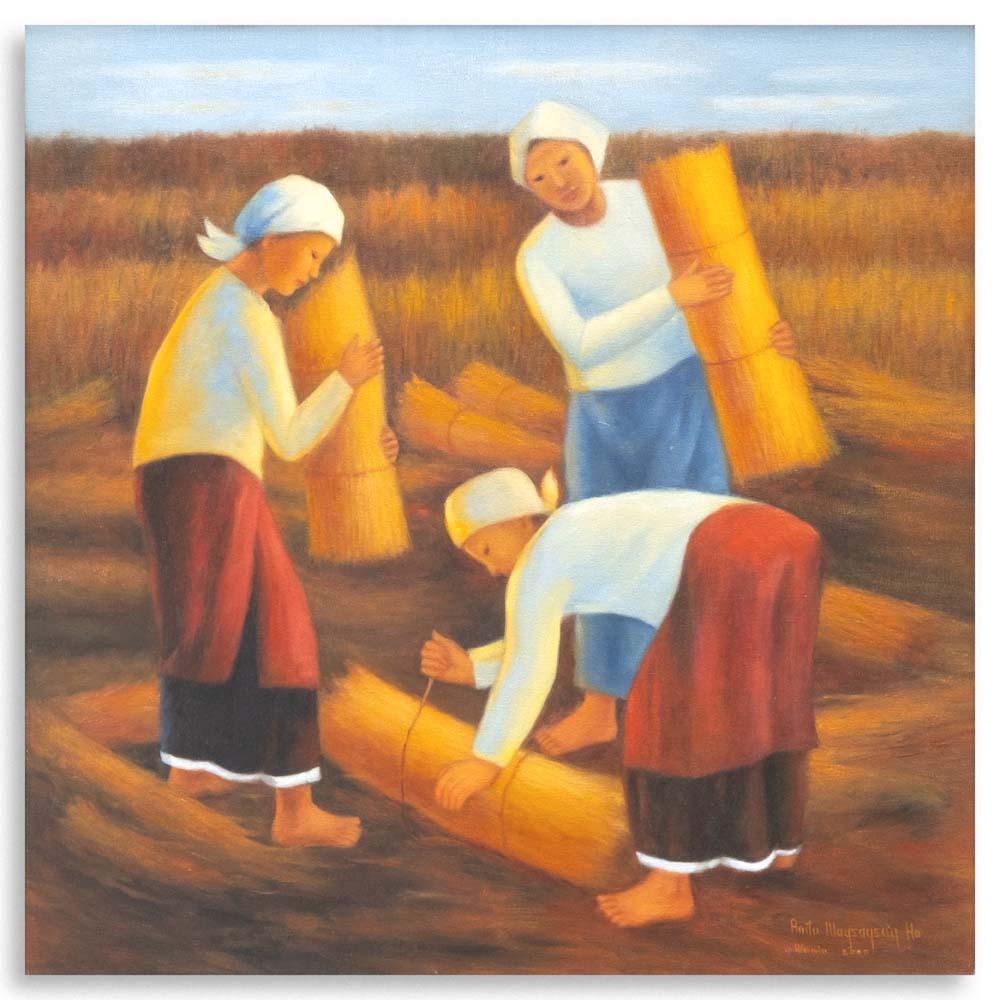
PROPERTY FROM THE HAYDEN AND VICKI BELO-KHO COLLECTION Women Gleaning signed and dated 2000 (lower right) oil on canvas 24" x 24" (61 cm x 61 cm) PROVENANCE Acquired directly from Mr. Randy Young Onwards to the new century and millennium, Anita Magsaysay-Ho found herself at the crossroads of prolific painting and building her legacy to Philippine art and culture. By the time the 2000s dawned, Anita transformed her canvases by incorporating what the eminent critic-painter Alfredo Roces described as "bright pastel colors," noting in a review of Anita's 2001 show at The Crucible Gallery that they "have now taken over her palette." Gleaning Women, painted at the turn of the millennium, features three ladies in a rice field collecting leftover grains after the harvest. Anita's composition has noticeably softened; her figures, particularly their faces, are rendered with a more delicate gracefulness. During this time, Anita had returned to Manila after years of constant travel from one country to another and having been a Canadian citizen for the past three decades. In the epilogue of her memoirs, simply yet evocatively titled An Artist's Memoirs, published in the same year as this painting, Anita wrote, "I have recently been spending more time in Manila to paint." "Although Canada is my country now, I often yearn for those little islands in the Pacific where my roots are, where my brother and sister and their families live, where I can reminisce about life with relatives and friends," Anita wrote. In this sense, Gleaning Women represents a full-circle moment for Anita. It can be recalled that Anita had always looked forward to her summer vacations in her father's hometown of Zambales when she was still a little girl. She wrote in her memoirs: "Why do we always have to holiday in Zambales? Now in hindsight, I thank my parents for bringing us to Zambales. These scenes of my childhood are so vivid in my mind; women pounding rice, winding our way back to town in the dusk after the picnic, the oil lamp lit windows of the nipa houses sparkling like fireflies in the dark. Had I never holidayed in Zambales, I do not think I would have the depth of impressions, which I subconsciously draw upon with so much fondness and passion when I paint." For Anita, her return to her motherland meant a renaissance of all sorts. Anita's employment of a brighter palette in Women Gleaning evokes a profound joy in her earnest reconnection with her roots. The warmth of Anita's composition captures that tender solace in the comforts of one's beloved land—and the everyday Filipina whom she exalted in her art. "I did not paint the people in the countries I lived in," Anita also wrote in the epilogue of her memoirs. "In looking back, this must have been a manifestation of my love for my mother country. For whenever I looked at an empty canvas, I saw only my Filipino women." Anita once said in the brochures and invitations of her 1988-89 retrospective at the Met Manila: "I dedicate this exhibition to the women of the Philippines—the source of my inspiration—their movements and gestures, their expressions of happiness and frustrations, their diligence and shortcomings, their joy of living. I know well, for after all, I am one of them." Perhaps, this is Anita's greatest legacy: finding relief in capturing the inherent joy and beauty of the Filipina to whom she had always been indebted for fostering her virtuoso, in hopes of empowering them much as they had strengthened her even if she was oceans away from her cradle.