Lot description
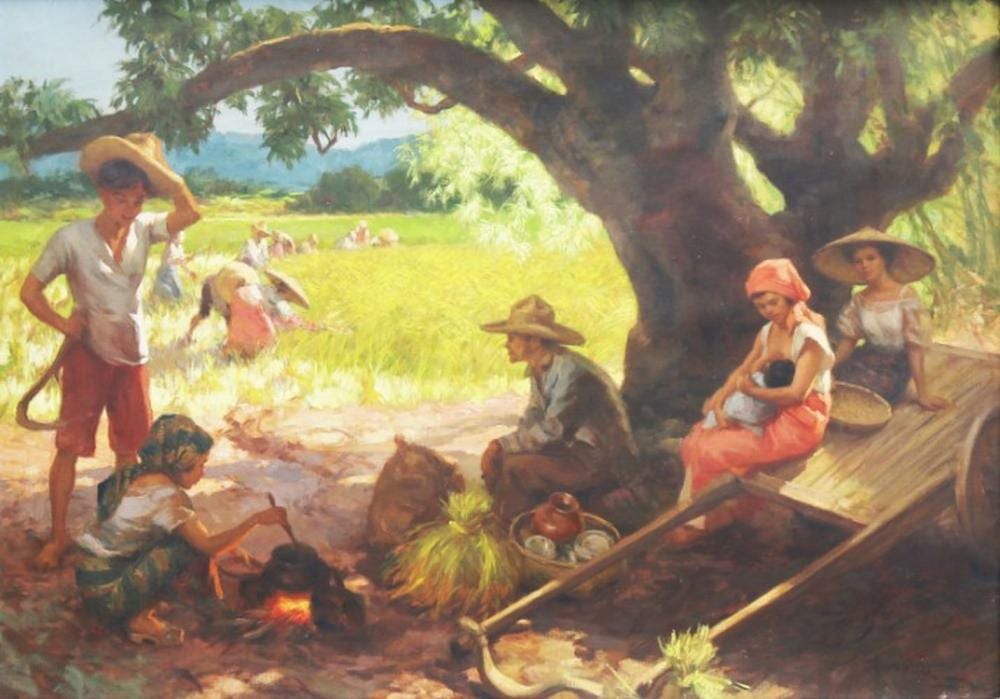
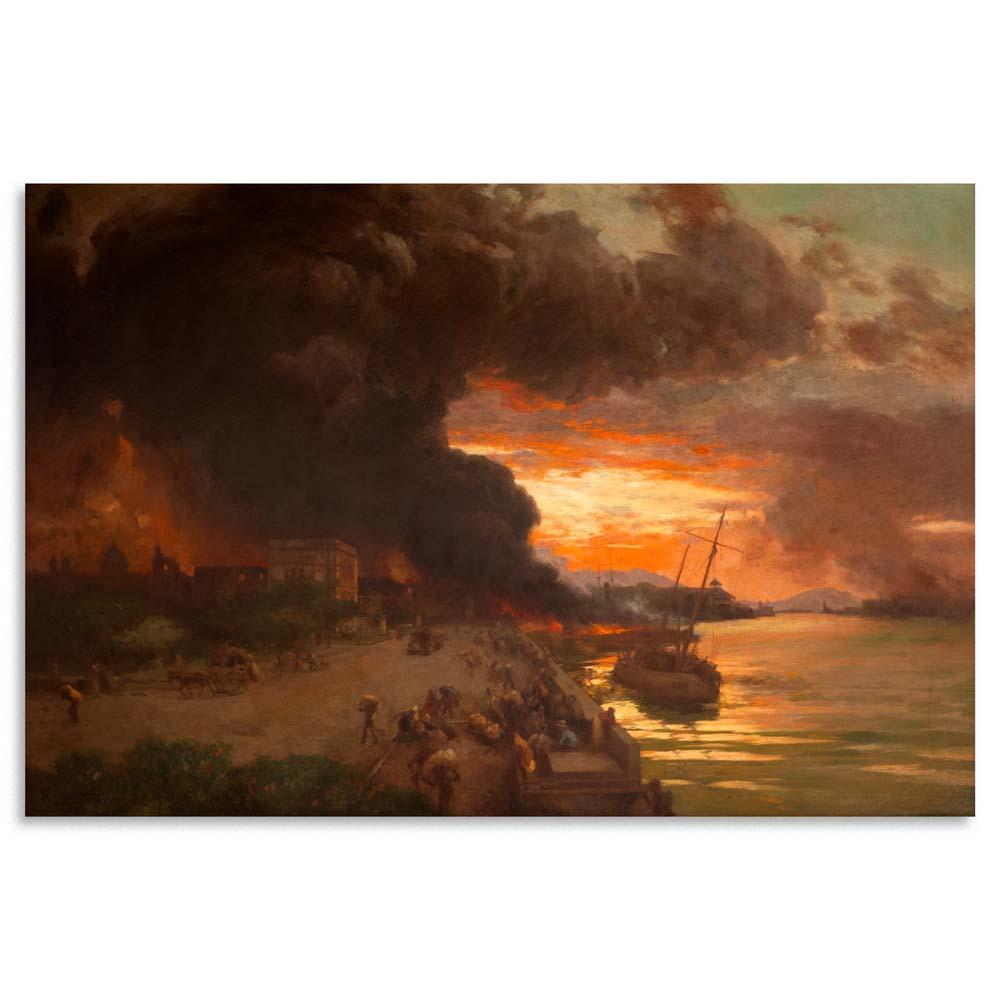
PROPERTY FROM THE E. ZÓBEL INC. COLLECTION The Burning of Manila signed, dated, and inscribed “Manila - New Year, 1942” oil on canvas 40” x 60” (102 cm x 152 cm) PROVENANCE Acquired directly from the artist by the Zóbel Family EXHIBITED National Museum of the Philippines, Gallery VIII (Silvina and Juan C. Laya Hall) of the National Museum of Fine Arts, Manila, Loaned to the National Museum of the Philippines from 2015 to 2025 The Burning of Manila Amorsolo, Visual Historian of the War One of the Largest Amorsolo Masterpieces to Enter the Market Impeccable Provenance Measuring 40 inches by 60 inches, The Burning of Manila is one of the largest Amorsolo paintings ever to be auctioned. It is also the largest of Amorsolo’s paintings centering on “The Bombing of the Intendencia” / ”The Burning of Manila” subject, even surpassing the one at the UP Vargas Museum. The painting possesses impeccable provenance and a storied history. The work was acquired by Don Jacobo Zóbel de Ayala y Roxas from Amorsolo himself during the Japanese occupation. Don Jacobo had been one of those sentenced to endure the infamous Bataan Death March and become a prisoner-of-war. As a serviceman, the painting may have reminded him of the unwavering heroism of the Filipinos during that darkest period in our history. In his final days in 1971, Don Jacobo would bequeath this painting to his son, Don Enrique. In November 2015, The Burning of Manila was leased to the National Museum of the Philippines on a long-term loan by Don Enrique's wife, Mrs. Dee Anne Hora-Zobel. The painting would become the centerpiece of Gallery VIII (Silvina and Juan C. Laya Hall) of the National Museum of Fine Arts, showcasing works depicting the Second World War. The work greeted museum visitors as they entered the gallery. The Burning of Manila would remain at the National Museum for a decade, until recently, when the family of Don Enrique decided it was time to pass it on to its new owner. Don Enrique's ties to the painting was emphasized by the fact that his grandfather and namesake, the industrialist and philanthropist Don Enrique Jacobo Zobel de Ayala, was the one who sponsored Amorsolo's scholarship to the famed Real Academia de San Fernando in Madrid, after being impressed of his design for the iconic logo (still in use today) of the popular gin brand of his own company Ginebra San Miguel. The Burning of Manila Beyond its provenance, The Burning of Manila holds greater significance, coinciding with the recently concluded 80th anniversary commemorations of the Battle for the Liberation of Manila and 83 years since its fall into Japanese hands. It sees Amorsolo as a visual historian, a painter imbued with a social responsibility to preserve on canvas the tragedy the war inflicted on his nation, serving as an act of remembrance, resistance, and melancholy. The Burning of Manila depicts the riverside portion of Manila as it looked on New Year's Day, 1942. On the left portion can be seen the towers of the Jesuit San Ignacio Church, the dome of the Manila Cathedral, the Aduana Building and the Santo Domingo Church (both had been reduced to ruins as they were casualties of the first Japanese bombing of Manila on December 27, 1941), and the Chamber of Commerce Building. To the right is Fort Santiago and its imposing Baluarte de Santa Barbara. The present-day Riverside Drive is packed with people in a state of frenzy: panicking men carrying sackfuls of goods, caretelas and calesas being pulled over to safety, anxious mothers and their frightened children, and others falling to their knees as they witness the horrors unfold before their very eyes. The raging flames, made intensely palpable through Amorsolo’s masterful handling of color and impasto, engulf a once glorious landscape of Hispanic, with the Pasig overwhelmed with fire and foundering boats that were once brimming with trade and commerce. Amorsolo's signature sunlit landscape seemingly struggles to free itself from the billowing smoke smothering the atmosphere, with the mighty Mount Samat covered in haze in the background foreshadowing the fate of thousands of men on their march towards their harrowing demise. It was the nation's darkest New Year. Manila's radio stations had fallen quiet in contrast with the screams and chaos of the people. Chanting the Lord's Prayer became a futile attempt at immediate salvation. There was no God among the people. Amorsolo’s actual encounter of the burning of Manila Amorsolo conceived The Burning of Manila from his vantage point at the Jones Bridge, when he and his family escaped from their home and ran towards the Pasig River. There, instead of encountering temporary relief, he witnessed how his beloved city had fallen from grace. During this time, Amorsolo lived in a rented two-story apartment owned by the Lopa Family at 2132 Azcarraga Street (Recto), located near the Far Eastern University and the Quiapo and San Sebastian Churches. He was riding high on his prolific success, with the most recent being his historic first-prize win at the 1939 New York World's Fair for his now- iconic Afternoon Meal of the Rice Workers. When the Japanese occupied Manila in January 1942, Amorsolo, as recounted by his grandson Don Amorsolo in the book Maestro Fernando C. Amorsolo: Recollections of the Amorsolo Family, "[was in] the second floor of his studio [and] heard people shouting and running. He saw the skies blackened with smoke. He ran out of the apartment and, with others, headed west of the Pasig River." Don continued: "Amorsolo had vivid recollections of that day along the Pasig. The authorities and Chinese businessmen left their stocks open for the public to take, fearing that the enemy would confiscate whatever they had. People carried away so many things: from food groceries, appliances, office equipment, medicines, army supplies, and even brand-new vehicles. Several of them rested and sorted their goods along the river, while horse- drawn vehicles carted away more goods. Others sold their stuff to latecomers who could not lay hands on what was now emptied warehouses and stores." "People in possession of invaluable goods became instant entrepreneurs. The state of looting along the Pasig River spread to other locations wherever there were stores and merchandise left. People had gone wild, thinking what was next for the future was nil and unstable. That New Year's day was "Looting Day," a time when the people of Manila did not know any more what was going and felt as if they were without eyes and cars." Amorsolo witnessed the looting in the name of survival and the burning of the city in hopes of salvaging it from the invaders. It was an anarchic mixture of faith and fate, fortune and desperation. Stores, warehouses, and gasoline stocks were burned to prevent the Japanese from using them. Gasoline was being emptied into the Pasig, setting the river aflame. Manila became an inferno of flames and chaos, an unfortunate presage of it becoming a shell of its former glory. The Life and Times of Amorsolo during the Japanese Occupation Amorsolo's recollections are supported by other accounts from that period. December 8, the Feast of the Immaculate Conception, was supposed to be a sacred festivity all over Manila. Breaking tradition, processions and masses were suspended, and the schools and their respective classes were closed. Pearl Harbor had been bombed ten hours earlier. The radios were turned all day long, hoping for an absolution and relief, but more so, expecting an ensuing chaos. There were air raid drills during the day and blackouts at night in hopes of reducing visibility from enemy planes. Manileños became wary of their Japanese neighbors. Even Amorsolo's Japanese neighbors donned their military uniforms and joined the Japanese troops when they entered the city. Christmas 1941 became the bleakest—no Simbang Gabi, no merry noche buenas, no electricity, no fanfare. Everything was bleak and black. Eminent historian Teodoro Agoncillo recounted in his essay "The Last Years of Intramuros," published in Archipelago magazine in November 1975, the day that would seal Manila's—and the entire Philippines'—harrowing fate. Agoncillo wrote: "And then the war came in December 1941—the Feast of the Immaculate Conception. Like the rest of Manila and surrounding towns, Intramuros experienced days and nights of terror from the bombing of the Japanese airplanes. General Douglas MacArthur, who had chosen No. 1, Victoria Street in the Walled City as his headquarters, declared Manila an open city on December 26 to spare it the cruelty of war. But the Japanese airmen, either by design or by incompetence, bombed Intramuros, partially destroying the Santo Domingo Church, the Intendencia Building (later the Central Bank and now the National Treasury, the Santa Rosa and the Santa Catalina Colleges, the D.M.H.M. Building [headquarters of the newspapers El Debate, Mabuhay, Philippines Herald, and Monday Mail], and other structures near the Pasig." Manila had yet to "recover" from the initial yet devastating bombings when, on the last days of December onwards to New Year’s Day, the Manileños expected a full-blown entrance of the Japanese troops into the city. Fr. Juan Labrador, O.P., then the Colegio de San Juan de Letran Rector, wrote in his diary: [This day, December 31 was] a day of conflagration. Yesterday, some of the big gasoline depots started burning. At first, the gasoline was being emptied into the Pasig River. But accidentally—or intentionally—the gasoline caught fire, setting the river and the esteros aflame. The houses situated along the river and the esteros, particularly in the Pandacan district, were the first victims of this ill-planned sabotage." He continued: "For the last 48 hours, a gigantic column of smoke has been spouting, very black in the daytime and very luminous at night. Officially, these fires are proof that Manila has become indeed an open city with no military installations. The general belief was that the gasoline stocks were burned to prevent them from falling into enemy hands." On January 1, 1942, Fr. Labrador wrote: "There is great fear and confusion among the civilian populace... In Intramuros, great multitudes milled around the doors of stores which they tried to force open. People in the streets carried boxes or bags of foodstuffs, machines, pieces of furniture, or a thousand other things. Some came in calesas, cars, or wagons to be able to carry more. For one peso, they would sell a whole case of milk or canned goods. For five pesos, a typewriter or an electric stove, or gas range. Fortunately, there were no indications of violence, although they burned some stores." Victor Buencamino, the first Filipino veterinarian and the Vice-President and Manager of the National Rice and Corn Corporation (NARIC), wrote in his diary: "Manila's gates are open. The Japanese are expected any moment. The oft-repeated, long-foretold 'yellow menace'" has come true... There are fires all over the city. Historic Santo Domingo church is a mass of ruins. The oil and gasoline dumps of Pandacan have been set ablaze. The piers are destroyed, wrecked, charred. The red sky above the city and the black coils of smoke rising to the clouds present a weird picture. At night, Manila looks like a burning cauldron.” His military son, Felipe Buencamino III, reported that the "red glare that filled the skies in the direction of Manila" can be seen as far as his location in San Fernando, Pampanga. The looting and the conflagration would continue in the following days, until January 3, 1942, when the Japanese declared martial law. Individuals caught looting, especially from Japanese trucks, were bayoneted to death; imperial soldiers confiscated food and personal belongings whenever they wanted; violators were tied to posts and made to endure the sun's scorching heat; men, women, and children were slapped when they failed to bow down to a Japanese sentry; unfortunate cases of rape happened. The Japanese had total control of the Pearl of the Orient.