Lot description
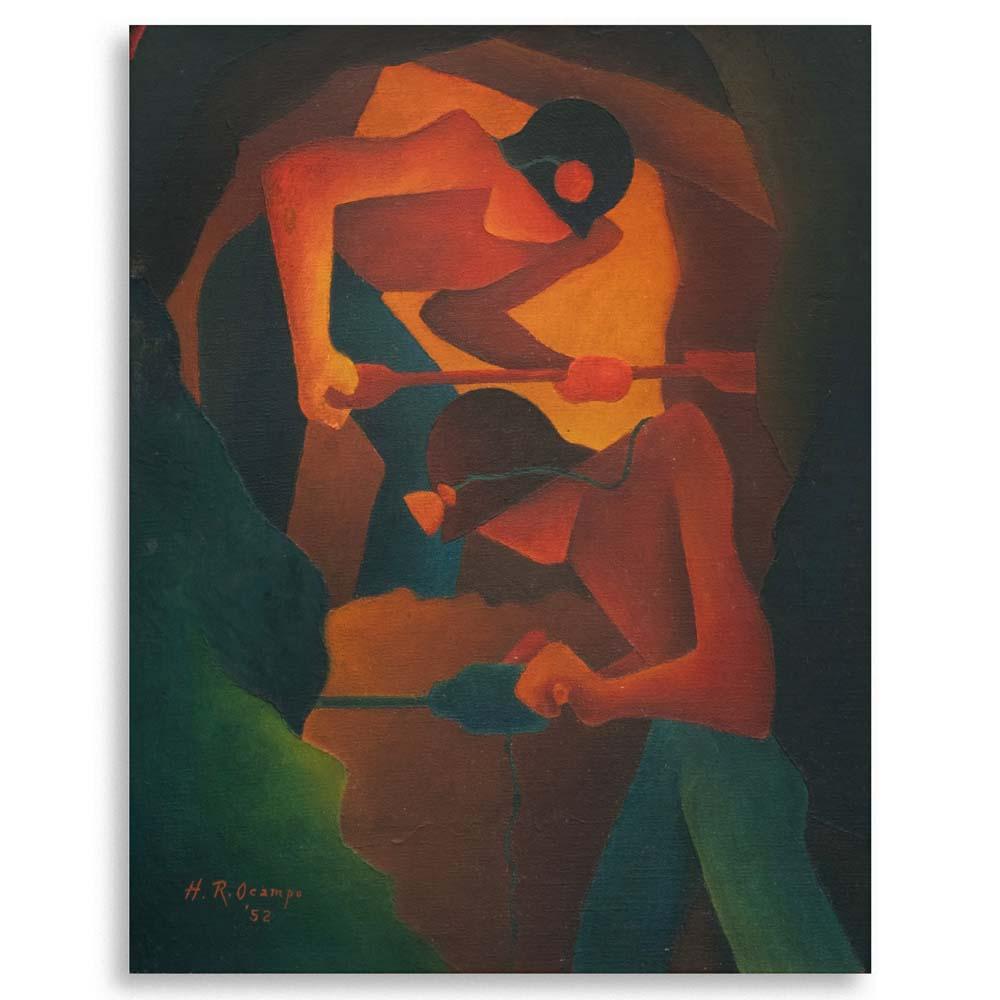
PROPERTY OF A DISTINGUISHED LADY Miners signed and dated 1952 (lower left) oil on canvas 18" x 14" (46 cm x 36 cm) PROVENANCE Acquired directly from the artist LITERATURE De Jesus, Angel G. H.R. Ocampo: The Artist as Filipino. Manila: Heritage Publishing, 1979. Full-color illustration on page 117 and painting description on page 119. Paras-Perez, Rod. Edades and the 13 Moderns. Published in conjunction with the exhibition of the same title at the Cultural Center of the Philippines. Manila: Cultural Center of the Philippines with the assistance of the National Commission for Culture and the Arts, 1995. Black-and-white illustration and painting description on page 70. EXHIBITED Cultural Center of the Philippines, Edades and the 13 Moderns, Manila, 1995 H.R. Ocampo’s Evocative Miners A Seminal Painting of Philippine Modernism by ADRIAN MARANAN Hernando R. Ocampo in the 1950s was the boldest of his generation. Ocampo, christened as "The High Priest of Modern Painting," spearheaded the cause for modernism's (and Neo-Realism’s) triumph against conservatism through his efforts to educate the public on modern art. As Editor of the highly popular This Week Magazine, Ocampo wrote articles on art appreciation. He also did paintings that served as the magazine’s covers, encapsulating the periodical’s headline news, usually tackling pertinent socio-economic issues affecting the post-war nation. In one of his articles titled "How I look at pictures," Ocampo defended modern art, writing: "The absurdity in art of the oft-quoted adage "everyone to his own taste" can be clearly shown by the fact that the failure of a child of six or an expert shoemaker to appreciate a Michelangelo, a Rembrandt, an El Greco, a Matisse, an Amorsolo, or an Edades cannot in any way detract from or add to the aesthetic qualities inherent in any of the aforementioned paintings...let not either of them say that any painting is good, bad, or indifferent just because the subject involved is a Madonna, a vase of flowers, or an abstraction...." It was in this experimental, dauntless milieu that Ocampo matured as a painter A Woman’s Unwavering Support for Modernism Painted in 1952, the work at hand titled Miners can still be grouped under Ocampo's "Proletarian Period” of 1934 to 1945, although it falls technically under his "Transitional Period" of 1945 to 1963, in which he would gradually delve into non-objective painting but intermittently return to the human figure. During this time, Ocampo was a producer- director for the Filipino Players Guild, a producer of radio programs. In Miners, Ocampo depicts two men inside a cramped, sweltering quarry, with only their headlamps, vulnerable endurance, and unabating pursuit to earn a living as their wellspring of strength. The work was acquired by the current owner's mother, whom the print media mogul Chino Roces employed in his own The Manila Times as a most trusted staff. Much like H.R. the nationalist who highlighted the Filipino struggle in his early paintings, the mother was noted to have supported the Filipino modernists when they were still struggling for acceptance amid a sea of searing conservatives. She and her friends Estrella Alfon, Carmen Guerrero Nakpil, and Lyd Arguilla (Philippine Art Gallery founder) championed Filipino modernism through their patronage and their articles published in the most popular newspaper, The Manila Times. The ladies hung out at the popular Jade Vine restaurant along Isaac Peral St. (now United Nations Avenue) in Ermita, Manila, where they had rousing exchanges of talks, debates, and gossip surrounding the state of Filipino art and society at that time. In fact, it was The Manila Times, in its 9 June 1950 issue, that first announced to its millions of readers the first-ever public exhibition of the Neo-Realists at the Manila Hotel's Rotary Room. Miners was originally in Ocampo's personal collection, with no records showing it was ever exhibited. The current owner's mother acquired it directly from Ocampo himself, with him recounting, "My mother bought it because she wanted to help H.R.—her friend—and the other new artists. Everybody started from scratch after the war, and there was no money to be made from art. But they eagerly wanted to promote Philippine modern art, which really made them excited." The owner reminisced that his mother became friends with Ocampo through Lyd Arguilla, who was also her close friend alongside Lyd’s husband, the writer Manuel (famous for the short story How My Brother Leon Brought Home a Wife imbued with nationalistic themes), who guided the Veronicans and died as a guerilla. "My mother gravitated towards Lyd, who really wanted to establish a gallery for the struggling Filipino modernists," the owner said. "Lyd was a widow and had no direct source of income for the promotion of their art. This was how all the early works of the modernists came into my mother's collection, through her eager purchase and unwavering support." The Manila Times ladies furnished their homes with these modernist paintings, bringing with them a sense of pride and joy in a newfound visual language, a strong showcase of the Filipino modernist’s unabating uphill battle. The owner added, "My mother did not consider herself a collector. She just wanted to help her painter friends." Miners at the 1995 CCP Retrospective of Philippine Modernism Miners would be exhibited in 1995 at the Cultural Center of the Philippines in the retrospective Edades and the 13 Moderns, tracing the history of Philippine modernism from Edades in 1928 up to the rise of Neo-Realism in the 1950s. The eminent art critic/painter Rod. Paras-Perez, the show’s curator, particularly chose this for the exhibition and was noted by the owner as “Mang Rod’s favorite, the critic’s choice” among the three dozen works in the show. “Miners was championed by Manong Rod as a seminal work in the development of Philippine modernism,” the owner recalled. “Manong Rod was in love with the painting. He requested my Mama to bring it back to Manila for the exhibit. Mama had sent it to my sister to display in the latter’s London home.” Miners, in Ocampo’s words As recalled by the owner, Ocampo said the following to describe this painting. "This work is my attempt at presenting the plight of two miners at work. Although figurative, I had already been figuring out how to abstract their features, and how to pull out color harmonies from the palette that would sync with Philippine realities." An avid reader himself, Miners may have been inspired by the Paracale mine disaster of December 15, 1952, when water rapidly rushed into a 400-foot-deep tunnel in a goldmine owned by the United Paracale Mining Co. in Camarines Norte. The mine became severely flooded, trapping and drowning 55 miners, making the incident the worst mining disaster in Philippine history during that time. Ocampo probes into poor labor conditions with this work. He was, in fact, a nationalist. While in jail due to false collaboration charges after the war (but soon revealed to be born out of jealousy, as his friend who filed the case allegedly saw Ocampo kiss his girlfriend, which, to Ocampo's defense, was his way of greeting women friends), Ocampo bonded with other nationalists who were also unfortunately accused of being collaborators, including Claro M. Recto, Jose P. Laurel, and even Victorio Edades, his painting companion at that time. His biographer de Jesus also recounted a newspaper debate in which Ocampo “maintained that in the future, the Philippines should try to depend on herself alone and not on other countries whose motives were not always altruistic.” In Miners, the artist's rendering of organic, sinuous forms emphasizes the humanity of the miners, with their faceless features highlighting their dehumanization under an exploitative environment. Miners also show an attempt to synthesize the colors of the Philippine flag and transform them into somber tones to evoke the desolate conditions the Filipino people had to endure in the post-war years: living amidst an environment of national trauma, of immediate survival and sustenance amid sluggish rehabilitation and reconstruction and the hegemony of neo-colonial, pro-American policies. Miners is a synthesis of Western surrealism and the Neo- Realist propensity of projecting an early form of Filipino social realism. Ocampo turns to the writings of Sigmund Freud on the interpretation of dreams. He colors his figurative works with a dream-like bizarreness of projecting repressed emotions and thoughts as metaphors for a new reality filled with the tension between chaos and order, death and survival, hope and despair. Ocampo heavily leans on the lived experiences of the times, painting a highly symbolic image through his subjective preferences of tropical colors and highly stylized forms to emphasize an objective reality—the Neo-Realist essence. A Reflection of Ocampo as a Proletarian For Ocampo to have empathized with the struggles of the common Filipino is deeply rooted in his past. If there was someone who could become the poster boy of the Filipino as a struggling artist, it was Ocampo himself. Raised in Maypajo, Caloocan, Ocampo had already faced the harsh realities of life in his youth. Eager to help his financially incapacitated family, Ocampo became a shoe-shine boy for the nearby cabarets' local and foreign customers. At 17, he became a cashier at the Maypajo cabaret. (Ocampo playfully recounted that aside from tending the cash register, he also dated some of the bailarinas (hostesses) whose daily attendance he checked.) During the 1930s, Ocampo was a member of the Veronicans, a group of twelve young writers that also included literary heavyweights Francisco Arcellana, N.V.M. Gonzalez, and Estrella Alfon. They were described by Leonidas Benesa in his book Hernando R. Ocampo: The Neo-Realist as Avant-Garde as "involved in proletarian literature, or social realism, in the belief that this was the 'true image,' which should show on the veil of literature." Ocampo's association with the Veronicans would spill out to his early years as a painter. When Ocampo painted Miners, he had transferred from the print media to the radio world, as there was a boom in radio drama and the compensation was three times bigger, as he said in a 1972 interview with Cid Reyes. In radio, he was also a writer, director, producer, and an occasional actor. This he did as the eldest child, all for the hustle of providing a living for his parents, his two families from two different wives, and his nephews and nieces whose parents (his siblings) were unemployed. (Because there would be no breadwinner for the family, Ocampo shockingly declined three international study grants, foremost of which was the Parisian scholarship of 1950 that was given to Manansala instead.) Putting all these struggles together, one can picture Ocampo's "Proletarian Period," where humanity's optimism and melancholy resonate with beautiful tension. He never left the Philippines to study and broaden his creative horizons abroad, but the collective hopes and struggles of the common Filipino proved powerful enough for his virtuosity to flourish.