Have one like this?
Upload a photo for a free check of what yours may be worth.
Lot description
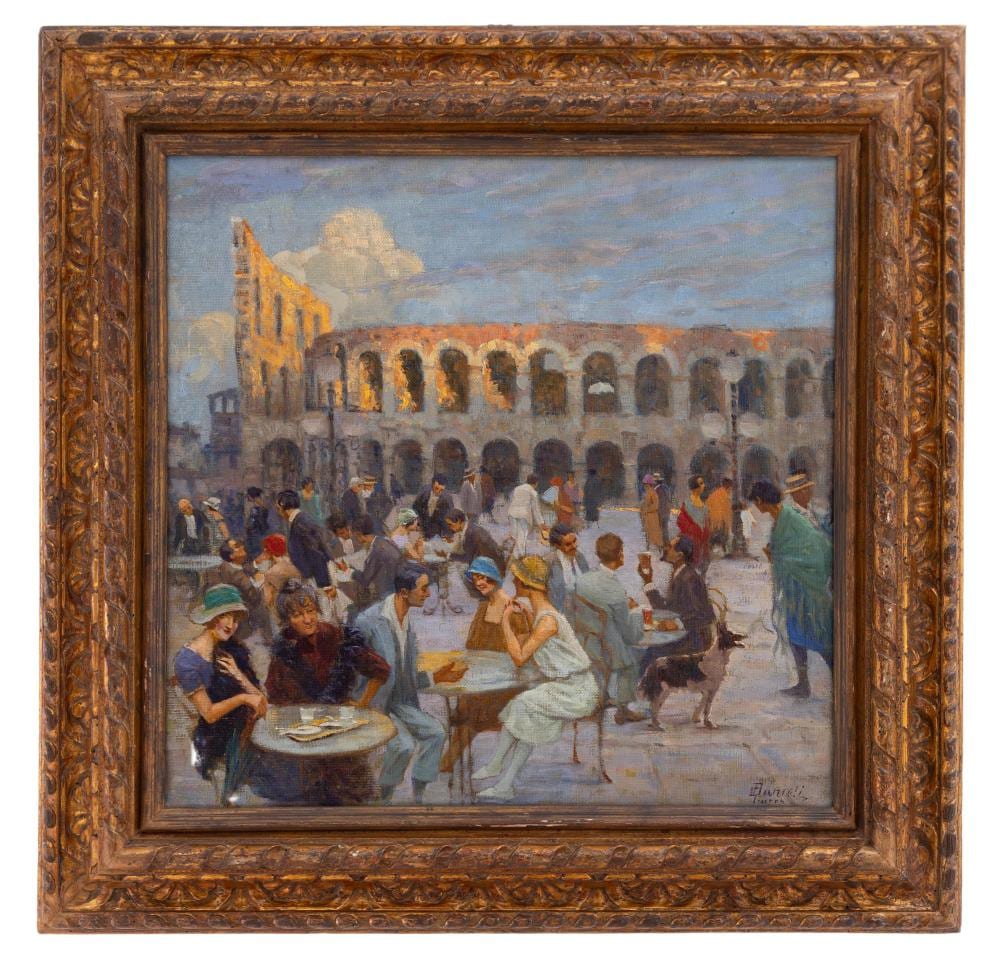
Giuseppe Danieli, Belluno 1865 - Verona 1931 (Belluno 1865 - Verona 1931) - Born in Belluno on May 10, 1865, the son of Paolo and Maddalena De Cian, Giuseppe Danieli was a student at the Accademia di Belle Arti in Venice, where he studied under Luigi Nono. From him he assimilated an interest in luministic research and a lively color palette, elements that particularly influenced his early works. His training was also influenced by the suggestions of Venetian artists active in landscape and genre painting, such as Giacomo Favretto, Girolamo Milesi, Guglielmo and Giuseppe Ciardi, Pietro Fragiacomo and Ettore Tito.In 1897 he participated in the III Triennale di Belle Arti di Brera with the works "Gray Day" and "On Sunset," exhibiting alongside Venetian artists such as Beppe Bezzi and the Ciardi brothers. The following year he presented "Reflections of Sunset" at the National Exhibition of Fine Arts in Turin, where his work was flanked by landscapes by Angelo Luxoro and Francesco Maragliano. This period was marked by intense exhibition activity, culminating in his participation in the III Venice Biennale in 1899 with "Sull'imbrunire - Alta montagna," a work that highlighted his predilection for crepuscular light effects. Here he had the opportunity to engage with European artistic currents, including French and Italian symbolism, as well as German, Swiss and Dutch landscape painting.From his encounter with different artistic experiences, Danieli drew inspiration to approach the modes of Delleani and the Piedmontese landscape painters, as well as the Ligurian school of Albaro. Some of his works, such as "Evening Prayer," "Sisters by the Lake," "Lakeside Landscape" and "Contemplation," show Symbolist influences, also evident in some pastels such as "Romantic Sunset," "Dreams" and "Evelina." However, he always remained faithful to the themes and modes of expression of his training, often returning to typically Venetian and Chioggia subjects, such as "Feast of the Lord," "After Vespers," and "Canal of Chioggia".Throughout his career, he also produced works with a social background, although devoid of denunciatory intent, including "The Foundry," "Return from Work," and "Last Job." Parallel to his painting activity, he devoted himself to teaching drawing in professional schools, which led him to sojourn in several Italian cities: Lentini, Sciacca, Chioggia, Porto Maurizio, Cuneo and finally Verona.He continued to exhibit in important exhibitions: in 1904 he was present at the International Exhibition in Munich with "Pescheria di Chioggia" and "Ritorno dal lavoro"; in 1906 he exhibited "Canale a Chioggia" and "Lago alpino di sera" in Florence; in 1908 he presented "Inverno a Chioggia" and "All'Ave Maria." In 1910 he participated in the Exhibition of the Society of Fine Arts in Genoa with works such as "Old Shipyards" and "Alto Cadore".His only solo exhibition in his lifetime was held in Cuneo in 1917, with some works later acquired by the Museum of Bra. During his stay in Cuneo, the artist drew inspiration for new landscape cues from excursions in the mountains. In his later years he moved away from landscape to focus on scenes of family life, such as "Family Portrait" and "Reading by the Lake." However, he was unable to find new avenues of expression and, plagued by health problems, took his own life in Verona on May 25, 1931.In 1942 some of his works were exhibited in Turin at the Società Promotrice di Belle Arti. In recent years, Piedmont galleries, especially in Turin, have promoted initiatives to rediscover and enhance his production.