Have one like this?
Upload a photo for a free check of what yours may be worth.
Lot description
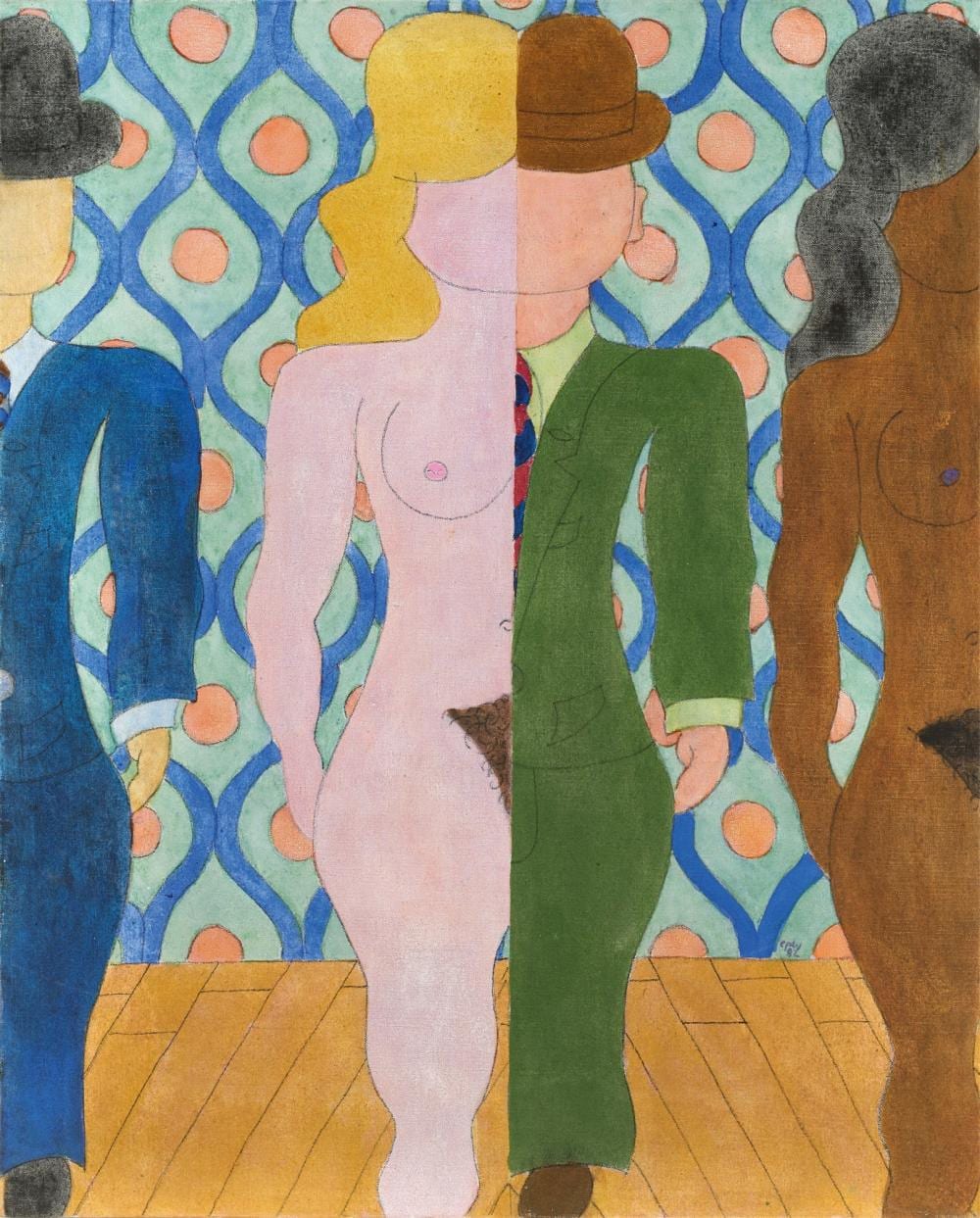
Signed and dated 'cply 82'. The present work is registered in the Estate of William N. Copley, New York. With ‘Intolerance’, William N. Copley creates a scene that deals with the categories of gender, identity, and conformity in a way that is as playful as it is subversive. A vertically split figure is featured at the centre of the picture: The left half of the figure is a naked female body with blonde hair, the right half a male in a suit wearing a bowler hat – a typical motif from Copley’s iconographic repertoire. With its stylised form, rounded limbs, and lack of individual facial features, the figure refers to cultural archetypes, which are ironically dismantled here. The central figure is flanked by two further figures: A male body-half on the left and a female body-half on the right – each divided exactly along the edge of the picture. A repetition of the division increases the effect of the fragmented identity. The duplicated characters – a stiff man in a suit and a physically accentuated, naked female figure – illustrate the reduction of both genders to clichéd role models. At the same time, the repetition places the seriality of social patterns at the centre of the pictorial statement. The rhythmic arrangement of the figures, combined with the ornamental wallpaper in the background and the wooden floorboards, emphasises the two-dimensional, artificial spatiality of the pictorial space, which has an almost theatrical effect. Copley himself compared his visual language to the principles of the Commedia dell’arte – a form of Italian impromptu theatre that spread throughout Europe from the 16th century and operated with fixed character types and masks. His figures also appear as stereotypical role characters: reduced, exaggerated, recognisable – and precisely for this reason – open to interpretation. Copley’s work combines the graphic clarity of American Pop Art with the symbolic complexity of European Surrealism. The seemingly naïve depiction is in fact highly reflective – his figures operate between dream, desire, and cultural role play. ‘Intolerance’ is an example of how Copley condenses these influences into an independent visual language.