Have one like this?
Upload a photo for a free check of what yours may be worth.
Lot description
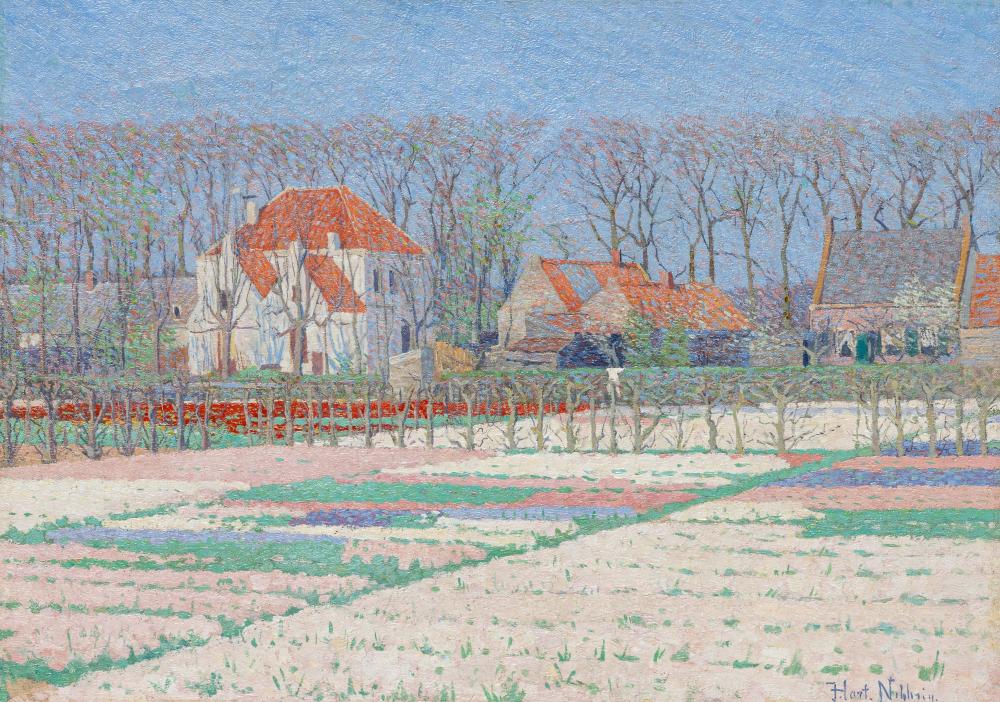
Bulb fields by Huize Vredeoord in Bennebroek, signed 'Hart. Nibbrig.' (lower right) , oil on canvas, 40,5x57 cm, Painted circa 1900.Please compare to a painting by the artist with a similar composition, exhibited in Singer Laren, 1967, no. 7, dated 1882/4. Please also compare to another painting by the artist with a similar composition, in the collection of the Stedelijk Museum, Amsterdam, inv. no. A29680, dated 1891. Ferdinand Hart Nibbrig's artistic talent was evident from a young age. He received a thorough classical education in the Netherlands, where his training focused heavily on drawing from plaster casts and still-life models. In 1888, he moved to Paris to further his studies, enrolling at the Académie Julian and later working in the studio of Ferdinand Cormon. During his time in the French capital, Hart Nibbrig was introduced—through Theo van Gogh—to the revolutionary work of artists such as Vincent van Gogh, Edgar Degas, Claude Monet, and Camille and Lucien Pissarro.It was only after 1892, however, that the influence of these encounters began to fully manifest in his own work. Prior to that, his paintings were defined by darker pigments and a vigorous, expressive brushstroke. A pivotal transformation occurred in 1892. According to contemporary art critic Johan Cohen Gosschalk (1873–1912), it was during a bicycle trip through the bulb fields around Bennebroek and Hillegom that Hart Nibbrig experienced a moment of artistic awakening. The brilliant, successive stretches of colour made such a lasting impression on him that he scraped the dried, dark paint from his palette and embraced a brighter, more luminous palette. From then on, the artistic insights he had gained in Paris found fertile ground in the Dutch landscape. Cycling offered him a fresh perspective—he began to see his surroundings in a new light, literally and figuratively.A survey of Hart Nibbrig’s oeuvre reveals a striking range of contrasts. His subject matter alternates between tranquil landscapes and carefully observed human figures. His technique spans the precise application of pointillism to broader, more impasto brushwork. His palette shifts fluidly between sombre tones and radiant colour. The present work is a quintessential example of his pointillist period, defined by lightness and clarity.Despite these variations, a constant thread runs through his work: the desire to capture a truthful, objective impression of a fleeting moment. Pointillism, with its systematic and analytical approach, served this aim perfectly. The painting under discussion exemplifies Hart Nibbrig’s dedication to this vision. It reflects his keen observational eye and his ability to translate the brilliance of natural light onto canvas—dot by dot, stroke by stroke—creating a serene, sunlit scene that distil both the essence of the Dutch landscape and the artist’s own luminous vision.In this luminous painting the composition is structured around a rhythm of horizontal bands—alternating fields in pastel hues of pink, blue, red, and green—that lead the viewer’s eye toward the red-roofed farmhouses nestled against a delicate backdrop of trees. The restrained yet radiant palette and the balance between architectural structure and natural elements reflect Hart Nibbrig’s masterful control over both form and light, exemplifying his unique contribution to early 20th-century Dutch luminism.