Have one like this?
Upload a photo for a free check of what yours may be worth.
Lot description
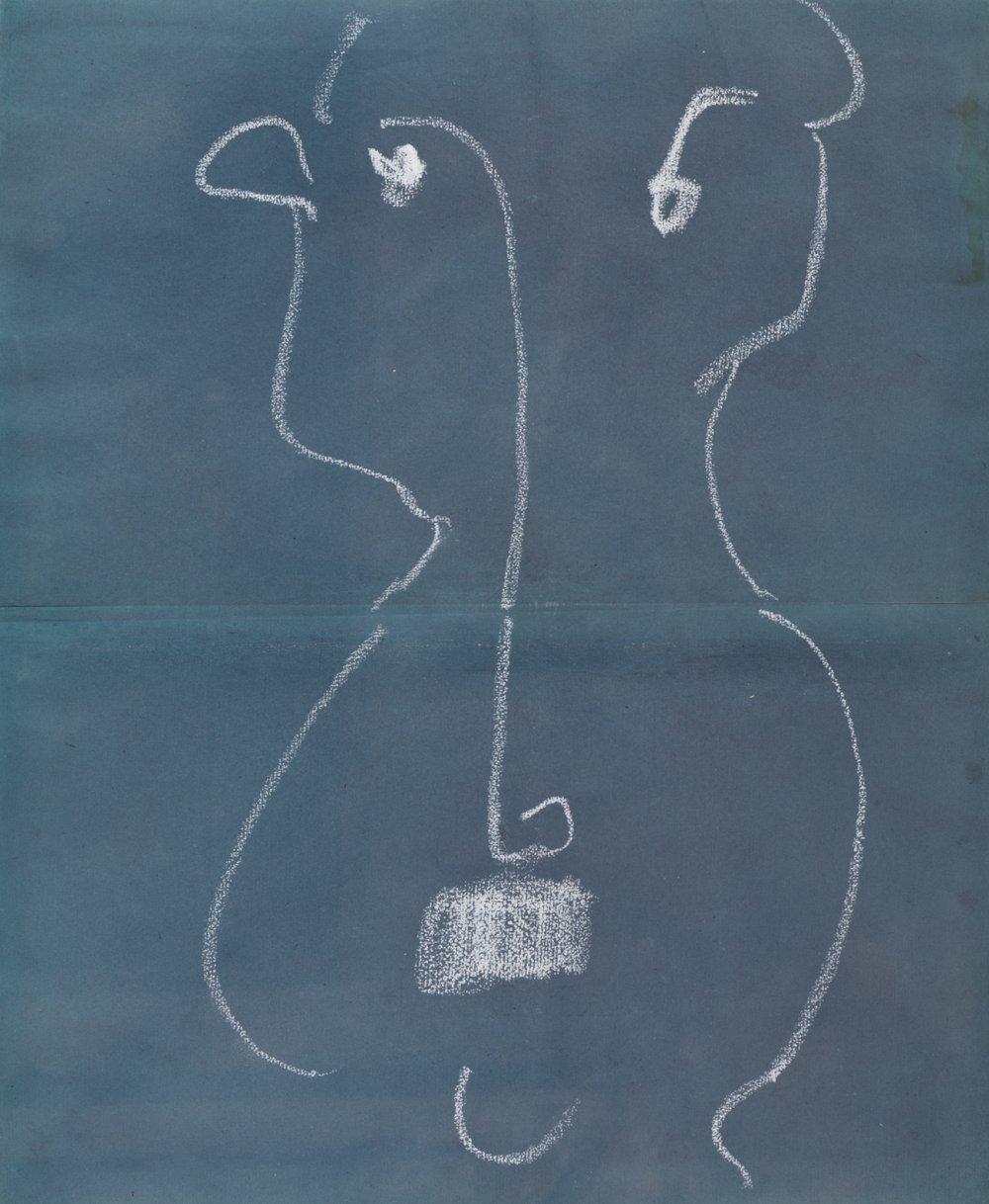
JORGE OTEIZA (Orio, Guipúzcoa, 1908 - San Sebastián, 2003). Untitled. Chalk on paper. Work reproduced in Jorge Oteiza "Drawings, sketches, college" II Volume, 2007, p.25. Measurements: 39 x 31 cm; 77 x 69 cm (frame). Fleeing from the usual constructivism that characterizes him, in this work he conceives a portrait based on simple lines, tending towards geometry. Through free strokes he configures a male face, as a sketch, practice or game. The lines are apparently random but precise, as they determine a face with marked features, a moustache and a bulge in the upper area, which may well represent the txapela. Jorge Oteiza is one of the fundamental Basque artists of the 20th century, as well as one of the most influential. The echoes of his work are perceptible, from the fifties to the present day, in the work of numerous sculptors, painters and architects. Self-taught, Oteiza began his career making sculptures within the orbit of expressionism or primitivism initiated by Gauguin, Picasso and Derain. After a long stay in South America, the sculptor developed, both theoretically and practically, the foundations of his aesthetics, and brought out the "natural" sculptor in him, taking the necessary steps to become an artist in control of his mechanisms and tools. This intellectual adventure will be reflected in texts such as "Letter to the artists of America" (1944) or "The aesthetic interpretation of American megalithic statuary" (1952). During these years he will teach at the School of Ceramics in Buenos Aires. At the end of the forties he returned to Spain, and in his work the influence of massive and monolithic sculpture underwent a process of dematerialization. In the early fifties, Oteiza is immersed in an abstract research, and begins what he calls his "Experimental Purpose" (1955), experimenting along the lines of constructivism. In 1957 he presented his work at the São Paulo Biennial, being awarded the extraordinary prize for sculpture. Two years later, understanding that he had reached his conclusive phase, Oteiza abandoned sculptural activity. During the sixties and seventies he devoted himself to researching the Basque language and the popular manifestations of his people. In 1988 he was awarded the Prince of Asturias Prize for the Arts. He is currently represented in the Jorge Oteiza Museum Foundation in Alzuza, the Reina Sofía National Art Center, the MACBA, the Guggenheim in Bilbao and New York, the Telefónica and Caixa Galicia Foundations and the Patio Herreriano Museum in Valladolid, among other public and private collections. Work reproduced in Jorge Oteiza "Dibujos, bocetos, college" II Volume, 2007, p.25.