Have one like this?
Upload a photo for a free check of what yours may be worth.
Lot description
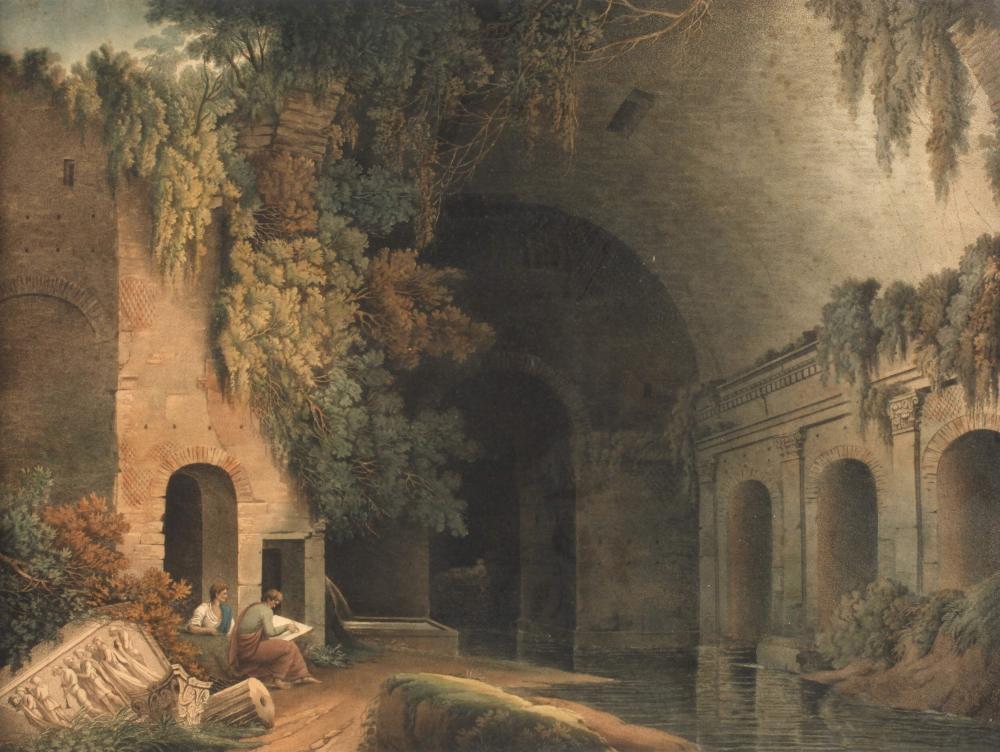
Francis Jukes, Die Egeria-Grotte bei Rom zwei sitzende Zeichner am Eingang der Ruine des antiken Nymphäums der Egeria in Rom im Tal der Caffarella, prächtige Farbradierung mit Aquatinta nach einem Gemälde des britischen Landschaftsmalers Robert Freebairn (1765-1808), hierzu bemerkt Thieme-Becker: "... arbeitete aber später meistens mit dem Stichel in der damals beliebten Aquatintamanier; wenn er nicht deren Erfinder war, so hat er doch diese Technik in hohem Maße vervollkommnet ... [sein] Oeuvre umfaßt hauptsächlich Veduten u. Marinen, von denen einige zu dem Besten gehörten, was in der Aquatintatechnik damals geleistet wurde. ...", links unter der Abbildung bezeichnet "From a Picture by R. Freebairn" und rechts Stechersignatur "Engraved by F. Jukes", unten mittig Dedikation und englischer Titel "... View of the Fountain of Egeria near Rome [Blick auf den Egeria-Brunnen bei Rom]" unten mittig datiert und Verlagsangabe "London, Pub´d Dec.´r 1st 1796, by F. Jukes, No. 10 Howland Street [London, Veröffentlicht am 1. Dezember 1796 von F. Jukes, Howland-Straße 10]", etwas stockfleckig, hinter Glas gerahmt, Abbildung ca. 43 x 57 cm, Falzmaße ca. 50 x 60,5 cm. Künstlerinfo: irrtümlich auch Juckes, englischer Architektur- und Vedutenmaler, Radierer, Kupferstecher, Illustrator und Verleger (1745, 1746 oder 1747 Martley/Worcestershire bis 1812 London), zunächst als Architektur- und Vedutenmaler tätig, widmete er sich schließlich nahezu ausschließlich der Aquatintaradierung, gilt zusammen mit Paul Sandby (1731-1809) als Erfinder und Pionier in der Kunst der Aquatintaradierung, zeitweise Zusammenarbeit mit den Kupferstechern Robert Pollard und Valentine Green, fertigte Stiche nach Gemälden von Sawrey Gilpin, William Mason, Edward Dayes, Francis Wheatley, William Sawrey Gilpin, Charles Ansell, Thomas Rowlandson, John Hanks und James Pollard, betrieb eine Stecherwerkstatt mit Verlag in London Quelle: Thieme-Becker, Saur "Bio-Bibliographische Künstlerlexikon", Nagler, Müller-Singer, Seubert, Müller-Klunzinger und britische Wikipedia. Francis Jukes, The Egeria Grotto near Rome Two seated draughtsmen at the entrance to the ruins of the ancient nymphaeum of the Egeria in Rome in the Caffarella valley, magnificent colour etching with aquatint after a painting by the British landscape painter Robert Freebairn (1765-1808), Thieme-Becker remarks: "....... but later worked mostly with the burin in the then popular aquatint manner; if he was not its inventor, he nevertheless perfected this technique to a high degree ... [his] oeuvre mainly comprises vedutas and marines, some of which were among the best achievements in the aquatint technique at the time. ...", inscribed "From a Picture by R. Freebairn" below the image on the left and engraver's signature "Engraved by F. Jukes" on the right, dedication and English title "... View of the Fountain of Egeria near Rome" dated lower centre and publisher's inscription "London, Pub'd Dec.'r 1st 1796, by F. Jukes, No. 10 Howland Street", somewhat foxed, framed behind glass, image approx. 43 x 57 cm, inner dimensions approx. 50 x 60.5 cm. Artist information: erroneously also Juckes, English architectural and veduta painter, etcher, engraver, illustrator and publisher (1745, 1746 or 1747 Martley/Worcestershire to 1812 London), initially active as an architectural and veduta painter, he eventually devoted himself almost exclusively to aquatint etching, together with Paul Sandby (1731-1809) he is considered an inventor and pioneer in the art of aquatint etching, collaborated at times with the engravers Robert Pollard and Valentine Green, produced engravings after paintings by Sawrey Gilpin, William Mason, Edward Dayes, Francis Wheatley, William Sawrey Gilpin, Charles Ansell, Thomas Rowlandson, John Hanks and James Pollard, ran an engraving workshop and publishing house in London Source: Thieme-Becker, Saur "Bio-Bibliographische Künstlerlexikon", Nagler, Müller-Singer, Seubert, Müller-Klunzinger a