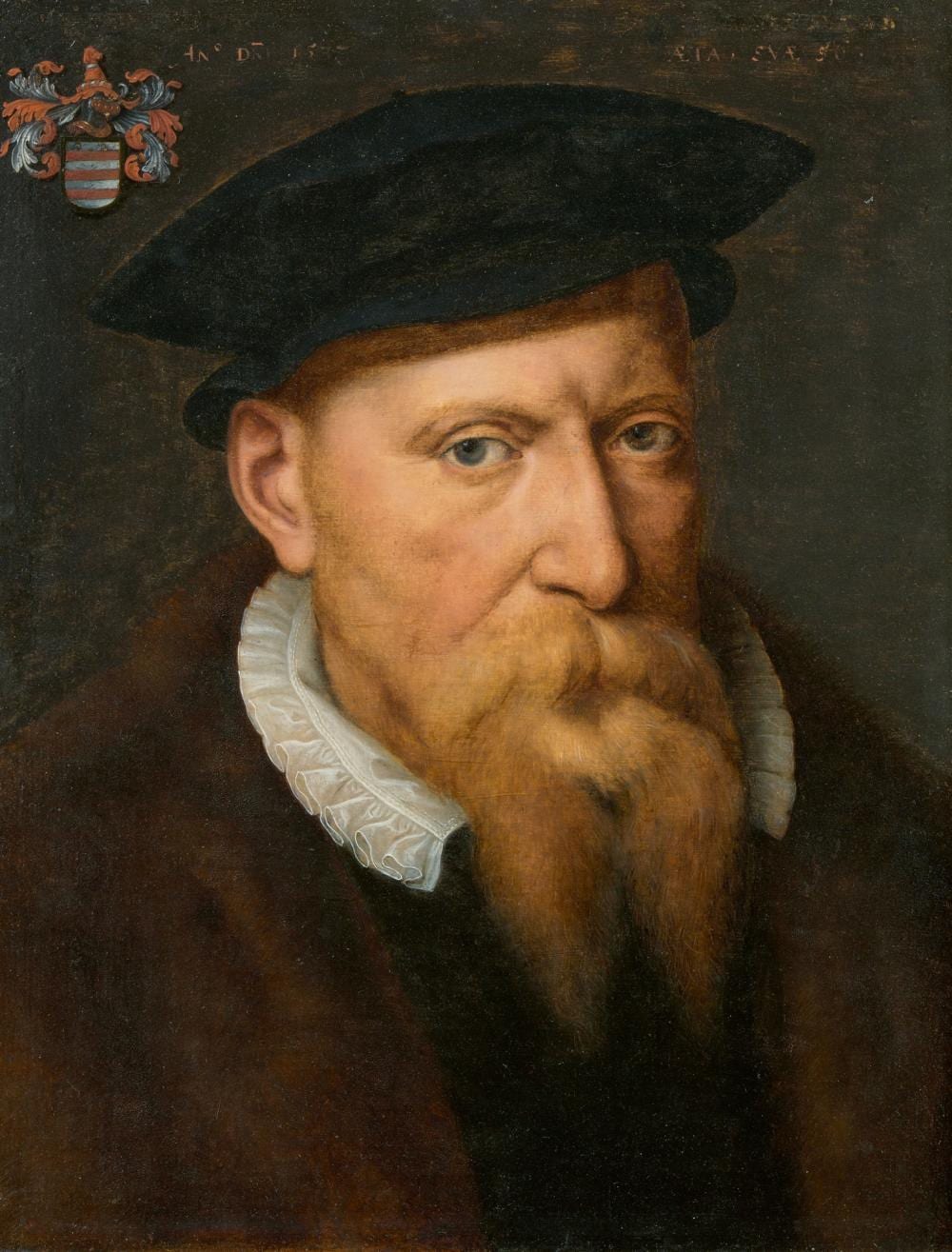
Lot description
With the Croÿ family coat of arms in the top left, beside it the inscription: "AN° DNI 1537 [the last two digits hard to decipher]." Top right: "AETA SVAE 56 [AE conjoined]." Above each is an older inscription that is no longer legible today. The attribution of the present portrait to the Flemish painter Willem Key was first proposed by Gustav Glück, as Tancred Borenius reported in his 1942 article in the Burlington Magazine. The sitter was identified at the time as Philippe II de Croÿ (1496-1549), 1st Duke of Aarschot. While the attribution to the Flemish artist Willem Key has never been questioned since and was reconfirmed by Koenraad Jonckheere in 2011. However, Jan van Helmont was able to prove in 2009 that the sitter is not in fact the Duke of Aarschot, but his younger brother Robert de Croÿ (1506-1556), who became Bishop of Cambrai in 1519 after another brother, Cardinal Guillaume de Croÿ (1498-1521), renounced the bishopric. Comparisons with other surviving portraits of the bishop confirm the identification, especially with a drawing in the "Recueil d'Arras", a manuscript containing numerous portrait drawings attributed to Jacques Le Boucq (1520-1573), which is kept in the Bibliothèque Municipale d'Arras (ill. 1; inv. no. Arras, BM, 0266). Robert de Croÿ had enrolled at the University of Leuven a year before his appointment as bishop. Therefore, his ceremonial entry into the episcopal city was not made until 10 years after his appointment, on June 13th 1529. A few days later, Margaret of Austria and Louise of Savoy also entered the city to sign the "Peace of Cambrai," which was intended to end the disputes between Emperor Charles V and the French King Francis I during which Robert de Croÿ celebrated his first mass. As the third son of Henri de Croÿ and Charlotte de Chateaubriand, Robert de Croÿ came from one of the most powerful noble families of his time, which ruled over numerous territories in France, the Spanish Netherlands and the Holy Roman Empire.