Have one like this?
Upload a photo for a free check of what yours may be worth.
Lot description
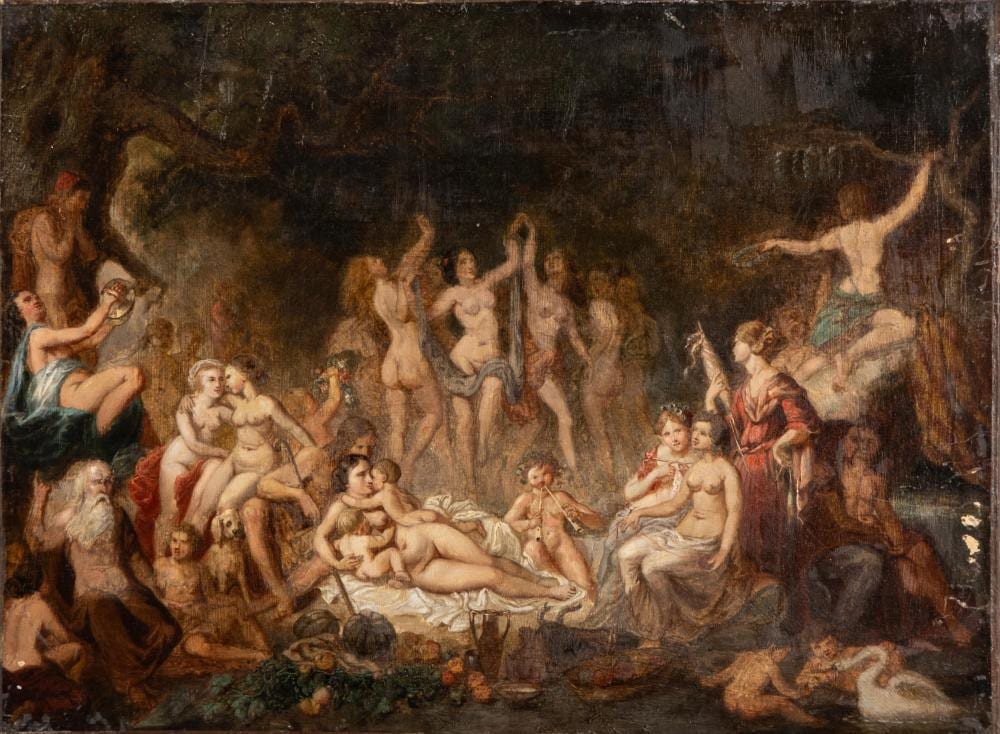
Keywords: Neoclassicism, Romanticism, French Academic Art, Historicism, Beaux-Arts, Salon Painting, Paul Delaroche style, Antoine-Jean Gros style, William-Adolphe Bouguereau style, oil on canvas, 19th century, signed on stretcher, allegorical nude, classical mythology Attributed to Thomas Couture (French, 1815–1879), oil on canvas painting depicting a mythological bacchanal or fertility celebration, signed on the stretcher, 19th Century Couture studied under Antoine Gros (1771-1835) from 1830-1835, and following Gros's suicide, switched to the atelier of Paul Delaroche (1797-1856). He was officially registered at the École des Beaux-Arts in April 1831. Under Gros and Delaroche he experienced a conflict between loyalty to their ideals and the need to maintain his individuality. In 1839 he struck out on his own. The dominant subject of Couture's repertoire is the portrait. Although orders for his portraits accelerated in the boom years after his early success with Romans of the Decadence, which climaxed his early series of works based on themes of moral depravity and for which he was heavily lauded at the Salon of 1847, he worked in the portraiture genre throughout his career. He pioneered a certain type of portrait, which affected such prominent contemporaries as Gustave Richard, Gustave Courbet and his students Uno Troili and William Morris Hunt: Couture showed only the head and shoulders against a shadowy or blank backdrop, and most sitters look out from the corners of their eyes at the viewer. The hallmarks of his style are a splash of scumbled light, which forms a kind of aura in the otherwise dark background, and a flash of white in the collar. Couture painted mainly distinguished sitters, aristocrats and self-made men who came to power during the July Monarchy and Second Empire. Couture's most important contribution to the history of art was as an independent teacher, and his eclectic proclivities attracted an international student body. Among his immediate students were the French painters Manet, Puvis de Chavannes, Desboutin; the Germans Feuerbach, Hennenberg and Gentz; and the Americans Hunt, Johnson and Newman. Since many of his disciples became influential in their own right, one must consider his far-reaching impact on Impressionism, Post-Impressionism (Seurat and Cezanne were admirers), and Symbolism