Have one like this?
Upload a photo for a free check of what yours may be worth.
Lot description
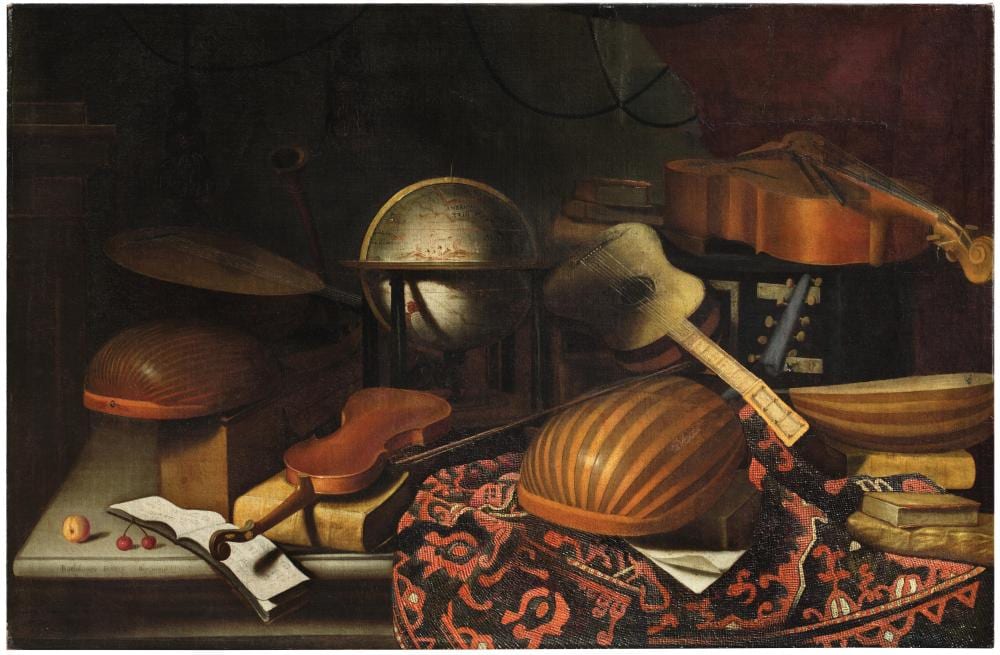
(Bergamo 1639 – after 1688) Archlutes, a violin, bass viola, guitar, mandora, books, sheets of music and a globe on a woven carpet, draped over a stone ledge, with an apricot and two cherries lower left, signed lower left on the stone ledge: Bartolomeo Bettera Bergamo, oil on canvas, 100 x 152 cm, framed Provenance: Private European collection; where acquired by the present owner Exhibited: Bergamo, Palazzo Credito Bergamasco, Bartolomeo Bettera, 4 – 24 October 2008, no. 10 (as Bartolomeo Bettera) Literature: A. Cottino, Bartolomeo Bettera, exhibition catalogue, Bergamo 2008, pp. 56–57 (as Bartolomeo Bettera) The present meticulously composed still life by Bartolomeo Bettera presents a lavish arrangement of musical instruments and scholarly objects, evoking the refined cultural milieu of seventeenth-century Lombardy. Resting on a richly woven oriental carpet, a variety of stringed instruments – including an archlute, violin, bass viola, guitar, and mandora – are carefully positioned among scattered books and sheets of music. A globe, symbolising knowledge, and exploration, adds an intellectual element to the composition. In the lower left corner, an apricot and two cherries introduce a note of naturalism, contrasting with the otherwise structured arrangement of objects. Bartolomeo Bettera was a still-life painter active in Lombardy during the second half of the seventeenth century. Although little is known about his biography, records suggest he left Bergamo for Rome before settling in Milan by 1687, where he probably remained for the rest of his life. While it is uncertain whether he formally trained under Evaristo Baschenis, Bettera was undoubtedly influenced by the elder Bergamasque master’s still lifes featuring musical instruments, opulent draperies, and rich oriental table carpets. Bettera’s compositions reflect a distinctive, personal evolution of Baschenis’ legacy. While both artists share a dark palette with warm tones, Bettera’s still lifes lean toward an elaborate and decorative aesthetic, incorporating rare instruments, intarsia-adorned Spanish guitars, and ornate coffers. Unlike Baschenis’ restrained arrangements, which emphasise empty space, Bettera fills his compositions with objects arranged for theatrical impact, creating a sense of opulence and density. His calculated use of lighting enhances the sculptural quality of his subjects, further distinguishing his works as vibrant, sophisticated explorations of musical and ornamental themes.