Have one like this?
Upload a photo for a free check of what yours may be worth.
Lot description
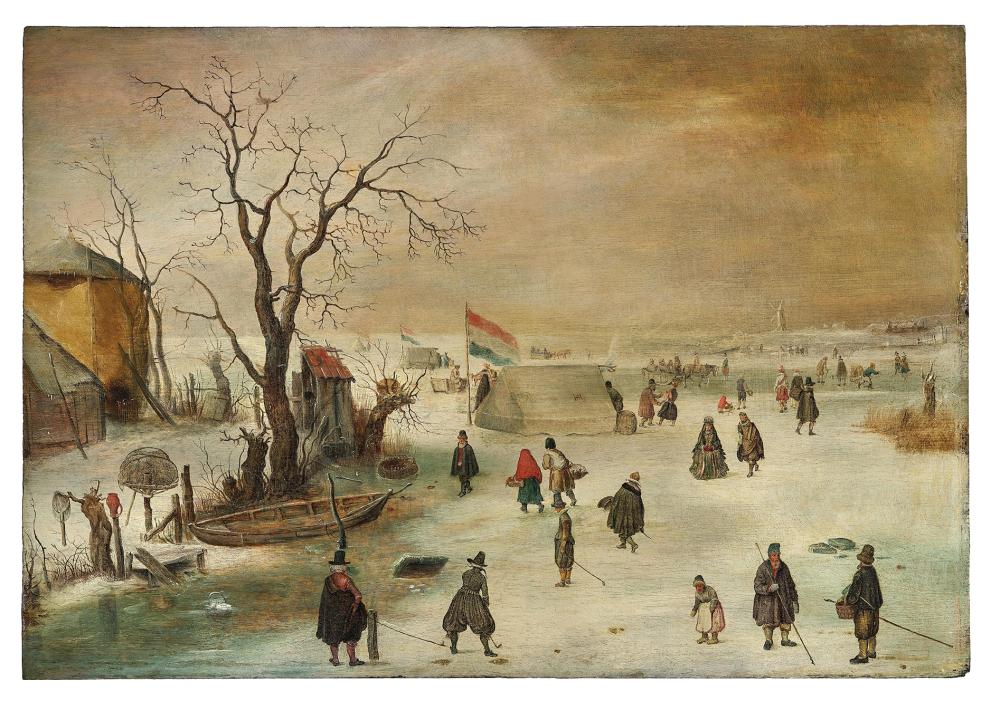
(Amsterdam 1585–1634 Kampen) Winter landscape with figures enjoying the ice, monogrammed (on the tent): HVA, oil on panel, 41.5 x 60 cm, framed Provenance: Collection of Henry Doetsch (1839–1894), London; his sale, Christie, Manson & Woods, London, 25 June 1895, lot 443; Private collection, United Kingdom; sale, Sotheby’s, London, 7 July 1976, lot 61; with Brod Gallery, London, 1977; with René Schreuder, Aerdenhout, 1990; with Galerie de Jonckheere, 1996; sale, Dorotheum, Vienna, 4 March 1997, lot 136; Private collection, Vienna Literature: W. v. Seilitz, H. Weizsäcker, G. Gronau, T. Thieme, Repertorium für Kunstwissenschaft, Vol. XVIII, Berlin/Boston 1895, p. 315; C. J. Welcker, Hendrick Avercamp, 1585-1634 bijgenaamd ‘De stomme van Campen’ en Barent Avercamp, 1612-1679, ‘schilders tot Campen’, Zwolle 1933, p. 228, no. S 366; C. J. Welcker, D. J. Hensbroeck van der Poel, Hendrick Avercamp, 1585-1634 bijgenaamd “De stomme van Campen” en Barent Avercamp, 1612-1679, ‘schilders tot Campen’. Bewerking oeuvre-catalogus door D.J. Hensbroek-van der Poel, Doornspijk 1979, p. 235, no. S 366 The present painting is listed in the RKD database under number 20403 (as Hendrick Avercamp / possibly studio of Hendrick Avercamp). The present work depicts an animated winter scene, typical of the work of Hendrick Avercamp, who successfully developed this genre. As is the case in the present painting, many of the artist’s compositions are painted from the vantage point of the bank of a frozen river or lake, set in the flat landscape in the Northern part of the Low Countries. This point of view allowed the artist to achieve perspective through the optical technique of repoussoir, produced here by the placement of the bare tree, the barn, and haystack in the lower left of the present work. Throughout the composition, numerous figures carefully walk on the slippery ice, which provides a new seasonal route to the other side of the water. Most of the figures seem to be enjoying this spectacular natural phenomenon. In addition, there are two horse-drawn sleighs in the background and figures in the foreground who are fully engaged in an early form of golf. Part of the entertainment of being on the ice is to be found in the row of tents along the waterfront; they offer warm food and beverages during a stroll, sleigh ride, or ice-skating tour, and are often present in Avercamp’s compositions. The artist’s signature, for which he used his ligated monogram, ‘HVA’, is found on the tent placed at the centre of the composition. Although the artist did not date his paintings and scholars have difficulty establishing a chronology within his body of works, the author of the catalogue raisonné, Clara Welcker, places the present painting amongst Avercamp’s early works (see literature). This is consistent with the composition of the present picture, in which there is an equal division between the clouded grey sky and the frozen stretch of ice. This relatively high horizon is common in early Dutch landscape painting. Another, probably early, painting by Avercamp, entitled Winter Landscape, which was sold at Lempertz, Cologne on 12 May 2012 as lot 1215, bears similarities to the work under discussion. The Lempertz painting also depicts a diagonal row of tents and a comparable composition on the left, where a bare tree, a haystack, and a barn are situated. Avercamp followed the tendency in landscape painting of lowering the horizon and enlarging the figures in the foreground in his compositions. This development is clearly illustrated in his painting Enjoying the ice near a town, dated circa to 1620 and today conserved in the Rijksmuseum, Amsterdam (inv. no. SK-C-1705). In thr Rijksmuseum painting the horizon is significantly lower than the horizon in the present painting. It should be noted that Clara Welcker notes in her catalogue raisonné from 1933, that the present painting bore the name ‘Isaack van Ostade’ in the lower left (see literature), though today there are no traces visible (see technical analysis by Gianluca Poldi). Despite this, Welcker confirmed the painting to be by Hendrick Avercamp. According to Ellis Dullaart of the RKD in The Hague, the use of repoussoir on the lower left as described above, along with the treatment of the boat, support the attribution to Avercamp and relate to his other early works. Although Dullaart considers the treatment of the figures and the stretch of ice as being less typical for the artist, she also notes a significant, clearly visible pentimento revealing the original presence of an elegant couple and a dog in the left part of the central tent. In addition, underdrawing can be seen through the paint layers near the boat on the left, which is confirmed by the technical analysis of Gianluca Poldi (see below). Concluding her observations, Dullaart considers the present painting to be a combined creation by Avercamp and a workshop assistant. Born deaf, and probably unable to speak, Avercamp was nicknamed “de Stomme van Kampen” [the mute of Kampen]. Raised in this eastern city along the river IJssel, situated close to the shores of the former inner Southern Sea, the artist would have experienced the joys of winter, and especially the ice, from a young age. Returning to his birthplace Amsterdam around 1607, he was apprenticed to Pieter Isaacsz and possibly received training from the Antwerp landscape painter Gillis van Coninxloo. The year 1608 was one of the coldest in the history of the Low Countries. The frozen rivers and seafronts were a source of inspiration for Avercamp, as they had been for artists such as Pieter Breughel I and others before him, who illustrated the winter landscape and the amusements on the ice in paintings, drawings and prints. The present painting was once part of the collection of the German born Henry Doetsch (1839–1894) who made his fortune in Spain where he was one of the founders of the company Sundheim y Doetsch and was director of the Rio Tinto Company. As a collector of old master paintings, Doetsch is thought to have been in contact with the American art historian Bernard Berenson (1865–1959) and purchased works by renowned Dutch and Italian masters. After his years in Spain, Doetsch settled in London where he continued to expand his collection and opened his house and art gallery to interested parties. At the time of Henry Doetsch’s death his collection numbered 400 paintings and 600 miniatures. A large portion was sold at Christie’s London in June 1895, by which means a number of works from the collection found their way into the Royal Collection and other prestigious institutions.