Have one like this? Check yours freeOr have an appraiser value it
Lot description
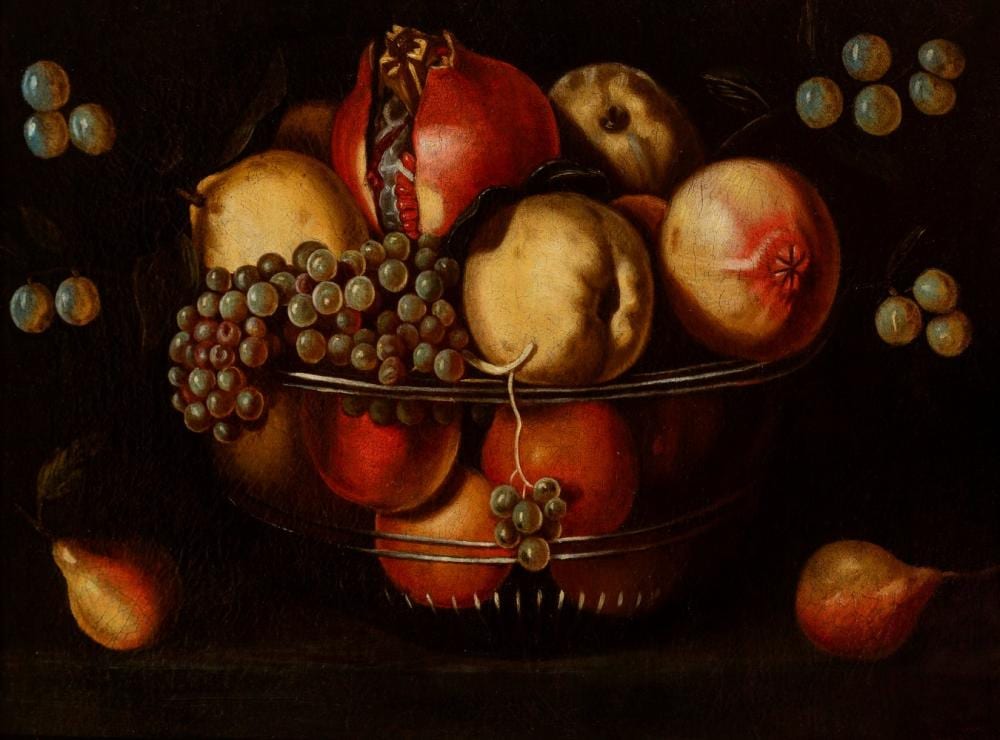
ANTONIO PONCE (Valladolid, h. 1608-h. 1667) "Still life". Oil on canvas. Relined from the nineteenth century: Presents restorations. It has a frame of the seventeenth century. Measurements: 44 x 59 cm; 62 x 79 cm (frame). Formally in this work highlights the delicate treatment of the different qualities and textures: the totally transparent glass vessel, the inside of a pomegranate, the leaf and the branch of a pear etc, qualities that are enhanced with the use of a completely dark background that supports greater three-dimensionality to the food that make up this still life. The work shows a certain tenebrist influence and the lighting highlights the volumes in contrast with the shadows. The reduced palette favors earth tones enlivened with touches of reds, whites and yellows. Some of these characteristics recall the work of Loarte or the late period of Van der Hamen: an accumulation of objects that conveys a kind of confused disorganization, somewhat lighter backgrounds, fine tactile qualities, and the play of diagonals suggest a new consideration of the inert. A new consideration of the inert aspects of still life on the threshold of the growing dynamism of the Baroque. His technical mastery is undeniable, with a succession of flat brushstrokes intermittently interrupted by touches that transmit the reflection of light. There is a curious way of delimiting the outlines of certain elements with thicker and more insistent strokes that underline their reality with greater vigor, which was common in Antonio Ponce's painting. In 1624, Antonio Ponce entered as an apprentice in the workshop of Juan Van der Hamen, the most famous still life painter of the time. The influence of his master is revealed in his early paintings, with an arrangement on stone entablatures sometimes superimposed and the strong chiaroscuro lighting of Caravaggesque origin. As a still life painter he tackled a wide variety of subjects and formats, fruits and vegetables, as well as game and flowers, series of months and small cabinet paintings. From 1637 to 1638, Ponce worked in the Buen Retiro Palace (Madrid), built by King Philip IV. In July and August of 1649, he collaborated with a group of artists in the ephemeral decoration of the steps of the square and the stairs of the church of San Felipe el Real, as part of the celebrations of the entrance of Mariana of Austria. In the 1640s, he adopted lighter and brighter backgrounds that were tinged with soft hallmarks and a chromatic scale tending to gray. It presents restorations.