Have one like this? Check yours freeOr have an appraiser value it
Lot description
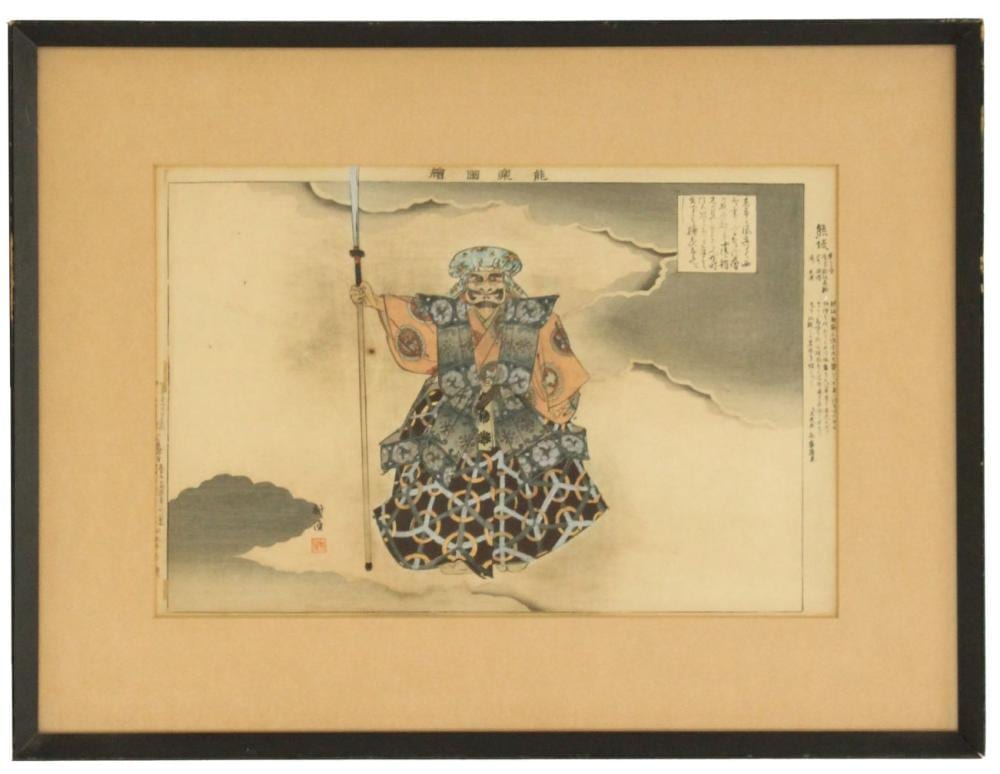
Kogyo Tsukioka (1869-1927) Japanese, "Kumasaka" Woodblock Print. Depicts an actor from a noh play, one of the artist's most popular subjects. Kanji throughout. Framed. Condition: Commensurate with age. Overall Size: 20 x 15 in. Sight Size: 9 1/4 x 14 in. #6740 . KÅgyo Tsukioka, sometimes called KÅgyo Sakamaki, was born on April 18th, 1869 in Tokyo, Japan, the year after the name of the city changed from Edo. He lived and worked as an artist throughout the Meiji period, and was a student and adopted son of Tsukioka Yoshitoshi who also studied with Ogata GekkÅ. Although KÅgyo sometimes painted other subjects, for most of his career he made pictures of Japanese noh theatre, either as large-scale paintings or colored woodblock prints. Many of the latter were published in series and sold as multi-volume sets. Some sets, such as NÅgaku zue, have been preserved as albums in their original bindings, including accordion-style bindings known as orihon, while other sets such as NÅga taikan, were issued in sewn bindings known as yamato toji. Although most bound sets belong to institutional collections, individual prints by KÅgyo can still be found through dealers specializing in Japanese prints, but they are especially rare. He passed away on February 25th, 1927, right at the end of the Taisho era and the beginning of the Showa era, and his work is emblematic of that chaotic and experimental period in Japan’s history between its austere past and its militaristic future.