Have one like this?
Upload a photo for a free check of what yours may be worth.
Lot description
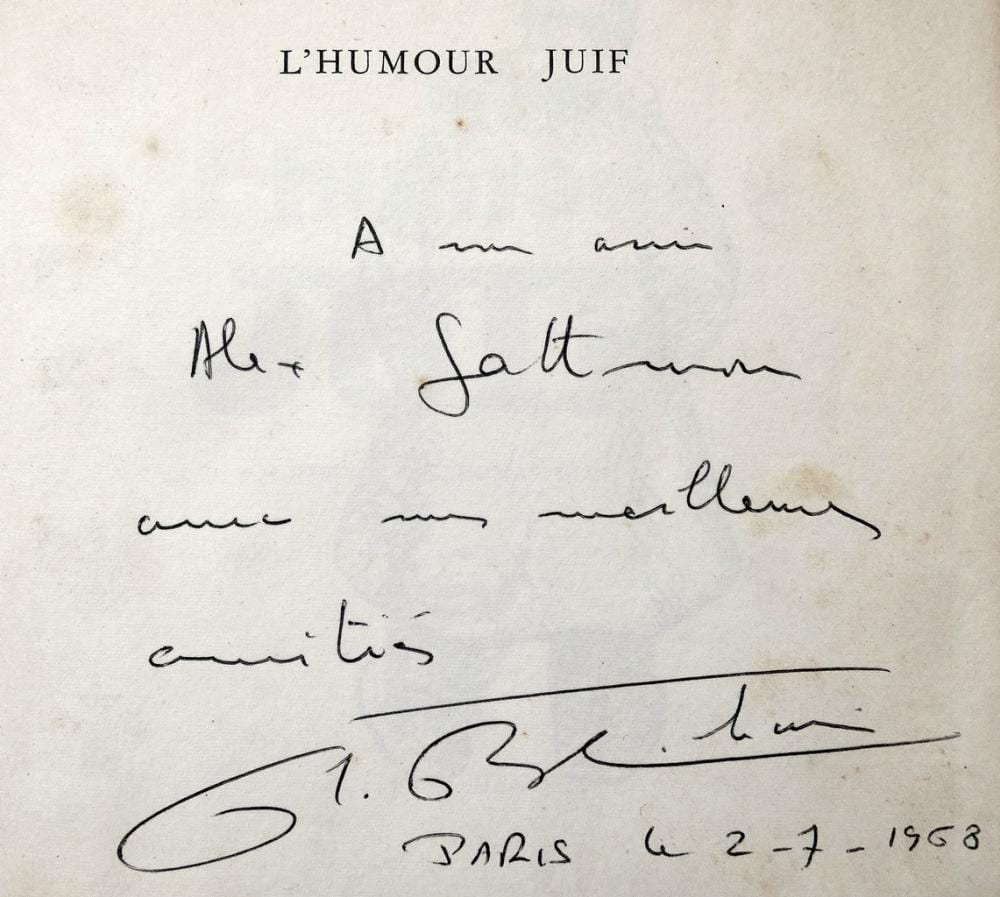
Thomas Gleb, Jewish Artist, Holocaust survivor, His Orig. Autograph on book “L’Humour Juif” by Adam, 1966, in French. Adam. L’Humour Juif. Dessins de Thomas Gleb, Autograph of the Artist on frontispiece page in French, 1968 Paris, Denoel, 1966., 118 pp., hard cover, 18.5 x 18.3 cm., Many illustrations Condition: Some wear and staining to cover. Damages to spine – tears Yellow paper, small foxing stains to first and last pages Weight: 250 gr. Thomas Gleb, pseudonym of Yehouda Chaim Kalman, born December 5, 1912 in Zelów (Poland) and died August 7, 1991 in Angers is a French painter, sculptor and tapestry maker of Polish origin. Yehouda Chaim Kalman was born on December 5, 1912 in Zelów, a small town southwest of Łódź, in central Poland. He was the second child in a family of five. His father, Moses Kalman, was a weaver1. His mother's name was Rebecca Laskier. In 1917, he entered primary school, the kheder (literally in Yiddish "the room"), where he learned Hebrew and became familiar with the Bible. "I learned the Torah. I learned the Ten Commandments, which became, after fifty years of gestation, a source of inspiration: you will find traces of my paths that lead to the source, to a beginning From 1922, he practiced various small trades: stamp engraver, water and bread seller and drew in secret. He was a weaver in 1925. In 1926, he became a student of Jozef Mitler (1895-1939) in Łódź, where he learned realistic drawing. He began a real artistic activity in 1929 and entered the Start studio in Łódź where he drew models from life and tackled oil painting (portraits, still lifes)1. He continued his pictorial research in Paris in 1932 and considered the painter Arthur Rennert as his master. Working in odd jobs, he was a retoucher of photographic portraits, a decorator of lead soldiers and a decorator. He adopted the pseudonym “Thomas Gleb”, following an article on the “glebe”, published on his painting1. “My nickname is Thomas because I didn’t believe it, Gleb is a name…” In 1935, his first exhibition took place in his studio, rue de la Chine in the 20th arrondissement of Paris with the photographer Władysław Sławny. During evening French classes, rue de Paradis1, he met his future wife, Malka Tetelbaum, known as Maria, born in 1910 in Biała Podlaska2. They married at the town hall of the 10th arrondissement in 1939. He went on foot to see the Rembrandt exhibition in Amsterdam, settled for a while in Brussels where he met the director Fernand Piette, and designed sets and costumes1. Back in Paris, he continued this activity and created 17 sets for the PIAT theatre until 1939. He exhibited at the Salon d'Automne in 1938 in Paris. Second World War In 1939, when the Second World War broke out, he enlisted in the marching regiments of foreign volunteers3,4,1. Losses amounted to 50% of the combatants. Demobilization took place in Toulouse on July 9, 1940. His studio was seized in 1940 and looted by the Germans. He moved to 15, rue des Beaux-Arts, in Paris. He joined the Jewish resistance group "Solidarité" (led by Félix Guterman) under the pseudonym Raymond Thomas1. He illustrated tracts. His eldest daughter Yolanda was born in 1941. He took refuge with his family in Grenoble in 1943 and held two exhibitions under his resistance name at the Répellin gallery. He became friends with Andry-Farcy (the curator of the Grenoble museum), Séverac, Verbanesco and Émile Gilioli (1911-1977), one of the leaders of abstraction in French sculpture in the 1950s alongside Constantin Brancusi and Jean Arp. Arrested by the Gestapo on July 8, 1944, he was transferred to Lyon to Montluc prison, then to Saint-Paul prison. Deported on 11 August to Germany, he managed to slip off the train at Serocourt in the Vosges south of Nancy. He hid near Serocourt until the arrival of the Leclerc division and the Americans who had decided to retake Épinal "in pincers". Nancy and Épinal were liberated on 15 September 1944 by General Patton. The Grenoble studio was looted and seized by the Germans5. Post-war His son Jean was born on 20 July 1945, the family returned to Paris. He exhibited in Lyon at the Folklore gallery. Thomas Gleb won first prize for a mural at the Polish Youth Club in Paris in 1947. He met Fernand Léger in 1948. He won a prize at the 1949 Warsaw International Competition for his Ghetto poster. Numerous exhibitions followed in Paris. Brief return to Poland Thomas Gleb became friends with the poet François Dodat and met Jean Cassou, then curator of the Museum of Modern Art in Paris, in 19501. He exhibited in Tunis and settled with his family in Warsaw. He lost his daughter Yolanda following an appendicitis operation in 1951. During his Polish period from 1950 to 1957, he developed a realistic style, inspired by his childhood, with rural and peasant subjects.