Have one like this? Check yours freeOr have an appraiser value it
Lot description
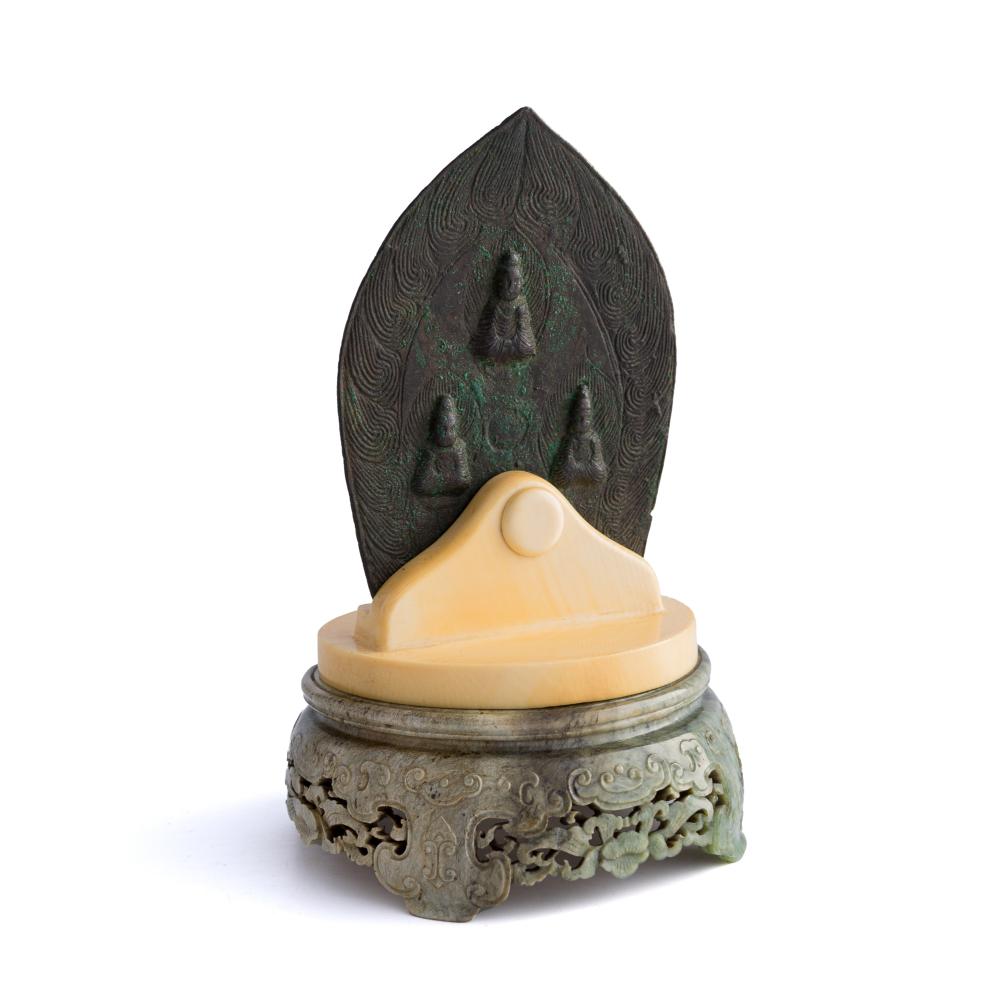
A Chinese bronze mandorla The 22nd year of Taihe, Northern Wei dynasty Decorated with a 'flame' motif encircling three miniature seated Buddhas, with eleven inscribed characters and a six-character seal sticker on the verso, indicating the date and either the maker or a previous owner. The mandorla sits atop a carved jade stand, also sold with an old hardwood box and with eight-character mark to inner layer. This exceptionally rare gilt-bronze Buddhist halo, dated Taihe 22nd Year (498 AD) of the Northern Wei Dynasty, represents an important milestone in the evolution of early Chinese Buddhist sculpture. The aureole (halo) is elegantly cast in the form of a flaming mandorla, its gracefully elongated flames emanating outward in a rhythmic, flowing motion, exemplifying the distinctive Northern Wei aesthetic. The reverse is inscribed with a dedicatory inscription, reading: "Taihe 22nd Year, made by the Buddhist disciple Yao XX", confirming its precise dating to 498 AD during the reign of Emperor Xiaowen of the Northern Wei Dynasty. The halo is mounted on an exquisitely carved jasper stand, adorned with intricate ruyi and floral motifs, symbolizing longevity and divine protection. It is secured to the stand by a meticulously sculpted ivory peg, a rare and luxurious material reserved for objects of high spiritual and imperial significance. Historical and Artistic Significance The Northern Wei period (386534 AD) was a transformative era in Chinese Buddhist art, marking the transition from Indian-influenced Gandharan styles to distinctly Chinese sculptural forms. The elongated proportions, flowing drapery, and ethereal expressions characteristic of this period laid the foundation for subsequent developments in Chinese Buddhist iconography. This halo exemplifies the stylistic refinement and devotional fervor of the Northern Wei court, whose patronage of Buddhism led to the construction of monumental cave temples such as Yungang and Longmen. The dynamic flame motifs, symbolic of spiritual radiance and enlightenment, reflect the deeply ingrained Buddhist cosmology of the period. Distinguished Provenance and Collectors Seals The lower reverse of the halo bears a rare collectors seal reading "Huai Xi" (??), identified as the personal seal of Wu Changshuo (18441927), one of Chinas most esteemed calligraphers, painters, and seal carvers. This exact seal is housed in the Shanghai Museum, with an imprint that closely matches the one on this artifact, suggesting it was part of Wus legendary collection of Buddhist art and epigraphic relics. Additionally, the halo is accompanied by its original red hardwood storage box, which bears the inscription: "Wei Taihe Buddha Halo X Jade Stand". Inside the box lid is a second collectors seal, reading "Zhanlu Studio of the Gong Family from Hefei", indicating that the piece was later owned by Gong Xinzhao (18701949), a renowned diplomat and one of the most influential Chinese collectors of the late Qing dynasty. Gong was celebrated for his scholarly approach to collecting epigraphic inscriptions, ancient bronzes, and Buddhist artifacts, and his collection was famed for its impeccable provenance and meticulous documentation. The presence of both Wu Changshuos and Gong Xinzhaos seals confirms that this halo was recognized and revered by two of Chinas most prominent collectors, significantly enhancing its historical importance and investment value. See below references for similar items: Shanghai Museum, Wu Changshuo 'Huai Xi Collection' Double-Sided Seal; The Palace Museum, No. ?00141888; Sotheby's Hong Kong Auction, October 2016, Lot 3210; Sotheby's Hong Kong Auction, October 2016, Lot 3206 H: 6 5/8, W: 4 1/8, D: 3 7/8 in. (H: 16.83, W: 10.48, D: 9.84 cm. (statue, overall)) Box dimensions: H: 5, W: 8 1/8, D: 6 3/4 in. (H: 12.70, W: 20.64, D: 17.15 cm.) Weight: 421.4 g (overall, approximately) Copy the following link for high resolution images: oag.smugmug.com/176-1/n-bXgD5F