Have one like this?
Upload a photo for a free check of what yours may be worth.
Lot description
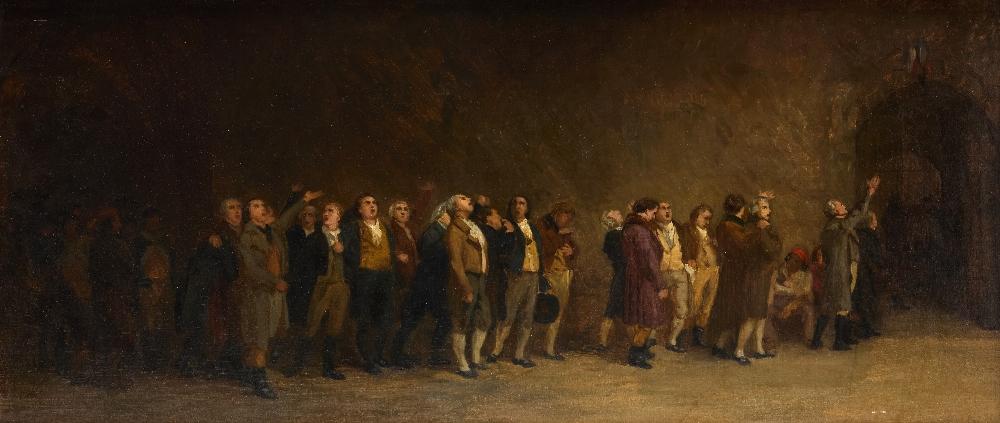
Claude Andrew Calthrop, British 1845-1893- Study for 'The Last Song of the Girondins'; oil on canvas, bears partial old label for 'Arthur Tooth, London' attached to the upper stretcher bar, 32.7 x 76 cm. Provenance: with Arthur Tooth & Sons, London. Fleming Williams (ex-Sotheby's). from whom purchased by the father of the present owner in 1967. Note: A preparatory study for Calthrop's finished painting 'The Last Song of the Girondins' which was exhibited at both London's Royal Academy in 1868 (no.390) and the Paris Universal Exposition in1878 (no.38), and latterly sold through The Maas Gallery [no.16353]. The following note was kindly provided by Rupert Maas and refers to the finished picture by Calthrop: Amongst the Jacobins of the French Revolution, the Girondins were the political faction which initially dominated the Paris Convention, overthrowing Louis XVI and declaring war on Austria and Prussia. In 1793, they were charged with ‘hostile conspiracy against the Republic’ by their rivals, the Montagnards, led by Robespierre. They were all summarily found guilty in a show trial, and at 11 p.m. on the 30th October 1793, they were sentenced to death. The very next morning, the 21 convicted men, including the corpse of Valazé, who had driven a pen into his own breast, were taken by cart from the dungeons of the Conciergerie to the guillotine. Stoic in their final hour, the processioners, led by Brissot, broke into the Marseillaise. The song dwindled to silence, until the very last Girondin was beheaded, which took only 36 minutes. The Reign of Terror had begun. This picture seems to echo Dickens’s famous opening sentence from A Tale of Two Cities (1859) recalling the French Revolution: ‘It was the best of times, it was the worst of times, it was the age of wisdom, it was the age of foolishness, it was the epoch of belief, it was the epoch of incredulity, it was the season of Light, it was the season of Darkness, it was the spring of hope, it was the winter of despair, we had everything before us, we had nothing before us, we were all going direct to Heaven, we were all going direct the other way - in short, the period was so far like the present period, that some of its noisiest authorities insisted on its being received, for good or for evil, in the superlative degree of comparison only.’ The Girondins in this picture are examples of bravery and moderation, going from darkness into light on their way to their deaths. It attracted considerable attention at the Royal Academy in 1868. One critic wrote that a ‘more difficult scene to portray could scarcely have been chosen; but he has given individuality to each character, whilst he has managed the processional grouping with an ease which says much for his appropriate idea of detail. The manner, too, in which the general scheme is worked out by means of a happy blending of colour, is also appropriate. The handling is minute, without being laboured; and the tone, kept down, to represent the vault from which the prisoners are about to emerge, is as sober as the scene is sad. We shall expect, after such a specimen as this, to note Mr C Calthrop’s rise in his profession’ (Bell’s Weekly Messenger, 23 May 1868, p 6). Another review suggested that the picture ‘seems to have been inspired by analogous works of Müller and Delaroche: the picture is dark. The painter, who is young, has talent which ought to lead him to success (The Art Journal, 1868, p 103). Recalling in 1868 an event seventy-six years earlier, the painting proved prophetic: within two years, the bloodbath of the Franco-Prussian War would bring about the downfall of the Second Republic.