Lot description
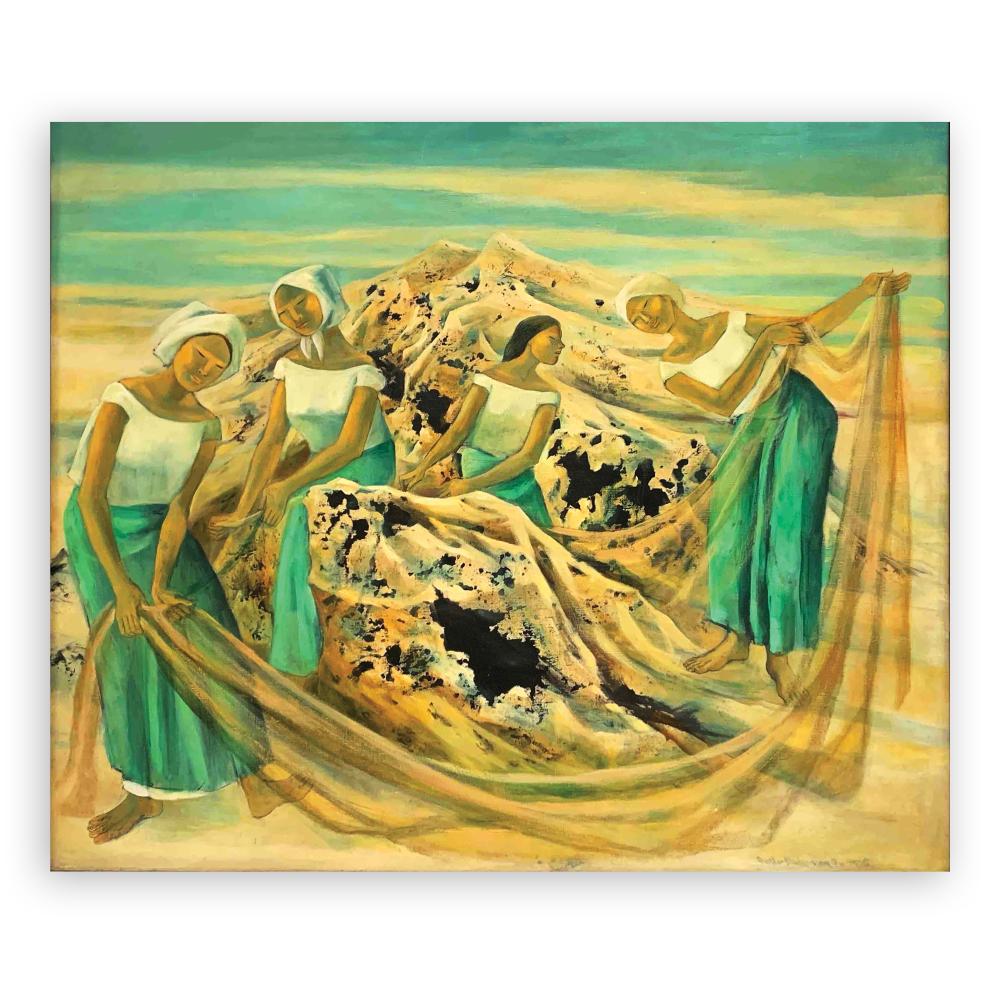
Anita Magsaysay-Ho (1914 - 2012) On the Beach signed and dated 1975 (lower right) mixed media on canvas 30” x 36” (75 cm x 90 cm) Provenance: Private collection, USA Literature: Guillermo, Alice, Purita Kalaw-Ledesma, and Anita Magsaysay-Ho. Anita Magsaysay-Ho: A Retrospective. Manila: A. Magsaysay, Inc., 1988. Published on the occassion of the exhibition Anita Magsaysay-Ho: A Retrospective at The Metropolitan Museum of Manila. Full-color illustration on page 111 and painting description on page 110. Magsaysay-Ho, Anita and Alfredo R. Roces. Anita Magsaysay-Ho: In Praise of Women. Pasig: The Crucible Workshop, 2005. Full-color illustration and painting description on page 263. Exhibited: The Metropolitan Museum of Manila, Anita Magsaysay-Ho: A Retrospective, Manila, 15 December 1988 - 15 January 1989 Anita’s Ocean of Memories: From Summers in Coastal Zambales to Her Lively Hong Kong Years by Adrian Maranan Anita Magsaysay-Ho painting is essentially born from the hallowed vessels of the artist’s memory, in which the Filipina emerges strong and triumphant in their dignified labor and proud joy in their day-to-day endeavors. She was once recorded to have said in an interview with BusinessWorld on the occasion of her 1988 retrospective at the Metropolitan Museum of Manila: “I’m familiar with Filipino women. I know how they feel, I can paint them from memory.” In the summers of her youth, Anita basked in the fresh country air of Zambales, the hometown of her father, Ambrosio Magsaysay. Every March, Anita would spend the hot summer days in the company of her “Nana,” her grandmother Ramona Corpus, recalling in her memoirs, “Each summer vacation in March brought on the exciting trip to Zambales. My Nana and I would take the two-day journey by sea from Manila to the port of Subic. My mother, with my sister and brother, accompanied by a retinue of servants, would follow later. They usually headed for San Marcelino, my father’s hometown. My grandmother, Nana, and I always stayed at her home in San Antonio. Her large house stood at the corner of the plaza.” Beyond San Antonio, Anita also spent her summer vacations along the shores of Subic Bay, where her family used to have a nipa house “with a big verandah,” as she described. “Subic Bay was once full of fish,” she recounted. “I remember when the ringing sound of the village bells was a signal that there was a school of fish near the shore. My brother, Mike, would rush to the shore to help pull the nets in. For his efforts, he would be rewarded with one bonito fish.” She added: “We used to have a nipa house by the sea with a big verandah where we would go on vacations. My male cousins would sleep in the verandah. Other relatives would often stop by, spend the night and go swimming the following morning. It was always like a picnic. We were so happy until the war came, and we had to stop going to Zambales.” “Although my father used to manage logging and sawmill businesses owned by my granduncle, Teodoro Yangco, he eventually bought a mango farm by the sea in Zambales. My life, and therefore, my paintings, are so enriched by these vacations.” The coastal town of San Antonio and the pristine, lively waters of Subic Bay would be the perfect spots from where Anita would cull her memories of fisherfolks—the women mending the nets while their sons, brothers, and husbands prepare to toil in the high seas, eager to catch a bounty of fresh sea produce. A Painter Away from Her Motherland Fast forward to the 1960s, Anita would find herself at the crossroads of painting and becoming a devoted housewife to her own family. The entirety of the 1950s marked her successive years of triumph in painting in her homeland, even being crowned by the highly popular This Week Magazine in September 1958 as one of the country’s “6 Most Outstanding Filipino Painters” (She was the foremost Filipina painter of her time, a consistent prize awardee at the AAP’s annual and semi-annual competitions, and her once in a blue moon exhibitions were always the toast of Manila’s art circle.). But in the early 60s, Anita made that very difficult decision of leaving her motherland. She had been devoid of her Filipino citizenship due to a Philippine law that dictates that a wife automatically assumes the citizenship of her husband. Robert, a Chinese citizen, could not return to Shanghai where he would build their own house as a couple, as China had recently been overtaken by the Communists under Mao Zedong. “I felt I had lost everything,” Anita said. “I was now [without a country]; I who loved my country so much.” At the urging of Robert’s father, who had been a Brazilian citizen for nine years, Robert, together with Anita and their children Helen, Linda, Doris, Robert Alexander, and Steven, migrated to the South American nation. “It was a difficult decision,” Anita said in her memoirs. “I did not want to leave my parents…It was, I believed, important for the family to have a country again.” Anita did not have the time to paint in Brazil as she had allotted her time to homemaking and knowing the ins and outs of the country to become a proper citizen. The following years would be marked by constant travels and migration to other countries, where Robert could see the prospects of having to smoothly run his shipping business: Tokyo in Japan, Vancouver and Montreal in Canada, and Hong Kong. Anita’s Ink Blot Paintings In 1967, Anita and her family moved to Montreal from Vancouver. Around this time, all her children had now gone to boarding schools, except for Linda, who stayed with her in their home. After more than a decade of being a devoted homemaker, Anita now had that chance to fully return to her first love of painting. "With more time on my hands, I did two woodcuts for my Christmas cards and began to paint again," Anita wrote. But Anita felt stagnant. Returning to her senses, she recalled that experience when they were still residing in Tokyo, where she learned the art of ink blots from an old Jewish lady. Learning from this recollection, Anita threw ink on her canvas, then water, then oil, where they would "rush and run into each other." "You will be surprised to see how beautiful the image of 'rocks' emerges," Anita said. "That's how the Chinese do those rocks. After it is done, you will be surprised to see the 'rocks' by the sea or the logs in a forest. Of course, you improve on the rock," she said. Anita's ink blot paintings can be viewed as another successful and earnest era of experimentation after her pioneering use of egg tempera during her modernist heydays of the 1950s. Anita would say that these ink blot paintings encapsulate her painting style that is most "difficult, if not, impossible to duplicate," as "the shapes formed by the ink blots cannot be repeated as they are." Anita’s On the Beach, Reclaiming One’s Identity and Memories The work on offer in this auction, On the Beach, from that series of experimentation, was painted by Anita when the Ho family moved to Hong Kong, dictated by Robert's Magsaysay Lines' relocation of its main office from Tokyo to Hong Kong, where it would now be known as Fairmont Shipping. In Hong Kong, they established their twentieth family residence at the old Estoril court before moving to a larger apartment in Grenville house on Magazine Gap Road. On the Beach depicts four women mending and preparing the nets to be used by the men, most probably their husbands, in their fishing ventures. The ink blots cast by Anita resulted in seemingly hollow voids that exude mystery. The women's nets become diaphanous extensions of the rocks made by the ink blots, the background suggesting a mountainous landscape that evokes the terrain of Anita's Zambales youth. The scene captures Anita's recollections of spending summer vacations in her family's nipa house by the beach. But, the overall composition exudes a mystical version of an otherwise real-life-inspired setting. Artist-critic Alfredo Roces wrote in his book on Anita: "Magsaysay-Ho created these images at a time when she herself was caught in the dilemma of changing worlds, between a past home in the Philippines of her happy childhood and the promise of her family's new homeland in Canada. A disparity, the uncomfortable juggling of two worlds, is the migrant's lot. It is this edgy, uncertain, precarious condition that the artist has recorded on canvas. The anxiety and the certainty of an uprooted person shape the artist's vision, and her works from that time revealed this." Rather than entirely creating images culled from her memory, as she had always done, she let her medium speak for itself. Was it suggesting an answer that Anita probably wanted during this time, seeking to uncover why in the world she must be uprooted from the environment from which she had fond memories that inspired her to pursue her creative passion? Or was it Anita submitting to an otherworldly Being all her feelings of alienation and anxiety as a way of purging all these negative vibrations, and in the process, letting her blissful memories of days past speak clearly to her at the forefront as a way of preserving her intimate bond with her motherland, which she dearly loved and treasured? The ink blot paintings produced by Anita during her Canadian and Hong Kong periods differed in how the latter exudes more luminosity, whereas the former possesses a relatively somber palette. Roces observed that the Hong Kong period was where Anita's memories of her youth "triumph[ed] over the reality of her happy sojourn in Canada, the land where Anita's children grew up in, and where, no doubt, their own coming-of-age memories of "home" would have to reside." “[It was in Hong Kong] where I lived for 17 years,” said Anita. “I consider this time my most productive years.” In her memoirs, she speaks highly of her Hong Kong years, writing that she “played a lot of bridge” there. “The interesting shopping for me was going to Stanley market—a shopping area by the sea, where one finds clothes not found in Hong Kong stores—and exploring Hollywood Road for antiques. I guess this is what newcomers in Hong Kong do.” Anita further wrote, “I also painted as much as I could.” The relative clarity Anita achieved in her paintings in Hong Kong, where she felt the most productive and prolific, may have been because her dear Philippines was now a mere 2-hour flight away, easing her homesickness. Anita also had more time for leisure and painting, as her children now had their own lives and families to build. The mid-1970s, when Anita created On the Beach, also marked the beginning of her "Green Period," which critic Alice Guillermo described in the catalog notes for Anita's retrospective as named after "its predominant coloration." "The green that predominates is the hue of leaves, fruit, and vegetables, and the women figures share this color quality perhaps symbolically as they become like fruit in harmony with nature." In a way, Anita had claimed a resolution to her own misery by finding the meaning of home in her own family and nourishing them with warmth through her experiences of tenderness. As Roces noted, "If the present and the future were uncertain, there was warm refuge in happy memories of the past." That Anita chose to delve into ink blot painting is a testament not only to her modernist spirit of bold experimentation; it is a demonstration of Anita going into her subconscious, demonstrating a capability of profound introspection. On the Beach at Anita’s First Retrospective O n the Beach was showcased in Anita’s retrospective exhibition held at the Metropolitan Museum of Manila from December 1988 to January 1989. Dubbed “The Retrospective of the Decade,” it was Anita’s first show in 10 years and marked her first-ever retrospective, celebrating her 40 years as a living legend of Philippine art. "With more time on my hands, I did two woodcuts for my Christmas cards and began to paint again," Anita wrote. As always, the retrospective’s opening night became the talk of the town, with more than 500 guests trooping to The Met to see Anita’s works and even catch a glimpse of the legendary artist, causing traffic jams and led to others abandoning their cars and rushing towards the museum. The retrospective was a microcosm of who’s who in town: Sen. Leticia Shahani, Pitoy Moreno, Purita Kalaw-Ledesma, Dr. Teyet Pascual, Judy Araneta-Roxas, Bambi Harper, Gemma Cruz-Araneta, among others. Society insider Maurice Arcache even reported that many failed to properly see and scrutinize Anita’s works due to the jampacked cocktails. In the brochures and invitations, Anita wrote a personal dedication to the Filipina whom she continuously championed in her art. "I dedicate this exhibition to the women of the Philippines—the source of my inspiration—their movements and gestures, their expressions of happiness and frustrations, their diligence and shortcomings, their joy of living. I know well, for after all, I am one of them." This brings us full circle to Anita’s past, where she had always been joyous and at peace in the comfort of her fellow Filipina.