Lot description
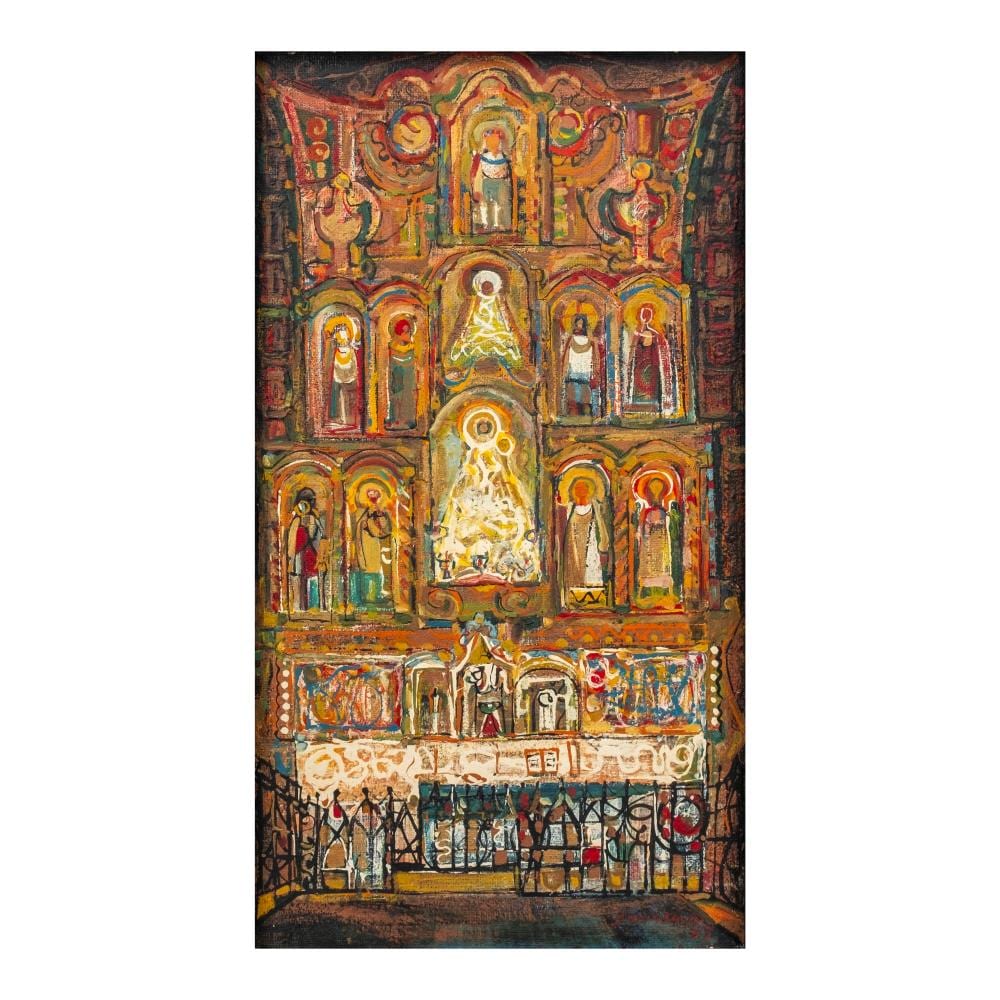
Vicente Manansala (1910 - 1981) Dambana signed and dated 1957 (lower right) oil on masonite 25" x 13 3/4" (64 cm x 35 cm) Provenance: Private Collection, USA Manansala’s Neo-Realist Sanctum An Heir to the Beloved Dambana of 1956 by Adrian Maranan Vicente Manansala: An Unstoppable Force of the 1950s A Dashing and Dramatic Experimenter Rising from the ruins of war, Manansala perseveringly worked his way up—from staff artist of the Evening News; all the while living in the slums of Reina Regente in Binondo, where he first conceived his barong-barong paintings, which he pioneered in Filipino art; to his meteoric rise as a foremost exponent of modernism, accompanied by his fellow Neo-Realists who would all strike the last blow to the weakening ascendancy of conservatism in the face of national trauma caused by the war. Philippine Art Gallery matriarch Lyd Arguilla once recounted that Manansala's participation in the groundbreaking “First Neo-Realist Exhibition” in 1950 "created lively talk in art circles…chiefly because [he] had suddenly broken away from "literal" to abstract.” Not only would Manansala be a most eminent painter, he was a muralist, a sculptor, a highly skilled watercolorist, an art educator at the University of Santo Tomas, and had a knack for ceramics. He worked in various media—oil, melted crayon, charcoal, woodcut, and enamel, among others. He had been the recipient of art studies abroad: in Banff, Canada in 1949 and Paris in 1950, with both cities contributing to his burgeoning interest in Cubism. In this decade, Manansala would often jump from one style to another: Cubism, Abstract Expressionist-like configurations, Art Informel. Painting what he felt rather than what he saw led him to “different styles,” wrote the influential and highly popular This Week Magazine in September 1958. “His style, which he would rather call mannerism, is influenced by his feeling, and a change in style is due either to change in mood or to the discovery of a new form.” No less than the widely circulated The Sunday Times Magazine wrote in its 10 November 1957 issue: "Vicente Manansala is a dashing and dramatic experimenter. He has been the recipient of several scholarships to foreign art capitals. He teaches at the University of Sto. Tomas School of Fine Arts. Manansala is one of the leaders of the "neo-realist" school of Manila art… which has been responsible for a great deal of the current activity in the city." Dolores L. Benavides summarized Manansala's achievements in her article "Modern Art Today" for The Manila Times' “Progress 1956” magazine. "While Vicente Manansala did not have his own show this year, he has not been idle. He was commissioned to do the mural "Freedom of the Press" for the National Press Club building, which opened December 30 last year. He won first prize in the United Nations art competition for the painting "Women Praying in Church," which now hangs in the UN Building in New York City. . "He has done a lot of oils and watercolors, which were exhibited in the omnibus shows sponsored by AAP, UNESCO, PAG, and others… With exuberance and vitality, he shows us facets of the Philippine scene: churches, city streets, family groups, market vendors, men with their fighting cocks. A fellow painter has noted that he has made remarkable progress this year and "is an artist to watch."" Towards the end of the decade, Manansala was crowned “Most Outstanding Filipino Painter” by This Week, lauding him by writing, “[he] is the most prolific painter in the Philippines today, has won more major awards than any of his contemporaries. Besides winning in almost all AAP art competitions, he won the top awards in the Spanish biennial exhibition, the United Nations art contest, and the Southeast Asian art competition.” Amid his glittering success, there was one masterpiece that stood out among the rest. A Tale of Three Altars In 1954, Manansala painted Altar Credo, an oil and enamel work that he presented in a solo exhibition held in December of that year at his beloved home, the Philippine Art Gallery, which had just moved to its new address at Mabini corner Arquiza Streets in Ermita, Manila. The work depicts an ornate retablo mayor of an old Spanish colonial church. An earlier iteration of the piece—a study—was featured as the cover of This Week's 11 July 1954 issue. Arguilla described this painting as Manansala's consummate showcase of his color sensitivity, which she explained was "second to none." Altar Credo would be acquired by an American named L.E. Phillips. In 1956, Manansala submitted another altar painting, this time titled Dambana, as part of the 5th Anniversary Exhibition of the PAG. The work was a showstopper, even spotlighted in This Week's pages. Dambana would then be acquired by Fernando Zóbel. Zóbel may have seen affinity with the piece, as he had created a thematically similar one, Carroza, which had previously won the First Prize in the 1953 AAP Semi-Annual. During this time, Zobel had long manifested his interest in Philippine religious iconography, culminating in his monumental 1963 monograph titled Philippine Religious Imagery, tackling the history of Philippine sacred images during the Spanish era in relation to his search for a genuine Filipino expression in art. Dambana's story did not end with its acquisition by Zóbel. The following year, in 1957, it would again grace the PAG halls in its 6th Anniversary Exhibition. Incidentally, the anniversary celebration was marred by swelling uneasiness due to problems with the monthly rent. The Manila Bulletin writes of this incident. "But a problem was bothering the members. Rent for the locale of the Gallery on Arquiza Street, near artists' row on Ermita, was soon due, and there was no knowing how it was to be paid." The re-entry of Manansala's powerful work aimed to reinforce hopes for a successful sale, attracting visitors and buyers, old and new. Bulletin notes its significance to the exhibition. "…not to mention Manansala's "Altar" being reshown, [it] gave promise of making the exhibit a memorable one for the Gallery." The 1956 Dambana would also be showcased in the widely publicized and acclaimed "Tour of Philippine Contemporary Art," a 1958 roving art exhibit of Filipino paintings sponsored by the AAP that visited major Asian cities: Tokyo, Hong Kong, and towards the western part of the continent. The tour, which lasted a year and a half, assembled a tour de force of the country's flowering modernism and showcased the Philippines as a rising Asian cultural power. Works by Botong, HR Ocampo, Legaspi, Anita, Zobel, Luz, and Abueva were also at the traveling art show. Talks for this exhibition had already been discussed in early 1957 during the Southeast Asian Art Conference and Competition (also sponsored by the AAP) held in the country, where, interestingly, Manansala won second place and a cash prize of $750 for his solemn work Give Us This Day. At the conference, Manansala and the other participating artists were requested to submit a work that best represents them. Manansala chose Dambana, "borrowing" it from its owner, his dear friend, Zobel. He also submitted another entry titled Tahim Buhay No. 7. Thomas Ichinoise of The Mainichi Times, one of Japan's "Big Four Newspapers," praised the exhibition, observing that Filipino art is something that radiates "a special atmosphere in a sense of form, of nuances, of textures, of color, of rhythm, creating their distinct presence." Charles S. Terry of another Japanese "Big Four Newspaper," Asahi Evening News, also commended the Filipino painters, noting that "they have gone beyond the stage of imitation to that of experimentation." The authoritative and highly popular The Manila Times particularly commented on Manansala's Dambana, praising that it "transforms a large table into semi-abstract relationships. The glow of colors…is rich and deep…." After all its exposure, even republished many times in magazines, the 1956 Dambana was gifted by Zóbel, along with his extensive collection of Filipino modern art to the Ateneo de Manila University in 1960, forming the core collection of what is now the Ateneo Art Gallery. The 1957 Dambana, Heir to the Iconic 1956 Altar The praises received by Dambana led Manansala in 1957 to paint another iteration, which is now offered in this year's opening salvo. It is a smaller yet more intricately beautiful painting depicting the same subject in the same style. Manansala's color palette exudes a lush mixture of the gravitas of meditation and a scintillating sensuality for the visuals. It is almost as if Manansala's pulsating colors impart a sense of physicality to an otherwise flat painting. The figures of the santos are rendered in what Rod. Paras-Perez noted in his book on Manansala as “the reduction of the image into calligraphic gestures became more pronounced, particularly in the delineation of each icon. The subject or motif, an altar, also lent itself to the concern for the informel…preoccupying Manansala at the time.” It was in France where Manansala encountered art informel, which was at its peak in the early 50s when he pursued his scholarship at the Ecole des Beaux-Arts of the University of Paris. Manansala's employment of the informel technique distills the subject to its essence, with his vigorous colors displaying a rich sensibility that captures the Baroque grandiosity of the country's colonial churches. Manansala's adaptation of the informel concept, or paintings born of/inspired by improvisation, befit his mantra of painting what he feels. The Dambana as a Symbol of Manansala’s Piety I saw God In a raindrop that fell Like a gem, a pearl, a tear And then I know where God has come I must go there, to see and feel And know my God Who came to me - Manansala Amid his blockbuster popularity, Manansala remained grounded in his pious roots. Faith had always been ingrained in Manansala’s creative psyche, even trying his hand at poetry detailing his sublime “encounter” with God and would be published by This Week in September 1958. Both the 1954 and 1956 Dambana and the Dambana on offer in this auction bear a striking resemblance to the retablo mayor of the old San Francisco Church in Intramuros, where Manansala attended mass every day when he was younger. “I used to go to mass every day at the San Francisco Church. At 14, I wanted to become a priest,” he said to Rod. Paras-Perez in his monograph. The creation of another Dambana is not only owed to the adulation the one from 1956 had received; it was a perfect avenue for Manansala to manifest his Neo-Realist identity, or in his own words, “My painting is a sort of emotional release…I paint not what I see but what I feel.” Manansala’s Dambana paintings may have brought him back to his youth when he used to wander and play atop the walls of Intramuros and bonded with his childhood friends, Jose Alcantara and Antonio Dumlao. It was a time of hopeful vigor, armed only with his dreams of becoming a painter someday. “As a boy, Manansala became a bootblack, a newsboy, a caddy, and a distributor of programs at movie houses,” recounted This Week. “At the age of seven, he was already drawing cockroaches, dragon flies, and June bugs. All through the elementary grades, he and Dumlao, who also had a facile pen, walked barefooted to the UP Bellas Artes on R. Hidalgo for free art lessons.” Dambana can also be seen as some emotional purging, a sense of nostalgia mixed with a feeling of melancholy and mourning for what had been lost—morally and culturally—in the harrowing destruction of the war. By utilizing a frontal, flat perspective and employing somber colors that evoke heartfelt solemnity, Manansala lets the viewer come face to face with the church as a sanctuary for the hopeless and the oppressed, where everyone, regardless of social stature, can liberally voice out all their woes and tragedies in the face of the ruins of a once glorious landscape. After all, Manansala used to be one of those poor, unfortunate souls, even sketching for American G.I.'s after the war in exchange for a paltry sum, just enough to buy rice. For Manansala, piety is purely manifested in an art that intertwines with the hopes and despairs of the ordinary people—in the barong-barongs, the mother and child imbued in impoverished conditions, the beggars, the candle vendors, the wailing devotees desperately in prayer, and the jampacked processions that have always been a people’s manifestation of faith and solemn yet inherently lively optimism. Manansala, who possesses an art that touches all facets of the common Filipino’s everyday living, wholeheartedly elevated all these themes and subjects in his art, bringing them into our collective psyche as images of our undying determination in the face of struggles.