Have one like this? Check yours freeOr have an appraiser value it
Lot description
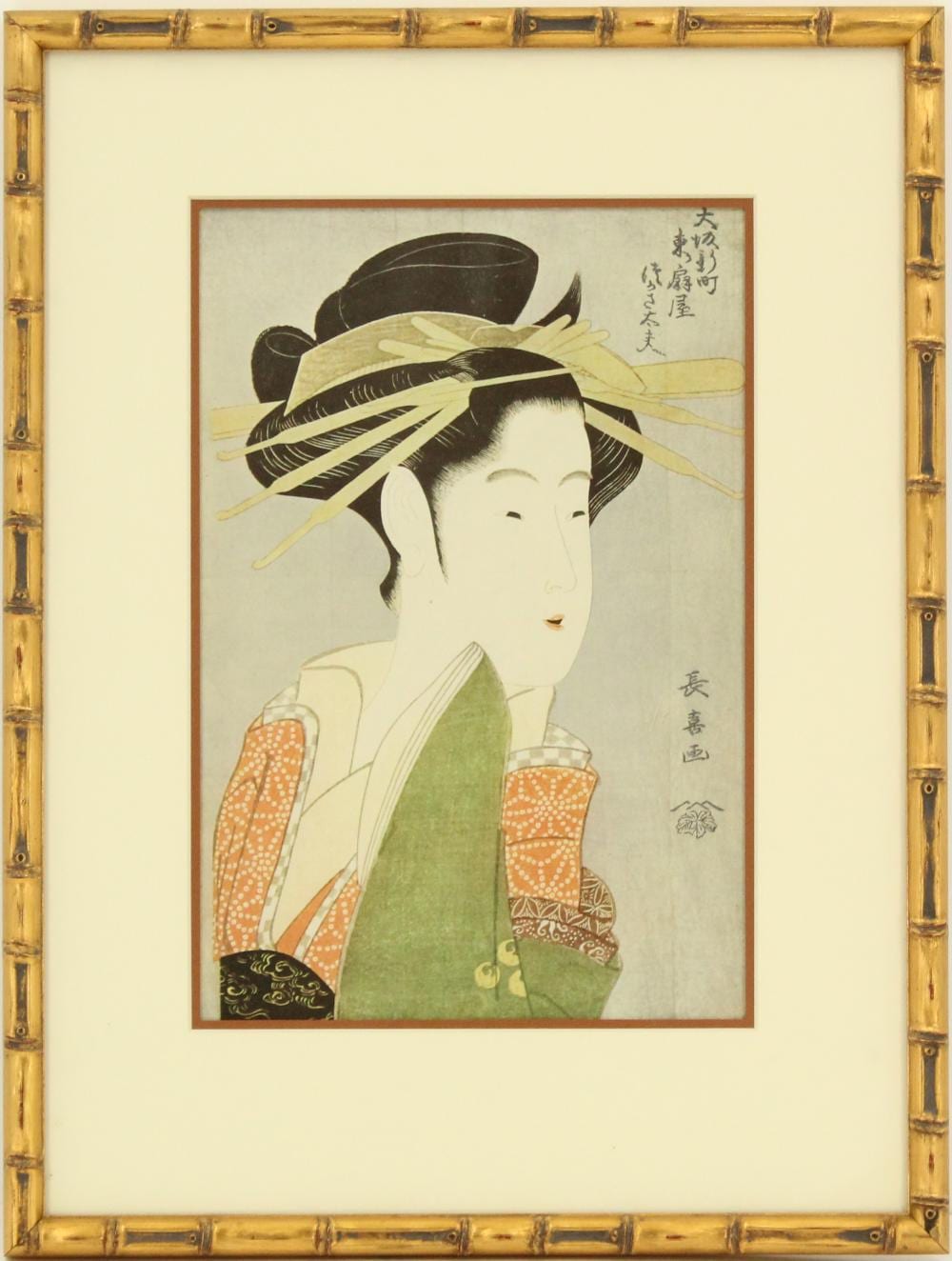
Eishosai Choki (fl. 1760-1820) Japanese, Bijinga Woodblock Print. In bamboo-lined frame with framing label on back. Kanji on top and middle right side. Informative label on the back indicates the artist, the title (The Courtesan Tsukasa-dayu), and the date it was made (mid-1790s), as well as an explanation of its place in the James A. Michener Collection of Japanese Prints in the Honolulu Academy of Arts, Hawaii. Overall Size: 16 x 12 in. Sight Size: 10 1/2 x 7 in. #4678 . EishÅsai ChÅki, also known as Shiko and Momokawa ChÅki, was a Japanese ukiyo-e artist active from the 1760s into the mid 1820s. Little is known about his personal life, including his birthdate, birthplace, and the date of his death, but he was a star pupil (and possibly adopted son) of Toriyama Sekien and his early works show the influence of Nishikawa Harunobu and Torii Kiyonaga, and later that of Kitagawa Utamaro (another pupil of Sekien) and ChÅbunsai Eishi. His bijinga (beautiful women) prints are often unique for showing women languidly or forlornly engaged in activities such as smoking and applying makeup, rather than the usual idolized poses and actions they were commonly portrayed doing by his contemporaries. His early works also display his immense fascination with shunga (erotica), sometimes depicting the same character or characters in a vast variety of settings but in the exact same sexual position, a portraiture study akin to some landscape series popularized by artists like Hiroshige and Toyokuni III. For almost a decade ChÅki lived in the Nihonbashi home of Tsutaya JÅ«zaburÅ, who published several of ChÅki’s print series. Tsutaya was a patron and mentor to many writers and artists, including Utamaro, TÅshÅ«sai Sharaku, and Takizawa Bakin, and ChÅki cared for him during the final stages of his early death at the age of 48 in 1797. Amongst ChÅki’s more popular series were the Eight Views of Lake Åmi and the Eight Views of the Treasury of Loyal Retainers. He also produced hashira-e pillar prints, kachÅ-e prints of birds and flowers, and book illustrations. His last known major work is the illustrations for the book Nakoso Gate by Kanwatei Onitake in 1809, although pieces with his signatures sporadically appeared over the next thirteen years, but the death of his main supporter likely contributed to his descent into obscurity.