Have one like this? Check yours freeOr have an appraiser value it
Lot description
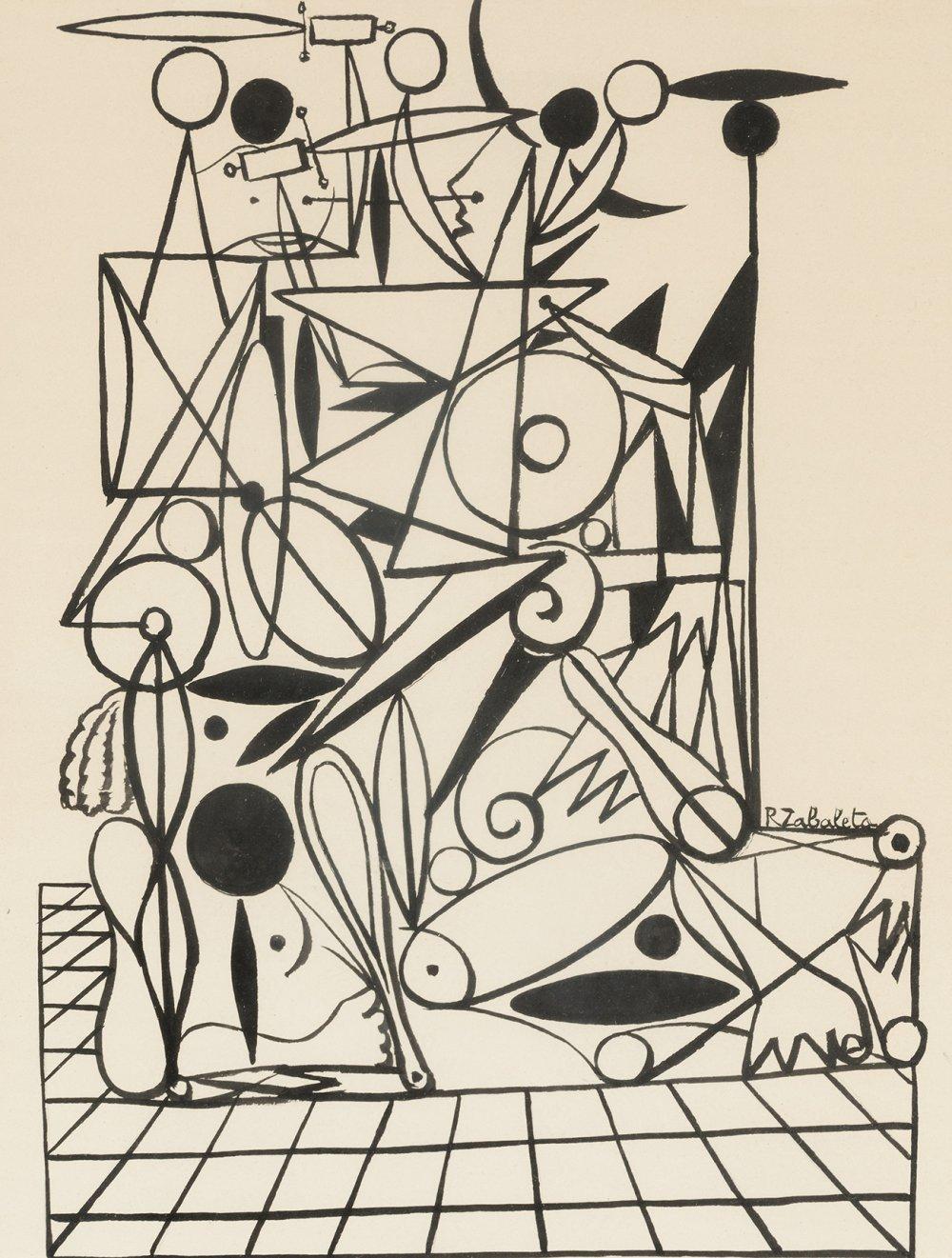
RAFAEL ZABALETA FUENTES (Quesada, Jaén, 1907-1960). Untitled. Ink on paper. Signed in the middle right area. Measurements: 28,5 x 21,5 cm; 49 x 42 cm (frame). This ink drawing on paper is a piece of great interest within Rafael Zabaleta's work on paper, a less frequent facet in his career but of enormous expressive and conceptual value. In it, the artist develops a language based on geometric abstraction and figurative stylization, configuring a dynamic universe where line and structural rhythm acquire absolute protagonism. The whole is composed of interconnected forms that evoke anthropomorphic figures and mechanical elements, in a sort of dance that recalls both cubist imagery and constructive abstraction. The firm lines and hallmarks between the deep black and white of the paper give the work a vibrant energy, reflecting Zabaleta's mastery in the synthesis of forms. From a compositional point of view, the piece plays with an unstable balance, where the figures seem to intertwine in an almost architectural structure. This dynamism refers to the influence of the European avant-garde, particularly the Picasso language and the plastic experimentation of artists such as Joan Miró. However, the direct line and the forcefulness of the design maintain the essence of Zabaleta's style, characterized by its expressiveness and evocative character. Rafael Zabaleta, born in Quesada (Jaén) in a wealthy family, is one of the great references of Spanish painting of the twentieth century. Trained at the Escuela Superior de Bellas Artes de San Fernando, he had as teachers figures such as Cecilio Pla and Ignacio Pinazo. In 1932 he participated in his first group exhibition, and three years later he traveled to Paris, where he studied the great contemporary masters. After the Civil War, during which he made a remarkable series of drawings, Zabaleta overcame difficult times to definitively establish himself in the 1950s. In 1951 he held a solo exhibition at the Museum of Modern Art in Madrid and, in 1955, he received the UNESCO Prize at the Hispano-American Biennial in Barcelona. During his career, he participated in important salons and exhibitions both in Spain and abroad, highlighting his connection with Paris and his friendship with artists such as Picasso. Zabaleta developed a unique pictorial language, in which he combined avant-garde influences with a deep connection to his native Quesada, which he captured in landscapes and rural scenes full of expressive force. His work, recognized for its vibrant color and formal synthesis, is represented in important institutions such as the Reina Sofía Museum (Madrid), the Zabaleta-Miguel Hernández Museum (Quesada, dedicated to his legacy), and in prestigious international collections, such as those of the Museum of Modern Art in Paris and the National Museum of Modern Art in Mexico, among others.