Have one like this? Check yours freeOr have an appraiser value it
Lot description
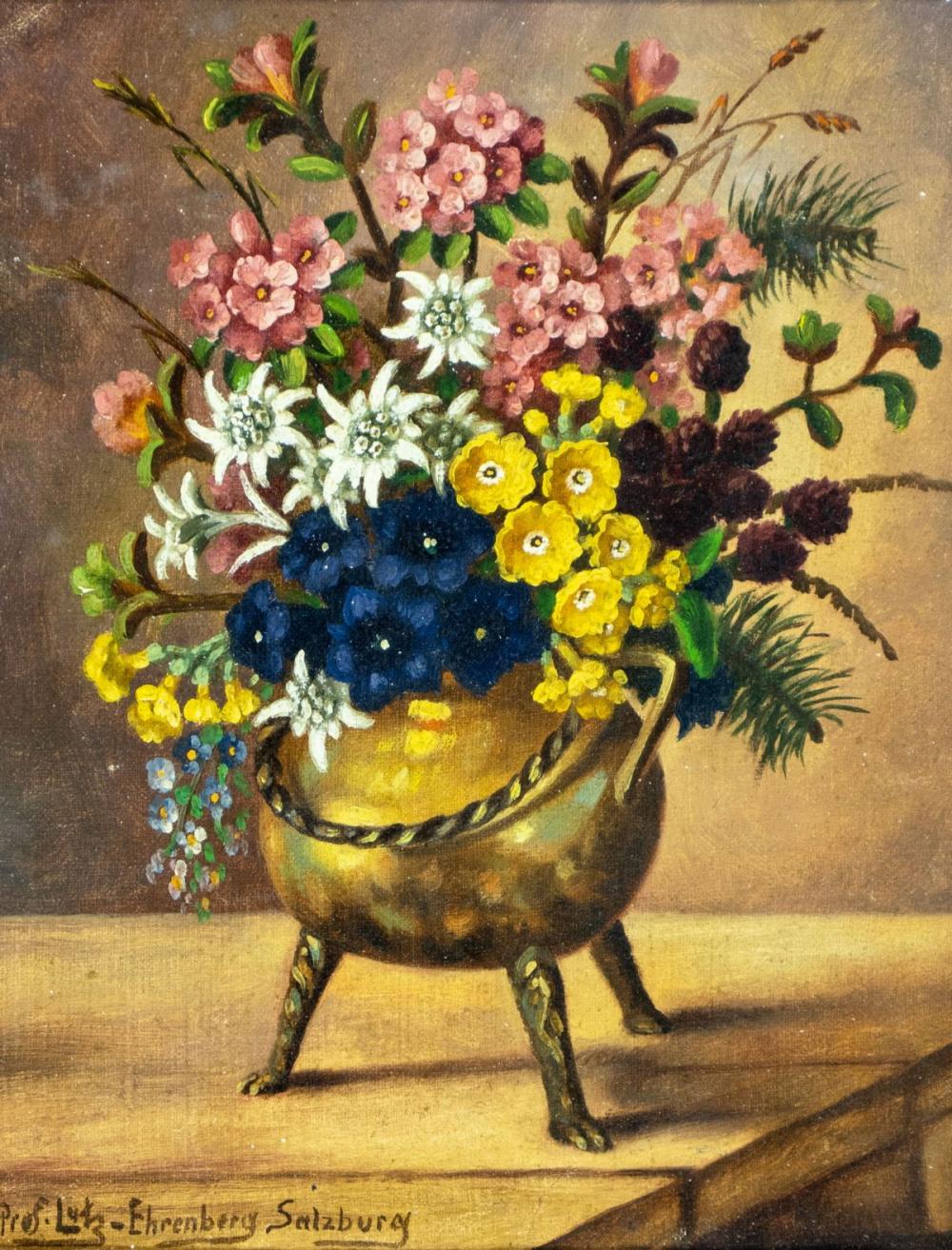
ARTIST: Ludwig Lutz Ehrenberger (Germany, 1878 - 1950) TITLE: Still Life with Flower Pot MEDIUM: oil on canvas CONDITION: Very good. No visible inpaint under UV light. Framed under the glass. ART SIZE: 13 x 10 inches / 33 x 25 cm FRAME SIZE: 19 x 14 inches / 48 x 35 cm SIGNATURE: lower left ATTENTION: This lot is located at our Mamaroneck, NY office. CATEGORY: old antique vintage painting for auction sale online AD: ART WANTED: Consign, Trade In, Cash Offer SKU#: 133857 US SHIPPING: $60 + insurance. BIOGRAPHY: Ludwig Lutz Ehrenberger was an Austrian-born artist, one of the leading artists of cabaret culture in Germany between two wars.Ehrenberger was born in Graz, March 14, 1878, the era of enthusiasm was blossoming. His father is a landowner; his grandmother, Baroness Bekonyi, attends Vienna and encourages her grandson's enrollment at the Priesten-Kloster High School, where the young man completes his humanistic studies, and then at the capital's Academy of Fine Arts. Lutz, then, studied at the Academy of Fine Arts in Vienna, under Siegmund LAllemand (1840-1910), a fine academic painter of realist impressions who had made a career as a war artist, and who was an advocate of the virtuosic tradition of the brush. The spirit of the new cannot have failed to reach him, not least because soon afterwards Ehrenberger would complete his studies at the Munich Academy of Fine Arts, another vibrant center of Secessionist experimentation. In 1904, at the age of twenty-six, he took a studio in Saalfelden am Steinernen Meer, a charming town in Salzburg, where in 1906 he would have an elegant Art Nouveau villa built, which he affectionately called the Little House of the Good Morning, and which he would always consider his corner of peace. But intellectual solicitations were to be found elsewhere, so in 1908 he took up a second residence in Berlin, where he opened a studio on Guntzelstrasse in the heart of the city. Here he was able to frequent the circles of the Academy of Fine Arts and, it seems, the Weimar School of Applied Arts, where he probably came into contact with Walter Gropius.The Great War, devastating for many young people of his generation, apparently for him merely a theme that sinsinuates among the subjects of his drawings for illustrated magazines, does not seem to have left too deep a mark on his life. During the most dramatic years his artistic activity apparently continued uninterrupted, as evidenced by his participation in 1918 in a major exhibition of German art in Baden Baden along with a large number of talented artists.