Have one like this?
Upload a photo for a free check of what yours may be worth.
Lot description
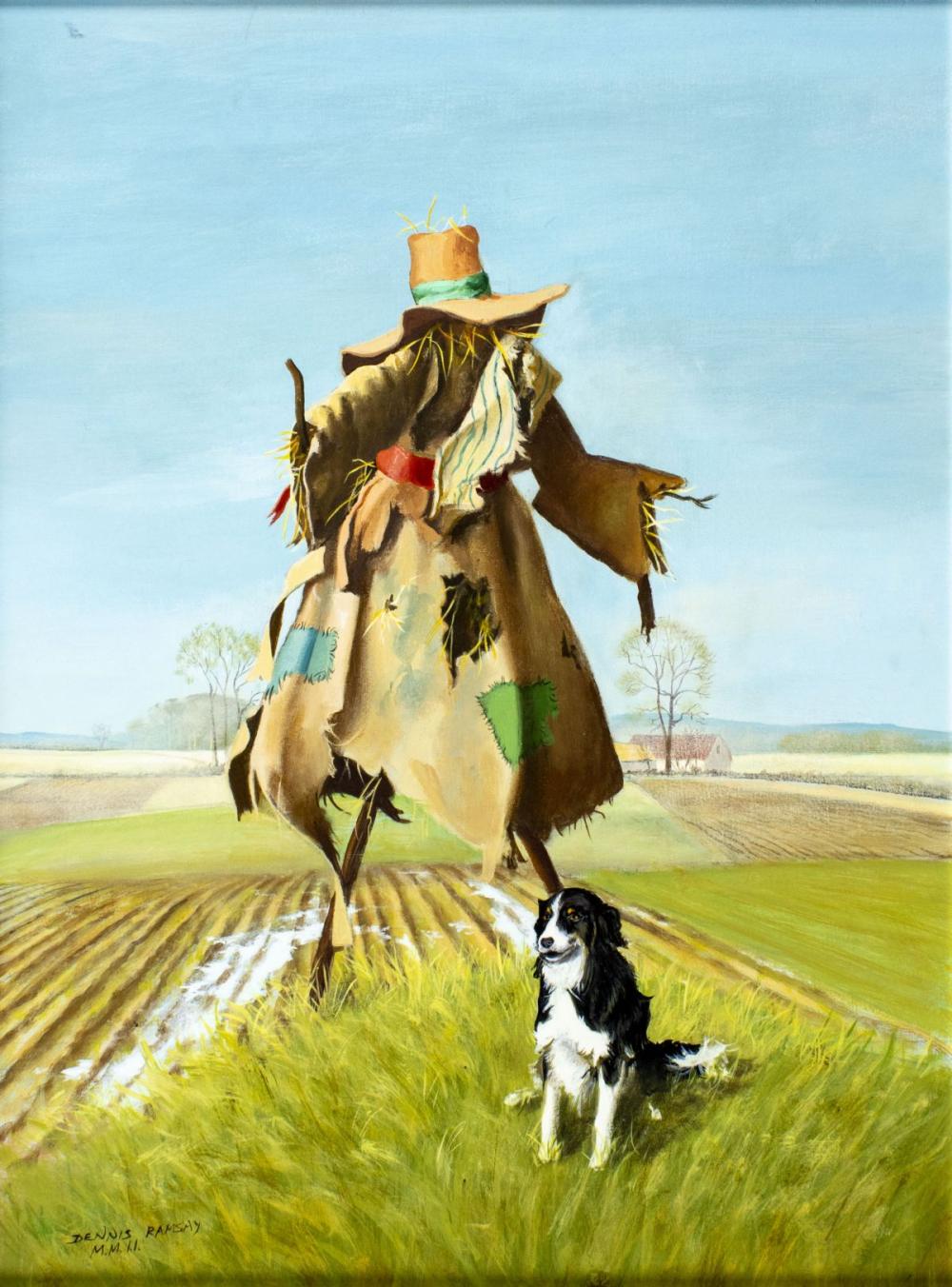
ARTIST: Francis Dennis Ramsay (United Kingdom, Australian, 1925 - 2009) TITLE: Countryside Landscape with Dog and Scarecrow MEDIUM: oil on board CONDITION: Overall good. No visible inpaint under UV light. ART SIZE: 24 x 18 inches / 60 x 45 cm FRAME SIZE: 27 x 21 inches / 68 x 53 cm SIGNATURE: lower left CATEGORY: old antique vintage painting for auction sale online AD: ART WANTED: Consign, Trade In, Cash Offer SKU#: 134838 US SHIPPING: $95 + insurance. BIOGRAPHY: Francis Dennis Ramsay (15 March 1925 - 8 February 2009), known as Dennis Ramsay, was a Scottish portrait painter, trained in London and Paris, who worked mainly in Australia in the classical tradition.A painter in the classical tradition, Ramsay was born in London of Scottish descent. He was related to the Scottish artists Allan Ramsay (1713-1784) and James Ramsay (1759-1854). Towards the end of World War II, he served in the RAF, and in 1952 he made a model of the State Coach which was, exceptionally, accepted by HM Queen Elizabeth II. This model coach was built as part of an exhibition undertaken in collaboration with Clothilde Highton GMC (Guild of Memorial Craftsmen), an Australian painter and sculptor living in Arundel, Sussex.His formal training included reading Architecture at University College London and three years' study in Florence (1953-1955) as a pupil of Pietro Annigoni (1910-1988), the internationally renowned grande maestro portrait painter of the 20th century (Annigoni subsequently became a godfather to Ramsay's younger son, Justin).Ramsay's training included drawing, both in pencil and in china ink, as well as water colour. However, much of his time as a pupil of Annigoni involved oil tempera (or tempera grassa, i.e. egg-oil) - originally a 16th-century technique which entails meticulous time-consuming work and which was revived in Italy during the 1930s by Dr Nikolai Lokoff (1872-1948), an exiled Russian industrial chemist and amateur painter. With the egg acting as an emulsifier, the technique allows water to be mixed with the paint thereby enabling the production of ultra-fine subtle glazes.