Have one like this?
Upload a photo for a free check of what yours may be worth.
Lot description
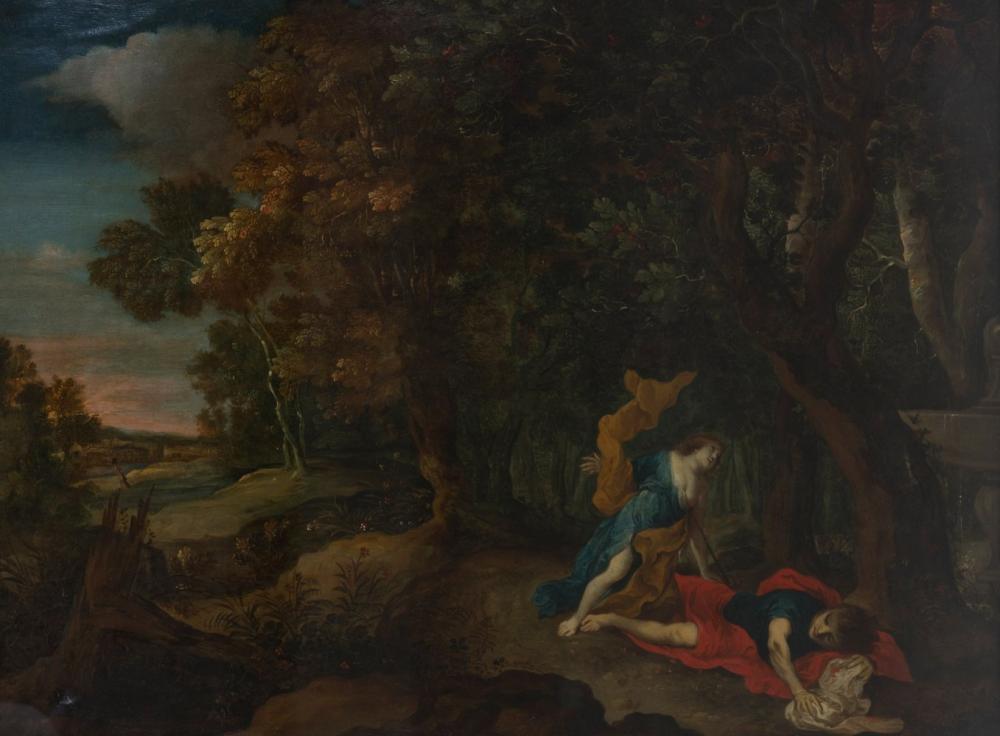
FRANS WOUTERS (Lier, 1612- Antwerp, 1659). "Pyramus and Thisbe". Oil on copper. Presents faults. It has frame of the twentieth century. Measurements: 55 x 72 cm; 79.5 x 96 cm (frame). Pyramus and Thisbe is a mythological tale of two lovers who, unable to be together, were a great inspiration for Shakespeare's Romeo and Juliet. It is about a legendary pair of Babylonian lovers, whose story is part of Ovid's Metamorphoses. The parents of Pyramus and Thisbe, driven by rivalry, forbade their union, but they communicated through a crack in the wall between their houses. They planned to meet under a mulberry tree, but a series of tragic misunderstandings led to their deaths: Thisbe fled from a lioness, leaving behind her cloak, which Pyramus found and mistook for proof of her death. Believing that Thisbe had been killed by the lioness, Pyramus committed suicide, staining the mulberry trees with her blood. Thisbe, finding Pyramus dead, also committed suicide. The gods changed the color of the mulberry trees to honor their forbidden love. Frans Wouters who was a Flemish Baroque painter who translated the monumental Baroque style of Peter Paul Rubens into the small context of cabinet paintings. He initially began as an apprentice to Pieter van Avont in Antwerp, but broke his contract to move to Rubens' workshop in 1634.He became a master in the Guild of St. Luke the following year. He spent the 1630s as court painter to the Holy Roman Emperor Ferdinand II. He was sent as Ferdinand II's ambassador to England in 1637. The following year, he became the painter to the Prince of Wales, the future Charles II of England. In England, Wouters would surely have had the opportunity to meet his compatriot Anthony van Dyck, who was at that time the court painter to Charles I of England. His style initially resembled the late mannerism of Joos de Momper and was later influenced by Rubens and, in particular, by Rubens' landscape paintings. After entering the service of Archduke Leopold William, Wouters' work showed the growing influence of Anthony van Dyck and the human figures in his paintings became elongated and emotionally expressive. He painted biblical scenes and mythological landscapes in this style.