Lot description
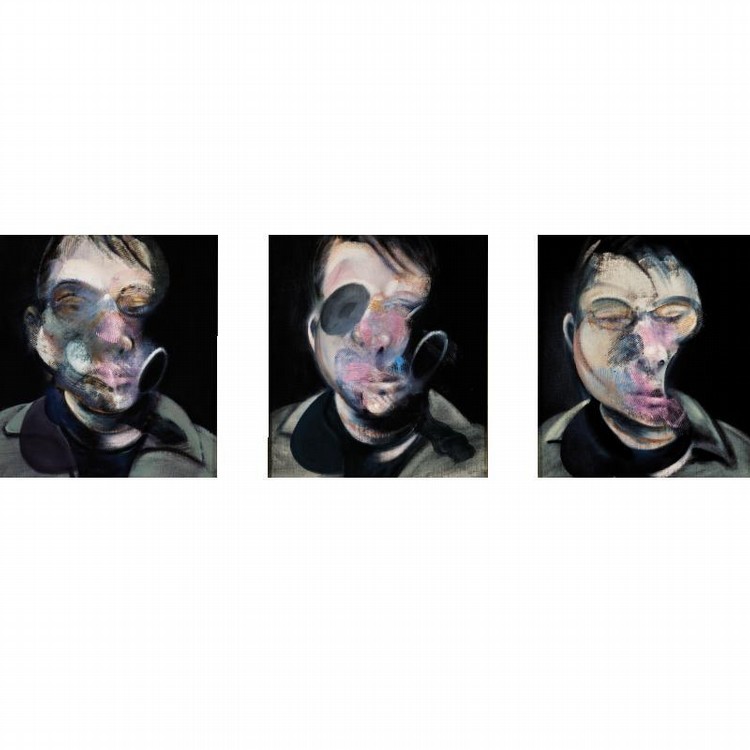
1909-1992 THREE STUDIES FOR SELF-PORTRAIT each: 14 x 12 in. 35.5 x 30.5 cm. each signed, titled and dated 1976 on the reverse oil on canvas in three parts PROVENANCE Galerie Claude Bernard, Paris Roberto Shorto, London Thyssen-Bornemisza Collection, Lugano Marlborough Fine Art, Ltd., London Galerie Jan Krugier, Geneva Private Collection, Europe Christie's, London, June 30, 1999, lot 514 Acquired by the present owner from the above EXHIBITED Paris, Galerie Claude Bernard, Francis Bacon: Oeuvres Récentes, January 1977, cat. no. 3, n.p., illustrated in color London, Tate Gallery; Stuttgart, Staatsgalerie; Berlin, Nationalgalerie, Francis Bacon, May 1985 - April 1986, cat. no. 100, n.p., illustrated in color LITERATURE Michel Leiris, Francis Bacon: Full Face and in Profile, London, 1983, pl. no. 106, n.p., illustrated in color Michel Leiris, Francis Bacon, Paris, 1987, pl. no. 95, n.p., illustrated in color David Sylvester, The Brutality of Fact: Interviews with Francis Bacon, London, 1988, fig. 109, p. 142, illustrated John Russell, Francis Bacon, London, 1989 (revised edition), fig. 89, p. 163, illustrated Exh. Cat., London, Marlborough Fine Art, Ltd., Francis Bacon 1909 - 1992, Small Portrait Studies, 1993, n.p., illustrated Wieland Schmied, Francis Bacon, Commitment and Conflict, Munich, 1996, fig. 115, p. 99, illustrated NOTE When discussing his own work, Bacon spontaneously turned to his portraits, as if these paintings came closest to epitomizing his creative ambition. Capturing so concisely his distinctive lick of hair and moonlike face, Three Studies for Self- Portrait belies a masochistic pleasure and fascination with tracing his own features, and corroborates Bacon's view that, "one always has a greater involvement with oneself than with anybody else." (Bacon quoted in Milan Kundera and France Borel, Bacon: Portraits and Self-Portraits, London, 1996, p. 241) Throughout his career, Bacon returned to the portrait format steadfast in his belief that abstraction was merely aesthetic, and that art devoid of human content lacked emotional resonance. Along with the meticulously scrutinised faces of a handful of close friends, lovers and acquaintances during the 1970s, it was Bacon's own visage that became the arena for his most ferocious and original investigations into pictorial representation. Combining the sinuous paint handling, visceral intensity and psychological depth of his mature oeuvre, the eye-catching immediacy of this powerful triptych assaults the viewer with mesmerizing force. Executed at the zenith of Bacon's mature career, Three Studies for Self-Portrait is arguably one of the most psychologically compelling and physically engaging works of Bacon's career; an iconic image of the artist who is himself an icon of his age. It is impossible to comprehend Bacon's portraiture and its organic mutations that simultaneously dismember and complete the human image, without understanding something of his sources, motivations and methods. In his work, Bacon sought to disturb not only the viewer's sense of self but also the conventions governing Western culture and traditional artistic practice. Calling into question expectations of beauty, narrative, chiaroscuro, likeness, the body and truth, Three Studies for Self-Portrait puts forward important propositions about the premises of figurative representation, setting in motion a process of narrative interaction between the viewer and the work. Bacon's oeuvre provides a self-conscious intervention into the history of Western art, challenging, complicating and undermining representation. Instead of the subject or reality, in Bacon's work, the process of looking itself is depicted, forcing the viewer to reassess conventional illusion and our role in the viewer-object relationship. "The eye, Bacon suggests, does not reveal but instead dissolves, does not produce but instead destroys, does not make but instead unmakes the object of looking." (Ernst van Alphen, Francis Bacon and the Loss of Self, London, 1992, p. 13) Bacon's obsession with portraiture stemmed from his desire to penetrate the innermost nature of human behaviour, to lay bare the human psyche and expose our inner core. Resolutely unmoved by the new forms of abstraction that were emanating from America, it was paradoxically within the narrowly circumscribed parameters of portraiture that Bacon found the most freedom to explore his creative voice to charter a wholly original direction for painting. Traditionally viewed the most facile of the genres, for Bacon portraiture was the most complex and in his own words "impossible" genre. The crux of the challenge for Bacon was to convey the principal tenets of portraiture -- physiognomy, gesture and attitude, or what Bacon called "fact" -- in a non-illustrative way. Representational verisimilitude, what he termed "illustration", was as abhorrent to Bacon as it was to his abstractionist peers. For him, painting had to expose something more brutal, vital and irrational: "The living quality is what you have to get. In painting a portrait the problem is to find a technique by which you can give over all the pulsations of a person~ The sitter is someone of flesh and blood and what has to be caught is their emanation." (Bacon quoted in David Sylvester, Looking Back at Francis Bacon, London, 2000, p. 98) In Three Studies for Self-Portrait, those pulsations and emanations, are enshrined in a rare painterly epiphany. Charged with solitary reflection and existentialist angst following the demise of his lover and muse George Dyer, the hidden depths of Bacon's self are exposed. Expressed in three brutally human images through a syntax of violently flayed anatomical forms that leap from the canvas and assault the spectator, the flurry of robust flesh-tones smeared onto the canvas are more akin to meat in a butcher's shop than human flesh. Bacon's distorted features here eschew physiognomic interpretation - not the autobiographical co-ordinates of an individual's life, but the physical sensation of living that life in all its "joyous despair". While the intrinsic expressiveness of the human head fascinated Bacon from the very outset of his career -- his first one-man show at the Hanover Gallery in 1949 showcased a series of anonymous Heads -- it is in his mature portraits that such expressivity is harnessed and refined to an unprecedented degree. Just as the tragic moment in the Shakespearean tragedies that so often inspired Bacon's paintings is preceded by a tranquil interlude, framed against a flat colour-plane background, Bacon is here able to bestow a full intensity on the human drama. Unlike the artist's first self-portrait of 1956 in which the full-length figure is physically located in a brooding, economically depicted abstract space, here his blurred, contorted face is savagely rendered with broad, violent strokes and aggressively pushed forward right up against the picture plane. Closely cropped, the focus here is sharpened and the drama intensified. This physical communication of life's flux is dynamically multiplied in the present work by the triptych format which Bacon liked for its filmic, sequential quality, and the sense of narrative and movement it gave his work. As each panel of the present work illustrates, Bacon's ability to condense multiple viewpoints and expressions into a single image sees an improvised fusion of Futurist and Cubist dynamism that animates the emotional complexity and inner vitality of the artist's self. The superimposed layering of distorted images maps the changing face of the artist, as if captured on a long exposure film. Bacon mutilates his lower jaw into a twisted animalistic blur that chews its way across the three panels. Bacon is often quoted as saying: "I loathe my own face," (David Sylvester, Brutality of Fact, London, 1975, p. 129), and in the case of the present triptych, it becomes an act of masochistic self-harm. Like a wasting disease eroding the artist's features, the paint around the nose is pulled, scraped and smeared violently across the fragmented cheek bones and mouth. There is something almost skeletal about the deep-set, cavernous eye-sockets and the whiteness of the faces, perhaps gleaned from one of his most invaluable working sources, a book on x-ray photography entitled Positioning in Radiography. Unlike Lucian Freud, who spends hours scrutinising his models in his studio with forensic precision, Bacon preferred to paint in absentia. Painting by nature is an artifice and Bacon felt that having the model before him suffocated spontaneous creative invention. Furthermore, he saw what he did as injurious, a violent paroxysm on the human figure that he did not want to practise before his subject. Bacon relied instead on the combination of photographic material and memory to inform his image production. Bacon often used photographic sources in his paintings, deriving from it a readiness to accept the deformed or implausible image as true and as a way of taking reality by surprise. The human figure caught in violent motion does not look like a conventional figure, and the instantaneity of the medium provided him with a new vocabulary of forms, neither fully human nor fully abstract. Hence, in the present triptych, while we can identify the individual with absolute certainty, the chaos of forms that make up the images are abstracted distortions. Bacon spoke admirably of Picasso, especially his work of the 1920s and 1930s, in which he saw a syntax of "organic form that relates to the human image but is a complete distortion of it." (Ibid., p. 10). There is a similar paradox at the very heart of Bacon's portraiture. In Three Studies for Self-Portrait the inscrutable, amorphous forms of the head are inhuman, yet they bring us back most vividly to the ethereal essence of humanity. They do not describe, they do not illustrate; but they unlock an area of sensation that brings us back to the "fact", the brutal fact, in a violent immediate way that illustration could never hope to achieve. The facts themselves are ambiguous and therefore this way of recording form is brought nearer to the fact by its ambiguity. "I think if you want to convey fact, this can only ever be done through a form of distortion~ What I want is to distort the thing far beyond the appearance, but in the distortion to bring it back to a recording of the appearance." (Hugh Davies and Sally Yard, Francis Bacon, New York, 1986, pp. 39, 41)