Have one like this? Check yours freeOr have an appraiser value it
Lot description
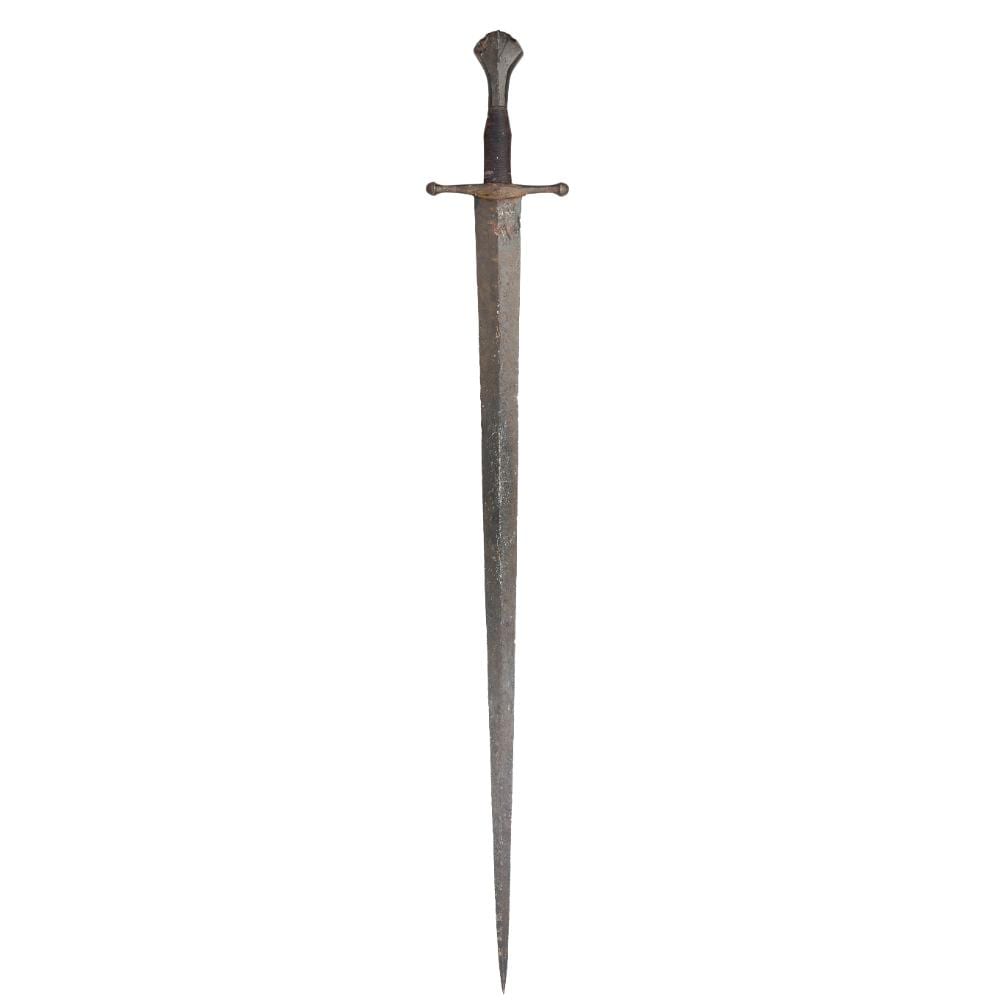
with markedly tapering straight double-edged blade of stout flattened diamond-section with a sturdy acute point (one filled edge nick), inlaid in latten with three marks including the "running wolf" of Passau and a Bishop’s crook, iron hilt comprising a pair of quillons of circular section, swelling at the centre to form an écusson and with bud-shaped terminals retaining some incised ornament, pommel of so-called ‘fishtail’ form decorated with a pronounced ‘V’ at he upper end of each face, expertly restored grip bound with cord, and in characteristic excavated black-patinated stable condition throughout, 92.3 cm blade, 110.9 cm overall Provenance Christie’s London, 29th October 1980, lot 50 An Important English Private Collection Literature Oakeshott, Ewart, A River-Find of 15th Century Swords, in, Stuber, Karl and Wetter, Hans, Blankwaffen, 1982, pp. 17-32, sword no. 10. Oakeshott, Ewart, Further Notes on a River-Find of 15th Century Swords, in, The First Park Lane Arms Fair, 1984, pp. 7-12, illustrated p. 9. Oakeshott, Ewart, Sword in Hand – A Brief Survey of the Knightly Sword, 2000, fig. 13. Thomas, Clive, Additional Notes on the Swords of Castillon, in, The Park Lane Arms Fair, 2012, pp. 40-63, illustrated p. 51. This well-formed sword is from the so-called ‘group B’ of swords found near the site of the last battle of the 100 Years War, fought near Castillon in Gascony in 1453. This group is characterised by so-called ‘fishtail’ or ‘scent stopper’ pommels of which the present sword is a notably good example surviving in good condition.