Have one like this?
Upload a photo for a free check of what yours may be worth.
Lot description
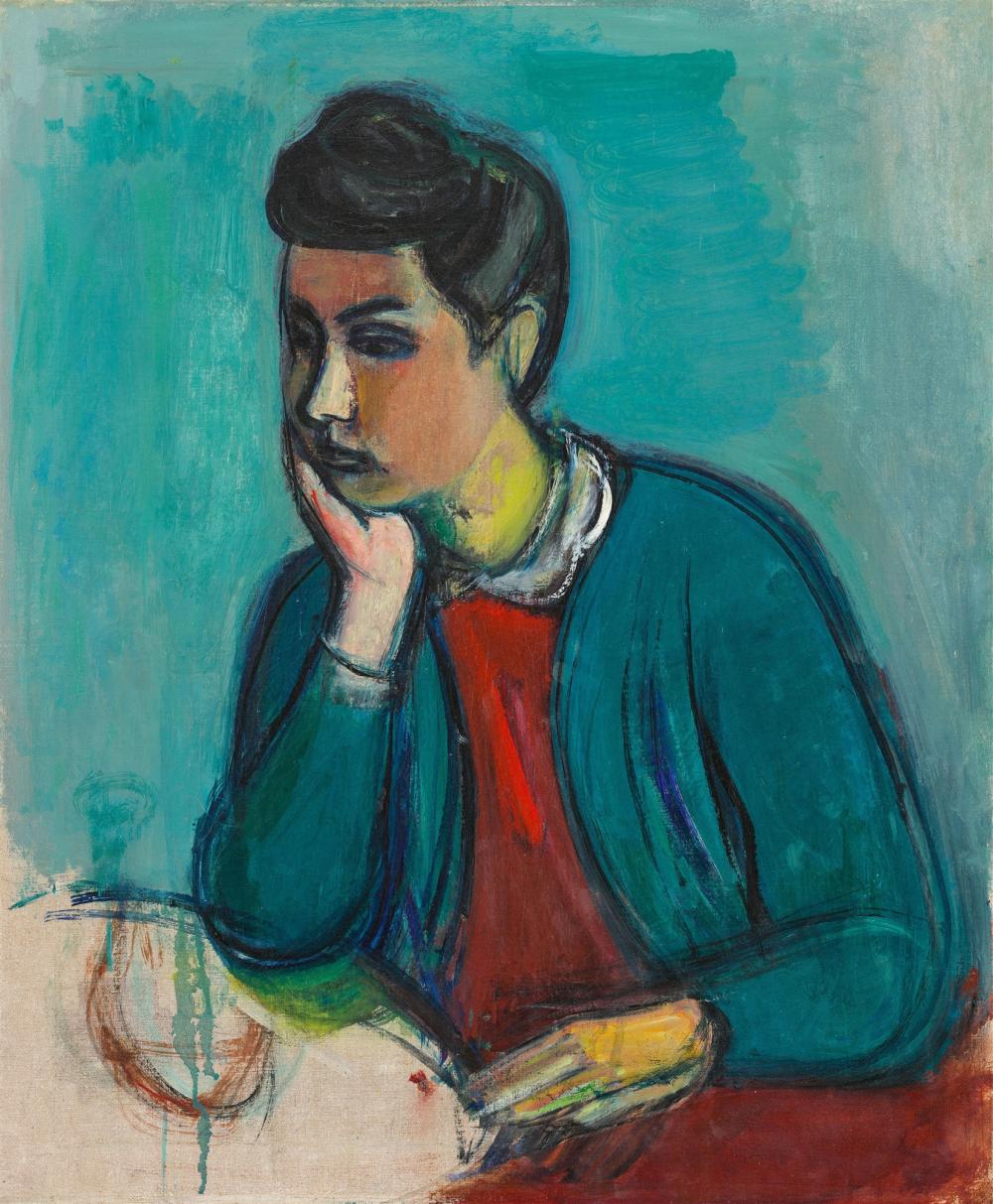
Stamped "R Levy AUS DEM NACHLASS DES KÜNSTLERS" verso on the canvas. The “Bildnis Nanda” was created by the Jewish artist Rudolf Levy in 1941: it belongs to a series of outstanding portraits from the period he spent in Florence, which was defined by persecution, flight and existential danger. In this work, Levy – who trained at the Académie Matisse and was inspired by his friends at the Café du Dôme – has achieved a portrait displaying a concentrated composition and bold use of colour. A young woman is sitting calmly with her head resting on her hand at a table; her dark, Mediterranean complexion and blue-and-red clothing stand out advantageously against the turquoise-coloured background. The two-dimensionality of the table and the lack of emphasis on the torso cause the volumetric forms of the face and right hand to stand out particularly strongly. The focus of the portrait is the woman’s face: framed by the dark contour, it becomes a medium of expression. Like many of the likenesses created in Florence, such as “Porträt Herbert Schlüter” (1941) and “Fiamma” (1942), Nanda also conveys a sense of reservedness and melancholy. In his Florentine exile, Levy often painted portraits of emigrants who, like him, tended to feel vulnerable and anxious on account of their experiences and uncertain future. However, his own situation and that of his companions did not lead to a stylistic change in the direction of a dismal grey – instead, in the early 1940s, he returned back to the intense palette of the years he had spent in Paris. Portraits from the late period of Rudolf Levy’s oeuvre are extremely rare on the art market. Two preliminary drawings related to “Bildnis Nanda” exist, in which he played with the young woman's pose.