Have one like this?
Upload a photo for a free check of what yours may be worth.
Lot description
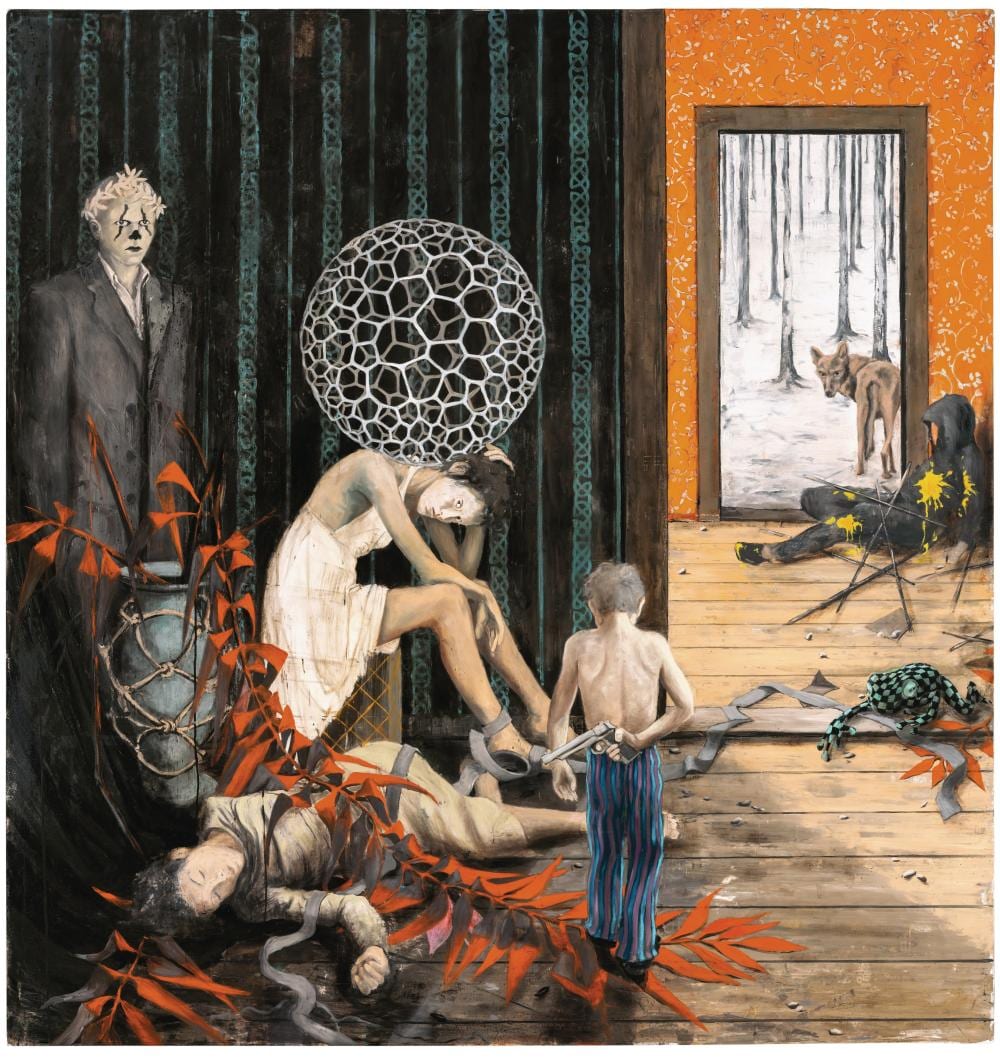
(born in Berlin in 1969) Untitled, 2005, signed and dated Jonas Burgert 2005 on the reverse, oil on canvas, 222 x 200 cm Provenance: Corporate Collection, Germany Exhibited: Long Museum West Bund, Shanghai, Jonas Burgert: blüht und lügt, 31 July – 10 October 2021 ARP Museum Bahnhof Rolandseck, Remagen, Jonas Burgert: Sinn frisst, 16 February – 13 September 2020 MAMbo, Bologna, Jonas Burgert – Lotsucht Scandagliodipendenza, 26 January – 17 April 2017 Kestner Gesellschaft, Hannover, Jonas Burgert: Schutt und Futter, 22 February – 20 May 2013 Exhibited/Literature: Kunsthalle, Tübingen, Kunsthalle Krems, December 2010 - June 2011, Jonas Burgert, Lebendversuch, exhib. cat. Cologne 2011, no. 19, p. 95, with full-page col.-ill. p. 86 Jonas Burgert's visually complex and multi-layered painting is characterised by an eerie calm, despite its many figures. The division of space with an escape to the outside is reminiscent of Dutch interior scenes, but instead of the sweeping maid or children playing music that populate those quiet interiors, the woman here is dressed in white, and, like Dürer's Melancholia, fills the air with melancholy. By creating unknown spaces within the pictorial space, Burgert's works point to a fourth dimension. They are dominated by an anarchic, devastated atmosphere whose story, expressed in the stoic disorientation of the figures, remains uncertain and as yet untold. The deliberately artificially charged levels of reality of each individual character lead to a labyrinthine, intertwined, and emotionally similar unravelling of infinite historical worlds. The viewer feels abducted into a surreal fantasy world, believing himself to be part of the floating state around him, in which, despite its hypnotising pull, the feeling of a forever lost idyll remains. ‘My interest,’ says Burgert, ‘is primarily focussed on the phenomenon of man, on the problem of self-definition. People don't know what a person is. We don't have a standard map, we have to constantly redefine our coordinates. We are constantly searching in this self-reflection. Because we are not simply instinctive beings. The resulting uncertainty leads to the need to embed ourselves. We dress up, subordinate ourselves to a culture, a ceremony, a rite, a fashion, a religion. I don't know how many thousands of gods man has invented in order to discover himself in them. Unlike animals, man argues with his existence, his definition. This phenomenon interests me’ (Jonas Burgert quoted in Heinrich Dietz, ‘Schutt und Asche’, https://www.jonasburgert.de/2016/02/17/heinrich-dietz-rubble-and-fodder/#more-271).