Have one like this? Check yours freeOr have an appraiser value it
Lot description
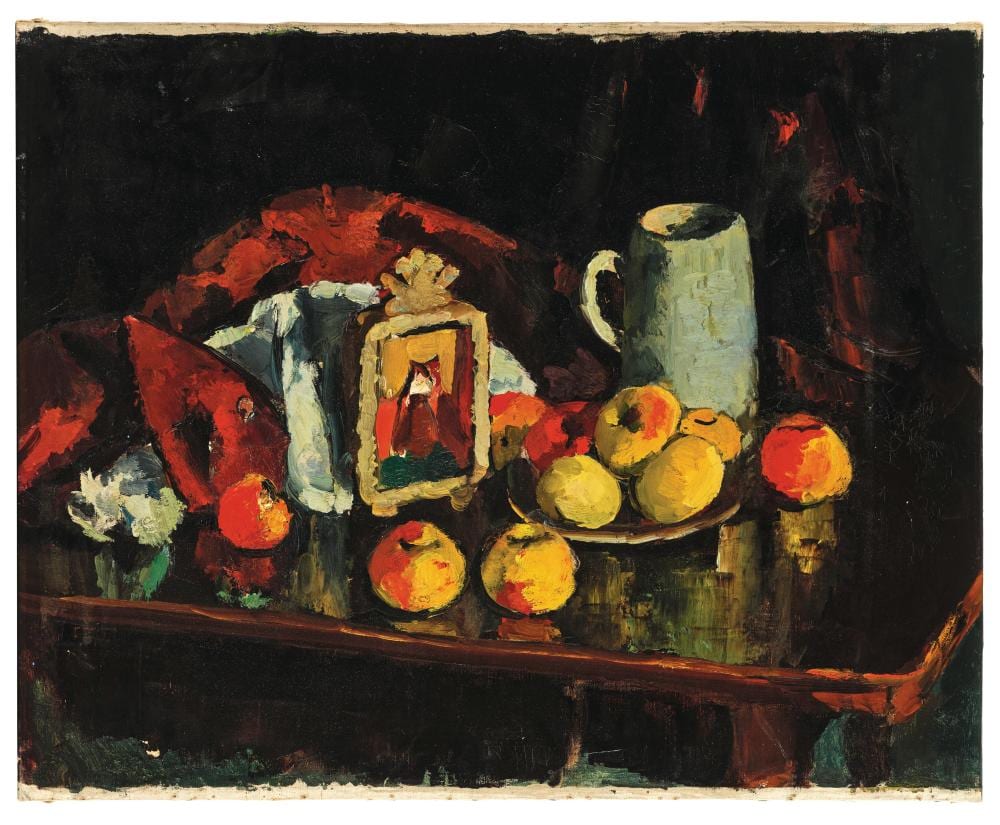
(St. Martin/Lofer 1887–1930 Vienna) “Stilleben mit Krug” (Still life with jug), c. 1912, on the stretcher titled and dated 1912 and further inscribed “Faistauer Privatbesitz, Wien” and “Eigentumer Lehrer Grasmayr, Salzburg Mönchsberg”, oil on canvas (mounted upside down on stretcher), 60 x 75 cm, framed Provenance: Magda Mautner von Markhof (Vienna 1881–1944 Salzburg), married since 1914 to Alois Grasmayr (1876 Hohenzell – 1953 Salzburg) - passed to his heirs - Family Collection We are grateful to Dr. Nikolaus Schaffer, Salzburg for confirming the authenticity and the information on the provenance. Faistauer only got to know Alois Grasmayr around 1920, but was well acquainted with his wife, Magda Mautner-Markhof from an early age. She may have acquired the painting earlier. Compare: Franz Fuhrmann, Anton Faistauer, Residenz Verlag, 1972, cat. no. 83: Still life with beer jug, very similar in composition and with the same jug. It is a real stroke of luck that full consciousness is unnecessary in order to absorb. Quite unconsciously, what I had seen sank into my inner self and now, often conveyed by present experience, it emerges into consciousness from an unsuspected reservoir. I experienced a Gauguin exhibition at Miethke's in the last year of the academy course which made an uncannily strong impression on me. I couldn't fully grasp things, it was all too new and strange. I carried the things around in me for a long time. At the same time I met Franz Wiegele and Kolig, who also studied at the Academy in Vienna. They inspired extraordinary respect in me. I had the feeling that they were already very much involved in what I yet longed for. I was impressed by Wiegele's strict classical drawing and the extraordinary strength and tenacity of his endeavours. I learned a lot from him about art books. His studio always had photos of ancient and Gothic sculpture. I was able to learn about pictures from him. Until then, I had only viewed as a connoisseur. From then on, I focused museums and became sceptical of one-day exhibitions. Kolig was much closer to my own problem at the time. He was concerned with colour as was I, and approached the material boldly and with great extravagance. Later I would get more out of Wiegele. I saw the first two very important Viennese art shows with him as well as everything French worth seeing at Miethke's and later at Arnot's. I only observed Kokoschka's development from a distance. He had a big head start. I initially rejected him altogether. Early Kokoschka was rather embarrassing for me. I was organised quite differently and couldn't make anything of an analytical big-city psyche. Nevertheless, he held our first important exhibition in the Hagenbund in 1910: the special exhibition that launched the new approach to painting in Vienna, leaving Klimt’s influence behind. My first large painting was shown at this exhibition: a Nativity 3:3 [= 3 x 3 m], in which I strove for a goal that I still pursue today. At that time, I had the great Venetians in mind, their colourfulness, their colour composition, their earthly nature. Two years later I discovered Cézanne, and then tried very hard to imitate only him... Anton Faistauer, from: Anton Faistauer. Catalog for the special exhibition of the Salzburg Museum Carolino Augusteum, 2005