Have one like this?
Upload a photo for a free check of what yours may be worth.
Lot description
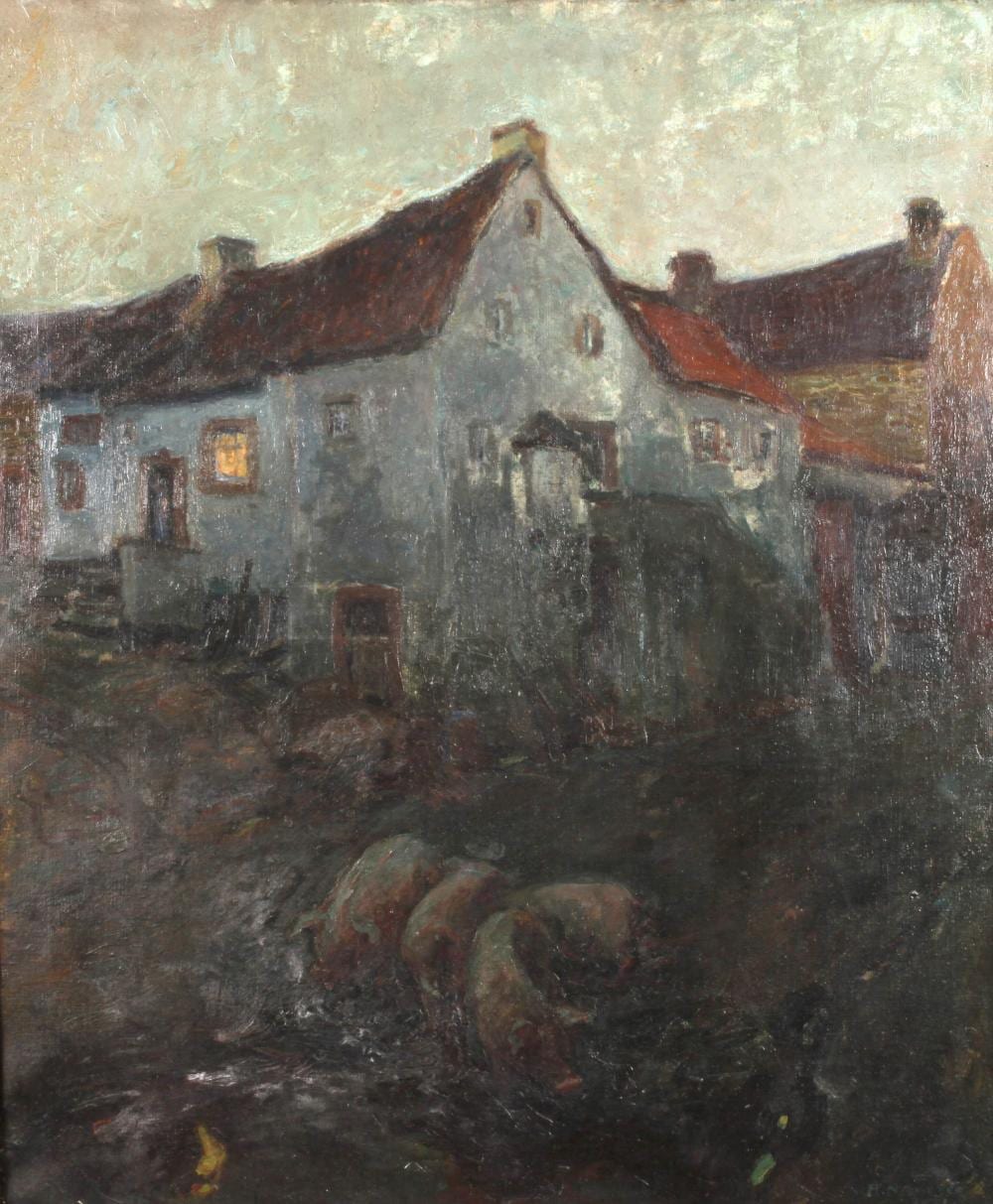
Adelbert Niemeyer, Nachts im Dorfe vor einem großen Bauernhaus, in dessen Stube noch Licht brennt, stehen im Schlamm drei Schweine, das von der Rückseite des Haupthauses einfallende Mondlicht ist malerisch nur indirekt durch das Türkis des Himmels gekonnt inszeniert, stimmungsvolle, große Ölstudie auf Leinwand in gedeckter Farbigkeit, rechts unten signiert "A. Niemeyer" sowie schwer leserlich wohl datiert "1901", rückseitig mit Etikett der Internationalen Kunstausstellung der Berliner Secession aus dem Jahr 1902 sowie unentschlüsselten, wohl ebenfalls von Ausstellungen stammenden Etiketten "H.K.S. 1161" bzw. "547", dazu diverse, schwer leserliche handschriftliche Annotationen auf Rahmen und Keilrahmen, geringes Craquelure am rechten Bildrand sowie kleinere Farbabplatzungen an den Rändern, Retuschen, ansprechender Rahmen der Zeit, Falzmaße ca. 93,5 x 78 cm. Künstlerinfo: eigentlich Adelbert Hans Gustav Niemeyer, dt. Maler, Architekt und Kunstgewerbler (1867 Warburg bis 1932 München), 1884–88 Studium an der Düsseldorfer Kunstakademie, im Anschluss an einer privaten Kunstschule in München und an der Académie Julian in Paris, ab 1907 Professor an der Kunstgewerbeschule in München, 1907 Mitbegründer des Deutschen Werkbundes und der Deutschen Werkstätten für Handwerkskunst in Dresden und München, war auch tätig für die Porzellanmanufakturen Meissen und Nymphenburg sowie für Villeroy & Boch, Richard Merkelbach und die Karlsruher Majolika-Manufaktur, 1925 Gestaltung des Festzuges zur Eröffnung des Deutschen Museums, Quelle: Thieme-Becker, Vollmer und Wikipedia. Adelbert Niemeyer, Nachts im Dorfe In front of a large farmhouse, in whose parlour a light is still burning, three pigs are standing in the mud, the moonlight falling from the back of the main house is skilfully staged in a painterly manner only indirectly through the turquoise of the sky, atmospheric, large oil study on canvas in muted colours, signed lower right "A. Niemeyer" and probably dated "1901" in illegible letters, label of the Berlin Secession International Art Exhibition from 1902 on the reverse as well as undeciphered labels "H.K.S. 1161" and "547", probably also from exhibitions, with various illegible handwritten annotations on the frame and stretcher, minor craquelure to the right edge of the image as well as minor colour flaking to the margins, retouching, attractive frame of the period, folded dimensions approx. 93.5 x 78 cm. Artist's note: actually Adelbert Hans Gustav Niemeyer, German painter, architect and art historian. Painter, architect and applied artist (1867 Warburg - 1932 Munich), 1884-88 studied at the Düsseldorf Art Academy, then at a private art school in Munich and at the Académie Julian in Paris, from 1907 professor at the Kunstgewerbeschule in Munich, 1907 co-founder of the Deutscher Werkbund and the Deutsche Werkstätten für Handwerkskunst in Dresden and Munich, also worked for the Meissen and Nymphenburg porcelain manufactories as well as for Villeroy & Boch, Richard Merkelbach and the Karlsruhe Majolica Manufactory, 1925 designed the procession for the opening of the Deutsches Museum, source: Thieme-Becker, Vollmer and Wikipedia.