Have one like this?
Upload a photo for a free check of what yours may be worth.
Lot description
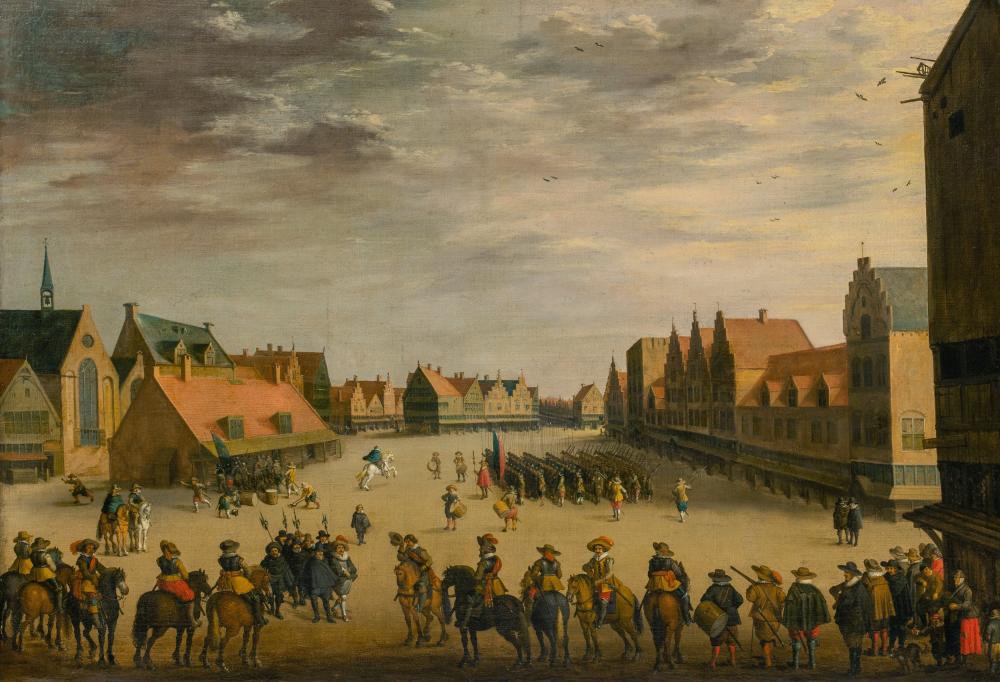
The disbanding of the 'waardgelders' by Maurits, Prince of Orange, on the Neude in Utrecht, 31 July 1618, signed and dated 'JC. Drooch Sloot. 1629.' (lower right), oil on canvas, 98x143 cm , Exhibited:-Delft, Legermuseum (nowadays the Nationaal Militair Museum, Soest), inv. no. 117443.Literature:-Jos Hilkhuijsen, ‘De afdanking van de waardgelders te Utrecht in 1618’, in ‘Armamentaria', Jaarboek Legermuseum 2003-2004, inv. no. 38, ill. pp. 311-329.Provenance:-Collection Kasteel Linschoten, Utrecht, 18th century (listed in the collection inventory).-By descent in collection of physician Dr J. Roosenburg, 's-Hertogenbosch, 19th century.-By descent in collection of his daughter L.A.A. van Roosenburg, married to Mr F.H. Fentener van Vlissingen, Huize Bergen in Vught, late 19th century.-By descent in collection of their son Dr F.H. Fentener van Vlissingen, Beukenhort in Vught, early 20th century.-Gifted by the above to Ir. W.P.C. Knuttel, Huize Meyendael in Deventer, 1952. -Thence by descent to the present owner, in 2002 given in long-term loan to the Legermuseum in Delft (nowadays the Nationaal Militair Museum, Soest), The dismissal of the waardgelders (mercenaries of the time) in 1618 was a historical event of crucial significance for the military authority of Maurits, Prince of Orange (1567-1625) - stadholder and military commander of the Republic of the Seven United Netherlands - and left a lasting impact on politics. On the Neude square in Utrecht, the waardgelders, under the watchful eyes of Prince Maurits, his brother Frederik Hendrik, Ernest Casimir van Nassau, and Deputies of the States General, laid down their arms. Further along are officers, pikemen, musketeers and flag bearers. The background shows a topographically accurate depiction of Utrecht’s Neude, surrounded by stone and wooden stepped gable houses, the waardgelders' guardhouse, and the Cecilia Monastery. Given the great importance of this event, multiple versions were produced in the workshop of the Utrecht painter Joost Cornelisz. Droochsloot, several of which are now housed in major collections, including the Koninklijke Museum voor Schone Kunsten van België, Brussels (dated 1618, inv. no. 2551), the Rijksmuseum, Amsterdam (dated 1625, inv. no. SK-A-606), and the Centraal Museum, Utrecht (dated 1629, inv. no. 2520). Commissions for these paintings came from noblemen, the Utrecht city council, army officers, and wealthy individuals, both domestic and foreign, who had been directly involved in the dismissal.Source, Jos Hilkhuijsen, ‘Armamentaria’, Jaarboek Legermuseum 2003-2004, pp. 311-329.