Have one like this?
Upload a photo for a free check of what yours may be worth.
Lot description
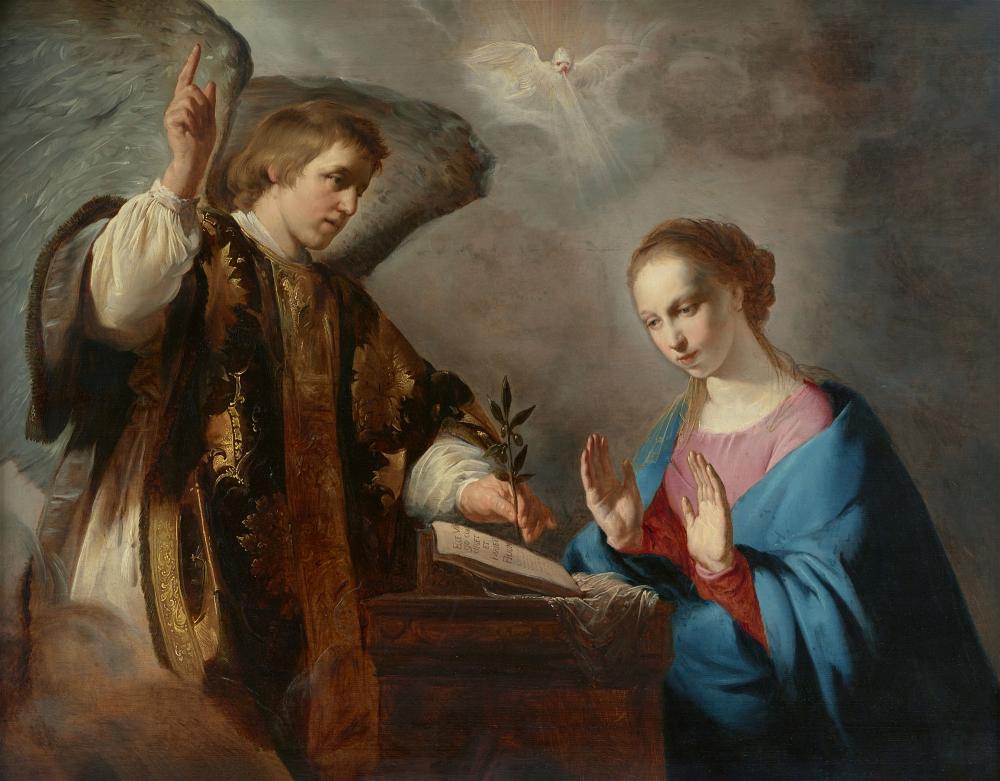
Monogrammed and dated lower centre on the lectern: P.DG / 1633 (D G conjoined) Pieter de Grebber's painting of the Annunciation was created in 1633, one year after the artist was accepted into the Haarlem Guild of St Luke. His father, the Catholic history painter and portraitist Frans Pietersz de Grebber (1573-1649), had already been a member of the guild. Neither the patron nor the subsequent whereabouts of this panel painting are known. It first appeared in Cologne in 1909, where it was sold at auction by J. M. Heberle (H. Lempertz' Söhne). Now de Grebber's much-praised masterpiece is returning to Lempertz after having been on loan from a private collection to the Niederländisches Landesmuseum in Hanover for almost 50 years. Pieter de Grebber was one of the few Catholic artists in the northern Netherlands who expressed their faith in their art. His work is Catholic in character, both in his choice of subject and in his use of light and staging. Even though Catholicism had been officially banned in the Dutch Republic since 1578, the Catholic Church remained active underground, especially in the city of Haarlem with its very active religious chapter, which awarded many important commissions. As a resident in Haarlem, De Grebber in particular benefited from this patronage. He received numerous commissions from ‘hidden’ churches, even outside the city. He also painted altarpieces for cities in the southern Netherlands such as Bruges and Ghent. On the other hand, as a history painter, de Grebber also became the leading representative of so-called Haarlem Classicism, and as such was the favoured painter of Frederick Henry, Prince of Orange (1584-1647) as of the late 1630s, for whom he decorated numerous palaces. This style was modelled on the classicist Baroque of the Flemish painter Peter Paul Rubens. In his Annunciation, De Grebber concentrates the composition on the two brilliantly painted and monumentally staged figures of the Archangel Gabriel and the Virgin Mary, who dominate the image against a cloudy, grey background. The omission of any decoration of Mary's chamber emphasises the supernatural process of the Annunciation, as do the clouds from which the magnificently robed messenger of heaven appears with outspread wings (Luke 1:26-35). Mary, kneeling at a lectern, has raised Her hands in an ambiguous gesture as She looks towards the passage in the Old Testament that the angel with the olive branch is pointing out to Her: "Ecce virgo concipiet et pariet filium". These are the words of the Prophet Isaiah, in which he foresaw the virgin birth of the Saviour (Isaiah 7:14). As a sign of the heavenly nature of his message, Gabriel points towards the sky with his right hand. The Dove of the Holy Spirit hovers above the Annunciation group. The narrative clarity is characteristic of Pieter de Grebber's works, as is the way in which it is emphasised by a striking use of light. The work's unusual iconography, that is founded in de Grebber's Catholic faith, has been pointed out by A. Blankert (see exhib. cat. Gods, Saints and Heroes, 1980/81, p. 194). The angel is wearing a deacon's robe made of heavy brocade with a golden pomegranate pattern. According to the rules of the Catholic liturgy, the deacon wears such a robe during the celebration of the Eucharist. Instead of the usual lily, the symbol of Mary's purity, the angel holds an olive branch in his hand, which symbolises peace. The olive branch and the Catholic regalia can be interpreted as a statement on the political situation in the Netherlands and as an expression of the desire for peace. The painting was created at a time when peace negotiations between the northern Netherlands and Spain were ongoing. In 1633, de Grebber created two more paintings for Roman Catholic churches in the northern Netherlands. A. Blankert (op. cit.) refers to the very similar pose of Mary in the painting ‘Adoration of the Shepherds’ in the church of Oude-Ade near Leiden. The second painting, a ‘Descent from the Cross’, was painted by De Grebber for the church in Enkhuizen, where his brother-in-law was a priest (ill. 1; today in the Rijksmuseum, Amsterdam, no. A2311). A. Blankert assumes that the present work was also intended for a (‘hidden’) Roman Catholic church or for a private chapel and was therefore kept out of the public eye.