Have one like this?
Upload a photo for a free check of what yours may be worth.
Lot description
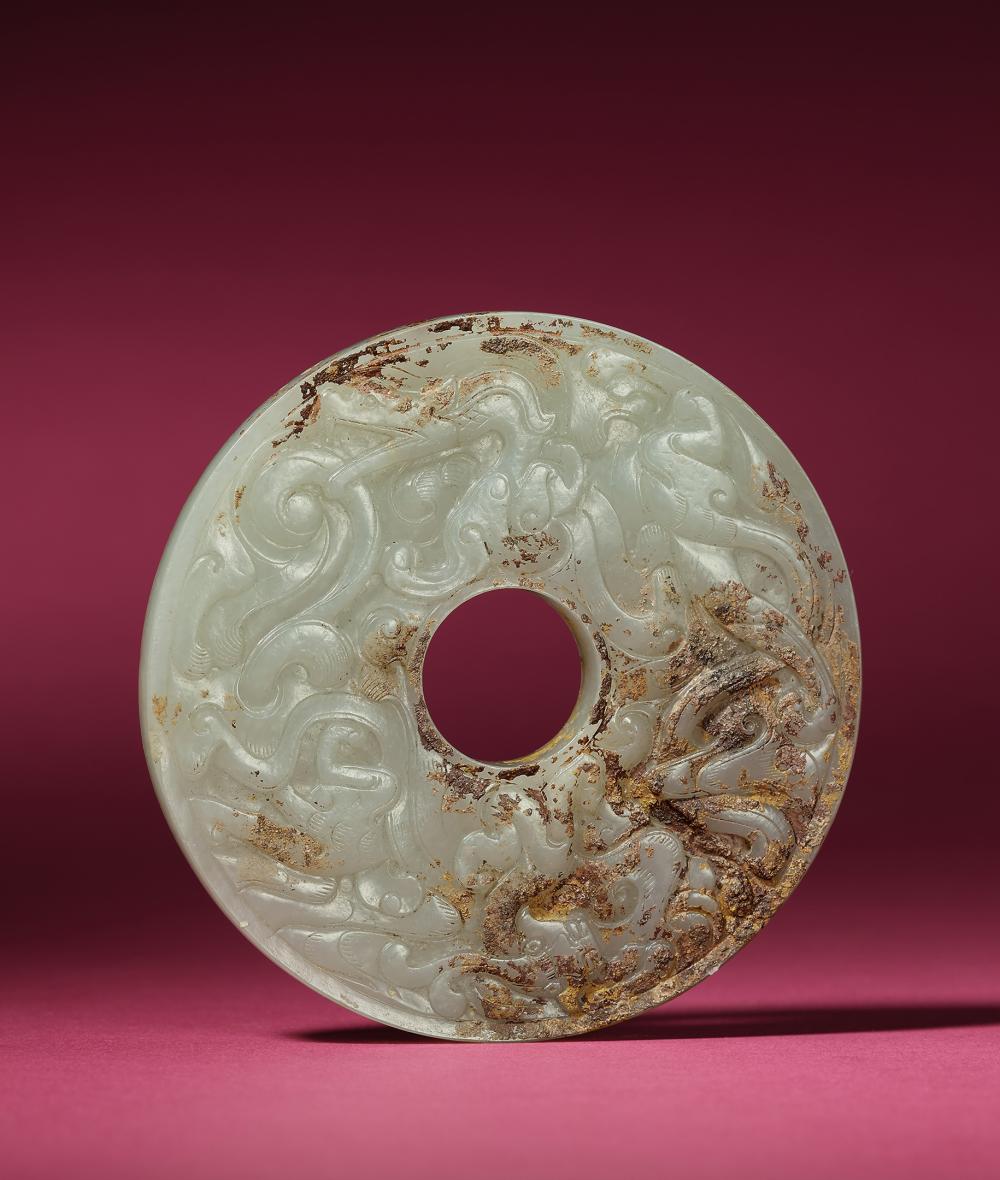
113 東漢 / 南北朝 白玉龍紋璧 D10.2cm 來源:傅忠謨收藏 牡丹堂收藏 巴斯東亞藝術博物館收藏 有愚山房收藏 《古玉精英》,臺灣中華書局股份有限公司,1989年,頁186 《Jades from China》,巴斯東亞藝術博物館,2001 年,頁 262 LOTS 112-114 有愚山房古玉珍藏 YO YU SHAN FANG COLLECTION 玉璧白玉製成,半透明質,局部受附深淺不一鈣化鐵礦。呈正圓扁平體,正中圓穿,孔型規整。兩面飾紋不同,採壓地浮雕技法,內外兩緣修飾凸起素寬邊廓線一周。一面廓內壓地浮雕蒼龍穿雲而起,虯曲矯健,瞠目張頷,威風凜然,祥雲迤邐,漫天飄飛,大有氣奪千里之勢。螭龍首似貓,頸細,腹粗,尾長,形象遒勁,四周雲氣繚繞,布局得當,氣韻生動,充滿力量感;另面廓內碾琢榖紋,渾圓凸起,密集勻稱,如同葉發芽樣式,是漢族農耕文明發展的產物,象徵萬物甦醒,生機勃勃之景和人們對豐收的盼望。 《周禮.典瑞》載:「以玉作六瑞,以等邦國···子執穀璧,男執蒲璧」,描寫不同官職授予不同玉器,其中子爵所拿便是穀璧。東漢經學家鄭玄:「穀所以養人,蒲為席所以安人。」皇帝用穀作為授予爵位的信物紋樣,寄予「五穀豐登」、「天下富饒」之寓意。兩漢玉璧還出現雲氣化動物紋裝飾,之後開始廣泛流行具象紋樣,如仙人、鳥獸、花草紋樣等,因此穀紋的使用大大減少,於東漢漸趨式微。北京故宮博物院庋藏漢〈玉螭紋璧〉,及1977年陜西省西安市北郊漢墓出土,陜西省西安市文物局庋藏漢〈玉劍珌〉皆以淺浮雕飾穿雲螭龍,大小相伴,曲體爬行,活潑矯健之形態與本品極為類似,可資參考。 兩漢是經學與神讖並盛的朝代,在重建商周用玉禮儀制度的同時,更扮演承前啟後的角色。史書記載,漢玉璧用於祭祀、朝賀、徵聘、進獻、婚娶和佩飾,為漢代文化的典型特色。本件東漢/南北朝〈白玉龍紋璧〉,龍首翹鼻張口,居於上方,頸部和身軀彎轉為S形,尾巴朝上勾捲,四肢前後展開,穿雲呈現立體感與自由奔放的特殊效果,具舒展輕快美感,帶有濃郁東漢風格。 南北朝(420年—589年)也是思想極其活躍的時期,製玉承襲的藍本,是按照東漢(25年—220年)製作題材與風格仿製。如同為傅忠謨藏南北朝〈白玉雕螭璧〉,一面雕蒲紋,另面雕雙螭在水中隱現出沒,便是延續漢代傳統。此類紋飾在東漢時期青銅器可見類似構圖,如1970年江蘇徐州土山出土,南京博物院庋藏東漢中期〈錯金雲龍紋樽〉,樽上以錯金飾龍紋、流雲紋之藝術風格,無不反映和體現出此時期雄渾大氣的藝術手法。 本品出自傅忠謨收藏,傅忠謨(1905—1974年),四川江安人。少時從先祖藏園先生習版本目錄學,得觀國內及日本公私名家所藏善本,造詣深厚。後致力於收集、研究古玉藝術,以「佩德齋」及「抱璞廬」為收藏齋名,藏品近千件。晚年結合考古新發現,並進行多方面考訂,多有創見。著有《佩德齋古玉圖錄》、《古玉精英》等。後由香港牡丹堂收藏,並成為巴斯東亞藝術博物館藏品,且出版於《Jades from China》書中,然再為有愚山房購藏,流傳有序,極為珍稀。細審本器,以壓地浮雕技法結合陰刻線裝飾,榖紋飽滿勻稱,作斜線交錯排列,規整精緻;穿雲龍紋加入新的審美意識和工藝技術之翻新,造型嚴謹有序,屈曲生動,藝術造詣極高,乃體現漢代玉璧象天禮祭思想之佳器。 LOTS 112-114 Have Yu Shan Fang Ancient Jade Collection YO YU SHAN FANG COLLECTION The jade bi is made of white jade, with a translucent quality, and partially attached with unevenly deep calcified iron ores. It is a perfectly round flat object with a circular hole in the center, the hole shape is regular. The two sides are decorated with different patterns, adopting a low relief technique; the inner and outer edges are surrounded by a raised plain border. One side features a low relief of a azure dragon soaring through the clouds, twisting and vigorous, with wide-open eyes and mouth, exuding a majestic presence, surrounded by auspicious clouds drifting, creating a strong momentum that seems to sweep thousands of miles. The head of the dragon resembles that of a cat, with a slender neck, a stout belly, and a long tail, presenting a vigorous image, surrounded by swirling clouds, with an appropriate layout, lively charm, and a sense of power; on the other side, the surface is engraved with grain patterns, rounded and raised, dense and uniform, resembling the sprouting of leaves, a product of the development of Han agricultural civilization, symbolizing the awakening of all things, a vibrant scene, and people's hope for a bountiful harvest. The "Rites of Zhou" states: "Use jade to create six auspicious objects for different states... the son holds the grain bi, and the man holds the reed bi," describing how different official positions are awarded different jade objects, among which the viscount holds the grain bi. The Eastern Han scholar Zheng Xuan remarked: "Grain is for nourishing people, and reed is for providing comfort." The emperor used grain as a token of nobility, embodying the meanings of "bountiful harvests" and "wealth throughout the land." During the Han dynasty, jade bi also featured cloud patterns resembling animals, which were later widely replaced by figurative designs, such as immortals, birds and beasts, flowers and grasses, leading to a significant decrease in the use of grain patterns, gradually declining during the Eastern Han. The Palace Museum in Beijing houses a Han jade bi with dragon patterns, and in 1977, a Han jade sword was unearthed from a tomb in the northern suburbs of Xi'an, Shaanxi Province, both featuring shallow reliefs of a cloud-dragon, with similar sizes and dynamic forms, closely resembling this piece. The Han dynasty was a period where Confucianism and prophetic thought flourished simultaneously, playing a pivotal role in reconstructing the ceremonial jade system of the Shang and Zhou dynasties. Historical records show that Han jade bi were used for sacrifices, court audiences, recruitment, tributes, marriage, and adornment, marking a typical feature of Han culture. This Eastern Han/Northern and Southern Dynasties white jade dragon pattern bi features a dragon's head with an upturned nose and open mouth, positioned at the top, with a neck and body curving into an S shape, the tail curling upwards, limbs extended forwards and backwards, presenting a three-dimensional and free-spirited effect, with a delicate and lively aesthetic that carries a strong Eastern Han style. The Northern and Southern Dynasties (420-589 AD) was also a period of extremely active thought, with the jade-making techniques inherited from the Eastern Han (25-220 AD) in terms of subjects and styles. For example, the Southern and Northern Dynasties white jade carved chi bi from the collection of Fu Zhongmo features one side with reed patterns and the other side with dual chi emerging and disappearing in water, continuing the traditions of the Han dynasty. Similar patterns can be seen in the bronze ware from the Eastern Han period, such as the Eastern Han gilt cloud dragon pattern zun unearthed in 1970 from Tushan, Xuzhou, collected by the Nanjing Museum, which reflects the vigorous and grand artistic techniques of this period. This piece comes from the collection of Fu Zhongmo (1905-1974), a native of Jiang'an, Sichuan. In his youth, he studied cataloging techniques from his ancestor, gaining insight into the significant collections of both public and private collections in China and Japan, achieving profound expertise. He later devoted himself to collecting and researching ancient jade art, naming his collection "Peide Zhai" and "Baopu Lu," with nearly a thousand pieces. In his later years, he integrated new archaeological discoveries and conducted extensive research, yielding many original ideas. He authored works such as "Peide Zhai Ancient Jade Catalog" and "Elite of Ancient Jade." Later, it was collected by the Hong Kong Mudan Tang and became part of the collection of the Bass East Asian Art Museum, published in the book "Jades from China," and was subsequently acquired by the Yu Shan Fang Collection, with a well-documented provenance, making it extremely rare. Upon careful examination of this piece, the low relief technique combined with the incised line decoration creates a plump and uniform grain pattern, arranged in a crisscross diagonal pattern, precise and exquisite; the cloud dragon pattern introduces a new aesthetic consciousness and innovation in craftsmanship, with a rigorous and orderly shape, lively curves, and a high level of artistic accomplishment, embodying the ideals of the Han dynasty's jade bi as offerings for celestial rites. (English translation for reference only; Chinese version prevails in case of discrepancies.) 預估價: TWD 4,800,000-5,200,000 RMB 1,090,900-1,181,800 AN EXCEEDINGLY RARE WHITE JADE 'DRAGON' BI DISC EASTERN HAN / NORTHERN AND SOUTHERN DYNASTIES D10.2cm Art of jade carving in ancient China, Chung Hwa Book Company Limited., 1989, p.186 Jades from China, The Museum of East Asian Art, 2001, p.262 PROVENANCE: Fu Zhong Mo Collection Property from The Peony Collection The Museum of East Asian Art Collection Yo Yu Shan Fang Collection