Have one like this? Check yours freeOr have an appraiser value it
Lot description
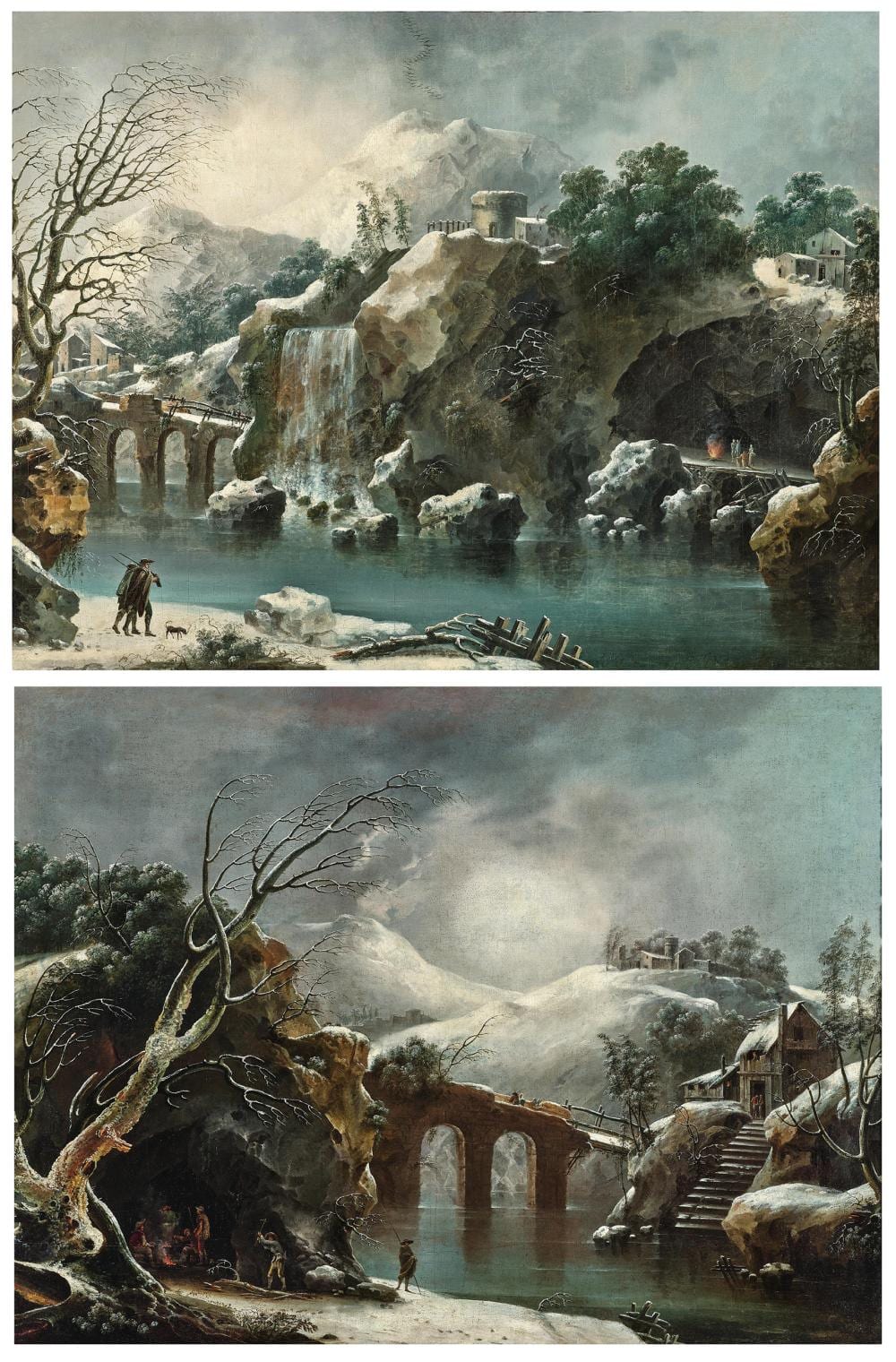
(Ancona 1710–1780 Rome) A mountainous winter landscape with a waterfall and two huntsmen by a river, villagers by a campfire beyond; and A mountainous winter landscape with figures by a river, a bridge and houses beyond, oil on canvas, each 91 x 125 cm, framed, a pair (2) We are grateful to Marietta Vinci Corsini for confirming the attribution of the present pair of paintings. Francesco Foschi was born into a wealthy family in Ancona in 1710. Several of his brothers also became painters, the most well-known probably being Carlo Foschi, who specialised in seascapes. Francesco trained in the workshop of Francesco Mancini in Fano and at the beginning of his career, Foschi enjoyed the protection of Count Raimondo Bonaccorsi, whom he assisted in the compilation of an art collection that also comprised of twelve episodes from Ovid’s Metamorphoses by Foschi. In 1729 the artist’s family moved to Rome, where the 19-year-old Francesco developed a keen interest in Panini and Vanvitelli’s topographical views. The impact of the latter’s panoramic vedute is already recognisable in the artist’s View of Loreto with Papal Portraits (Palazzo Apostolico, Loreto), a work that also betrays his teacher Mancini’s influence in terms of the figurative style. The artist’s signed Winter Landscape, now in the Musée de Grenoble, which bears the date 1750, is the first known example of a subgenre that would become his speciality. Amongst Italian artists, Foschi can be labelled as a master of winter landscapes. The genre of snow-covered scenery had been popular in Flanders in the seventeenth and eighteenth centuries, yet Foschi interpreted the subject in a highly personal manner, and contributed to the depiction of an act of nature that was mostly neglected by his contemporaries. The limited palette used for the present pair of paintings, with its emphasis on various shades of white, a selective use of greys, and different hues of brown, ochre and green, is typical of Foschi’s art. By means of this chromatic spectrum and a meticulous technique, Foschi achieved outstanding effects in the treetops, patches of grass, bare branches, and heavy clouds in the sky. Another characteristic feature of Foschi’s art is the way in which the figures are used to convey their proportions as opposed to the overwhelming natural setting, which, however, still gives a warm and tranquil impression that entirely complied with the taste of the eighteenth century. In 1755, Foschi moved to Paris, where he stayed until 1764. Then he returned to Rome, where he lived for the rest of his life. His obituary published in the newspaper Ordinario Cracas (11 March 1780) describes him as the “famous painter of winter landscapes”, concentrating on the artist’s later period. Luigi Serra’s research undertaken in the first quarter of the 20th century was followed by studies carried out by Bonfrancesco and Marietta Vinci Corsini, who examined Foschi’s life and work in a wider context.