Have one like this?
Upload a photo for a free check of what yours may be worth.
Lot description
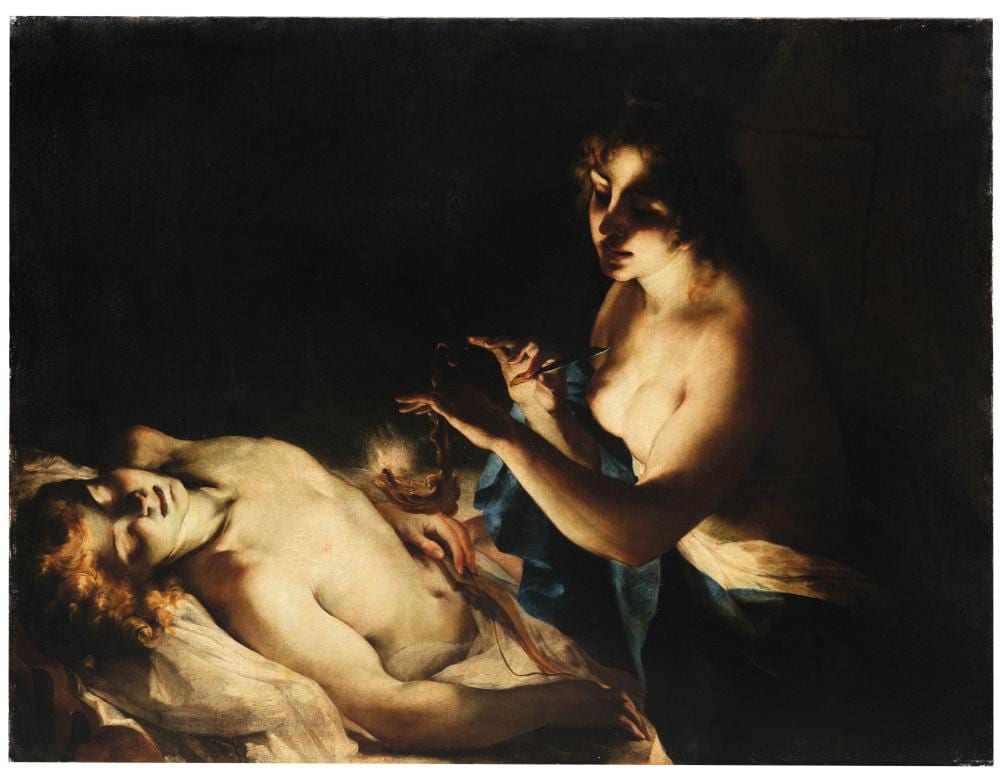
(Milan 1660–1713) Amor and Psyche, oil on canvas, 112 x 152 cm, framed Provenance: Private European collection Literature: M. dell’Omo, Per il Legnanino sacro e profano. L’affresco di Casa Durini e Nuovi Quadri da Stanza e da Chiesa, in: Nuovi studi, no. 2, 2003, vol. 9, pp. 185–186, figs. 182, 183 (as Legnanino) The theme of Amor and Psyche has enjoyed great popularity in Italian and European visual culture since the 16th century. The most famous interpretations of this subject are those by Raphael in one of the loggias of the Villa Farnesina in Rome and by Giulio Romano in the Sala di Pysche at Palazzo Te, Mantua and both of these are part of decorative cycles depicting the whole of Apuleius’s Metamorphosis. The single theme of Psyche observing the sleeping Cupid by candlelight, which was particularly popular for its sensual connotations, also became widespread. In the present painting Legnanino demonstrates remarkable compositional skill and technical ability, crafting a scene with a strong foreshortened perspective and animated by striking lighting effects. It is possible that the artist drew inspiration from a painting by Rubens, currently in a private collection and known through a printed reproduction (see D. Bodart (ed.), Pietro Paolo Rubens, exhibition catalogue, Rome 1990, pp. 94–95). Some of the Legnanino’s figurative solutions, however, seem to be influenced by 17th-century sculptural models, particularly in the figure of Cupid, which may be inspired by Bernini’s celebrated Ludovica Albertoni, in the church of San Francesco a Ripa in Rome. The painter must have been well acquainted with that work, as he also painted an altarpiece depicting theHoly Family for the same church, still visible in the Chapel of Saint Joseph. Stefano Maria Legnani was born in Milan on 6 April 1661, the firstborn son of the painter Giovanni Ambrogio, who was also a painter. Thanks to the correspondence of the young artist with Prince Vitaliano VI Borromeo, which has recently been rediscovered, we know that through the intercession of this powerful patron, he was able to stay in Bologna between 1682 and 1684, where he received important commissions. Between 1684 and 1685, he worked in Rome, where he painted the altarpiece for San Francesco a Ripa as discussed above. Here, he deepened his knowledge of the Bolognese masters, particularly through the study of the works of the Carracci, especially the Farnese Gallery (see M. Dell’Omo, Gli esordi di Legnanino tra Bologna, Roma e la protezione di Vitaliano VI Borromeo, in: Arte cristiana, Vol. 108, no. 919, 2020, pp. 252–255). By the time he returned to Milan, Legnanino was a fully mature artist and was soon sought after as a fresco painter in Novara, Saronno, Monza, and Orta. However, the real turning point in his career came in 1694, when he was called to the Savoy court to work on large decorative projects in Palazzo Provana Druent, and Palazzo Carignano in Turin. Despite the many travels he undertook during his career, the centre of Legnanino’s activity remained Milan, where he became the director of the Accademia di San Luca in 1698.