Have one like this? Check yours freeOr have an appraiser value it
Lot description
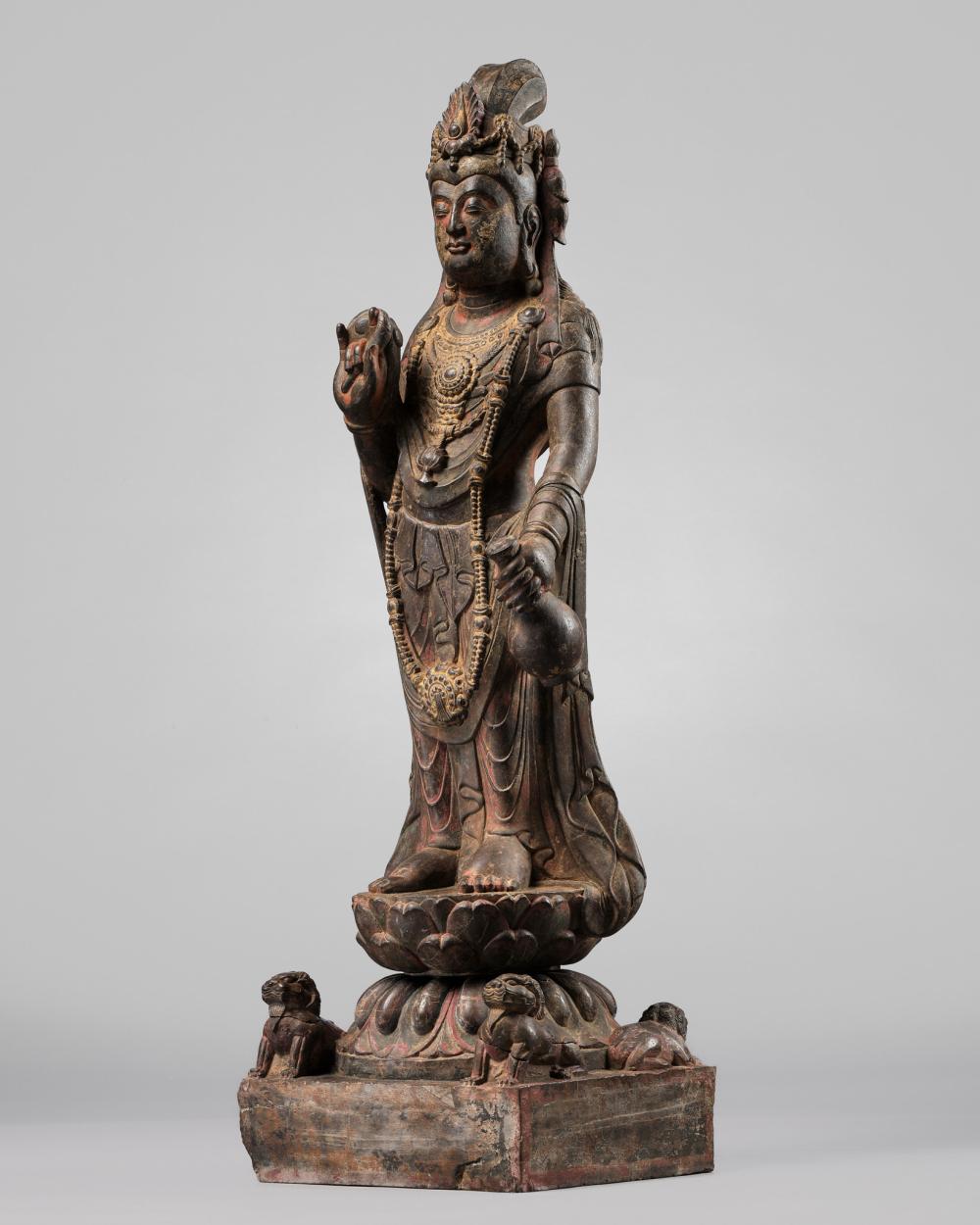
† A PAINTED LIMESTONE FIGURE OF WILLOW GUANYIN, NORTHERN ZHOU-SUI DYNASTY Expert authentication: Dr. Chang Qing, a renowned scholar and professor specializing in Chinese and Buddhist art, has authenticated this lot as being in the typical style of the Northern Zhou or Sui period, identifying it as the left attendant to a figure of Buddha. The statue’s slender form and ornamentation are reminiscent of Buddhist limestone sculptures found in Shaanxi province, the heart of the Northern Zhou and Sui empires. A notarized copy of Dr. Chang's expertise, dated April 21, 2021, in the State of New York, accompanies this lot. Dr. Chang holds a Ph.D. in Art History from the University of Kansas and has held prestigious positions, including post-doctoral fellow at the Metropolitan Museum of Art and senior research fellow at the Freer and Sackler Galleries of the Smithsonian Institute. He has conducted extensive research in China, participating in archaeological excavations at various historical sites. Dr. Chang is the author of several influential works, including Compassionate Beings in Metal and Stone: Chinese Buddhist Sculptures from The Freer Gallery of Art (2016) and Light of the Buddha in the Desert: Essays on Mogao Grottoes in Dunhuang from 5th-14th Centuries (2012). He is currently a professor at Arts College, Sichuan University. China, 557-618. Finely carved standing in samabhanga on a circular lotus dais inserted into a separately carved petal-form base raised on a square plinth with a small Buddhist lion to each corner. The Boddhisattva of Compassion with the left hand lowered holding an amphora and the right hand raised grasping a willow branch. Richly adorned with long flowing robes, billowing shawls, beaded necklaces and chains, all falling in skillfully detailed graceful curves over the pleated dhoti. The serene face of Guanyin shows downcast eyes, arched brows, and full bow-shaped lips forming a gentle smile. Her hair is arranged in an elaborate chignon, backed by an intricately detailed diadem of twisted, beaded, and jeweled strands. Provenance: From a private collection in New York, United States. Condition: Good condition, commensurate with age. Ancient wear, signs of weathering and erosion, encrustations, structural cracks and fissures, nicks, losses, chips, and abrasions. Extensive remnants of old pigments. The base with some old repairs. Dimensions: Height 105 cm (excl. stand), 112 cm (incl. stand) (two separate pieces) Regal in countenance and adornment, this rare figure effortlessly bridges the aesthetic style of the Northern Zhou and Sui dynasties. The annexation in 553 of Sichuan by China’s northwest (then ruled by the Western Wei dynasty) is essential in understanding the formation of Northern Zhou bodhisattva images. The Northern Zhou style is marked by lavish surface decoration, stemmed from the aesthetic of the northwest and was transmitted from India, forging deep roots in Sichuanese Buddhist art. As seen on the present carving, figures of this period were heavily adorned with necklaces and ornate crowns, thus accentuating their sense of mass. While further aspects of Northern Zhou carving, such as the columnar body surmounted by a square head with broad nose and lips, remain, the characteristic stockiness has been replaced by a refined lengthening of the silhouette which is typical of Sui dynasty figures. This is evident in the slender waist, emphasized by the sash that is draped over the shoulders and meets at the front and back with a clasp, and the tassel hanging from the center of the necklace. The subject can be identified as Avalokiteshvara, known as Guanyin in China. Characteristically, the deity carries in her left hand a vase, a 'pure water bottle', one of the eight symbols of good fortune. The vase was believed to contain pure water capable of relieving suffering. The right hand holds a willow branch used to sprinkle the divine water. Literature comparison: Compare a related limestone statue of Guanyin with a similar base, dated about 580, 249 cm high, in the Museum of Fine Arts, Boston, accession number 15.254. Auction result comparison: Type: Closely related Auction: Bonhams Paris, 26 October 2022, lot 238 Price: EUR 403,575 or approx. EUR 427,000 adjusted for inflation at the time of writing Description: An exceptionally rare stone figure of a bodhisattva, Northern Zhou/Sui dynasty Expert remark: Compare the closely related subject, modeling, and manner of carving with similar beaded jewelry and voluminous garments. Note the different size (54.3 cm). Auction result comparison: Type: Closely related Auction: Sotheby’s New York, 12 September 2018, lot 15 Estimate: USD 400,000 or approx. EUR 448,500 converted and adjusted for inflation at the time of writing Description: A marble figure of a standing bodhisattva, Northern Zhou / Sui dynasty Expert remark: Compare the closely related modeling and manner of carving with similar beaded jewelry and voluminous garments. Note the material and the size (88 cm). 13% VAT will be added to the hammer price additional to the buyer's premium - only for buyers within the EU. 13% VAT will be added to the hammer price additional to the buyer's premium - only for buyers within the EU.