Have one like this?
Upload a photo for a free check of what yours may be worth.
Lot description
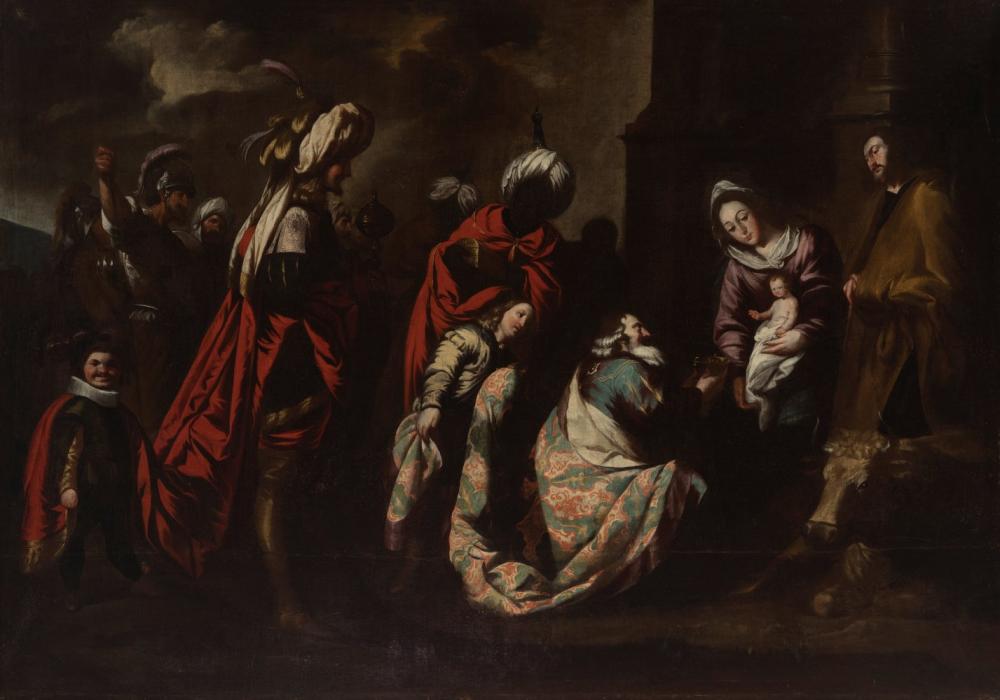
ANTONIO DEL CASTILLO Y SAAVEDRA (Córdoba, 1616 - 1668). "Adoration of the kings". Oil on canvas. Relined. It conserves frame of epoch. Measurements: 142 x 202 cm; 164 x 224 cm (frame). In the book of Benito Navarrete and Mindy Nancarrow on Antonio del Castillo is collected a "Adoration of the kings" belonging to the collection of Valderrama, Madrid. Both pieces, although they vary in size being the present work of larger dimensions, have the same composition. According to the book "The deteriorated Adoration of the Kings in the sanctuary of the Fuensanta is one of the only two known autograph versions of a composition that enjoyed tremendous popularity in Cordoba. Castillo, with the help of his workshop, reproduced it on a larger canvas, in a private collection in Seville, whose better state of preservation is useful to reconstruct the original appearance of the lesser canvas". There is a copy of this painting made by Acisclo Antonio Palomino, currently in the Museum of Fine Arts of Cordoba. Antonio del Castillo y Saavedra was the son of an Extremaduran painter from Llerena, Agustín del Castillo, whose work is little known, but whom Palomino describes as "an excellent painter". He was orphaned in 1626 and was educated by another painter of whom we have no news, Ignacio Aedo Calderón. At an unknown date he may have arrived in Seville -of which there is no effective proof-, where Palomino makes him a pupil of Zurbarán, which has been corroborated in view of the stylistic influence of the master from Extremadura in Castillo's work. In 1635 he was in Cordoba, where he married and settled permanently, becoming without discussion the most important artist of the city. There he painted religious altarpieces as well as portraits and medium-sized series. In his work there is no evolution, and he always kept away from the baroque novelties of other contemporary painters. If in the figures of saints he remains closer to strict naturalism, in the historical productions he tends to be more open, especially because of the ornamentation of architectures and landscapes with which he decorates them. Lázaro Díaz del Valle, Palomino praised his capacity for capturing nature, describing him as "an excellent landscape painter, for which he went out for a few days to walk, with the purpose of drawing, and copied some places from nature". This assertion by the treatise writer is interesting, as it shows Antonio del Castillo to be especially interested in capturing nature, both in landscapes and in everyday characters and animals.