Lot description
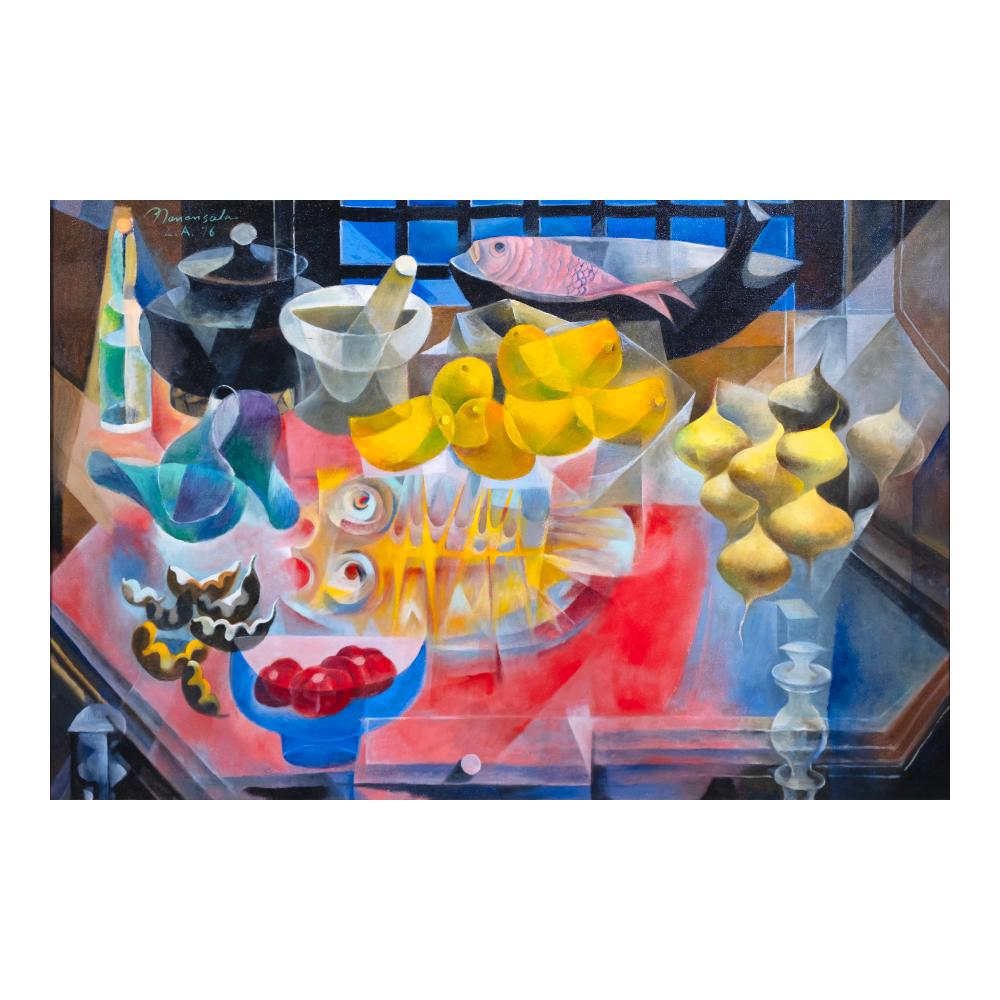
PROPERTY FROM THE PRISCILLA L. CHIONGBIAN COLLECTION Still Life signed, dated 1976, and inscribed L.A. (upper left) oil on canvas 24” x 36” (61 cm x 91 cm) PROVENANCE: Acquired directly from the artist LITERATURE: Paras-Perez, Rodolfo. Manansala. Manila: PLC Publications, 1980. Full color illustration and painting description on page 174. WRITE UP Manansala’s Still Life Capturing the Filipino Collective Spirit The beauty of Vicente Manansala’s Cubism stems from the originality with which he took to the genre. His first profound encounter with Cubism was in 1949 when he, as a UNESCO scholar in Canada, began flirting with the then-burgeoning Cubism as a way to understand and emphasize the planes on his canvases. It was no more than a brush; however, that brush was more than enough to nudge Manansala down that direction – it was a path that would shape the perspective he would take with his oeuvre. Following his stint with Cubism, Manansala took it and manipulated it to serve his personal view – he simplified its methods, flattening the figures without distorting their shapes. In Manansala’s works, his figures retain their structure while dissolving into their base composition; unlike the style of analytic cubism, his works retain their essential forms, tones, and shapes that are both delicate and translucent in quality. His 1976 Still Life is a culmination of his illustrious lifelong career. A visual treat of an image, Manansala's Still Life overflows with colors. Eagle-eyed viewers may notice that Manansala used the same colors as the Philippine flag – the yellows of the mangoes, the blue of the bowl, and the red light washing over the table are the same shades of the flag, echoing the Filipino sensibilities that call to Manansala over and over again The beauty of Vicente Manansala’s Cubism stems from the originality with which he took to the genre. His first profound encounter with Cubism was in 1949 when he, as a UNESCO scholar in Canada, began flirting with the then-burgeoning Cubism as a way to understand and emphasize the planes on his canvases. It was no more than a brush; however, that brush was more than enough to nudge Manansala down that direction – it was a path that would shape the perspective he would take with his oeuvre. Following his stint with Cubism, Manansala took it and manipulated it to serve his personal view – he simplified its methods, flattening the figures without distorting their shapes. In Manansala’s works, his figures retain their structure while dissolving into their base composition; unlike the style of analytic cubism, his works retain their essential forms, tones, and shapes that are both delicate and translucent in quality. His 1976 Still Life is a culmination of his illustrious lifelong career. A visual treat of an image, Manansala's Still Life overflows with colors. Eagle-eyed viewers may notice that Manansala used the same colors as the Philippine flag – the yellows of the mangoes, the blue of the bowl, and the red light washing over the table are the same shades of the flag, echoing the Filipino sensibilities that call to Manansala over and over again Sharp lines expertly guide the viewer's eyes from one element to another, acting both as marks for the viewers to notice as well as the light filtering through the window. The usual items found in a Filipino table are depicted in this painting – one can see mangoes, a mortar and pestle, and a black pot, among others, reduced to their basic elements but not fragmented. Still Life, like many of the works of Manansala, relishes in the warmth and belongingness that permeates the Filipino culture. His still lifes echoes the diversity that, ironically enough, binds the Filipinos together, his kitchen still life as quintessential a Filipino view as ever. (Hannah Valiente)