Have one like this?
Upload a photo for a free check of what yours may be worth.
Lot description
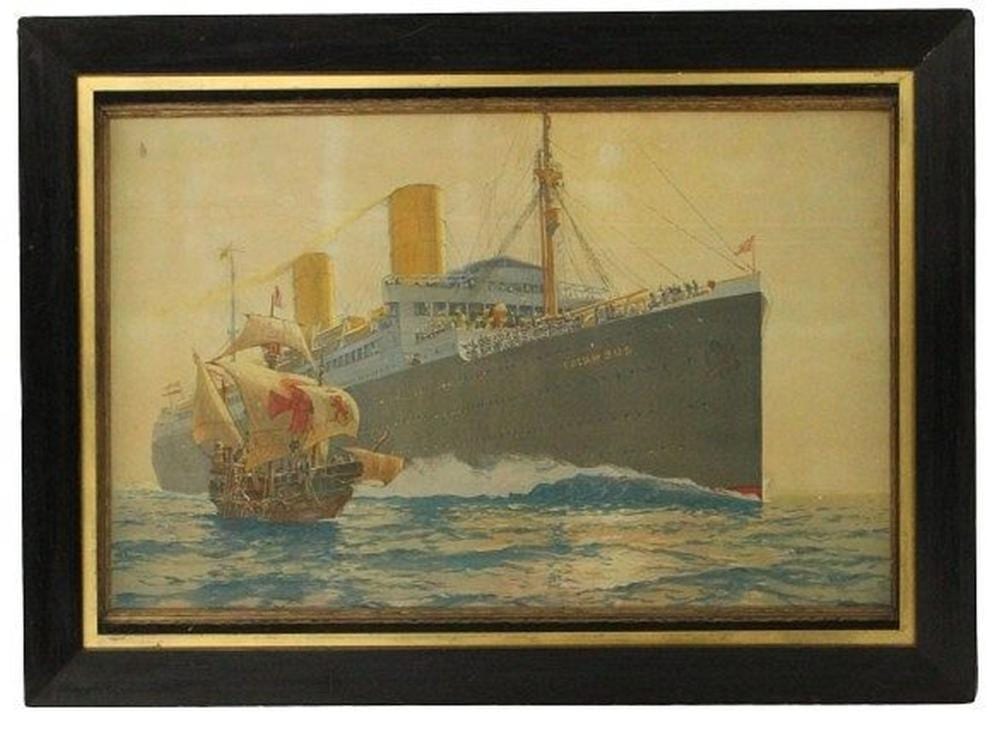
Hans Bohrdt (1857-1945) German, Large Original Lithograph. Depicts the Norddeutscher Lloyd Bremen oceanliner Columbus and Christopher Columbus' flagship Santa Maria side by side. Title: "Einst und Jetzt" ("Then and Now"), first printed in 1924. Overall: 24 X 33 in. Sight: 18 X 28 in. Depth: 2 1/2 in. #2757 . Hans Bohrdt was born on February 11th, 1857 in Berlin, Germany. His family was comfortably well-off and middle-class, and he was one of 7 siblings. Bohrdt’s love for the sea began when he was 15 after visiting the port of Hamburg. Without any prior exposure to art, he sought out materials and taught himself to paint seascapes, primarily in oils. Long after he had begun painting, Bohrdt studied sporadically at the Academy of Fine Arts in Berlin, but grew tired of copying from plaster and classical subjects, preferring to paint his subjects along the water’s edge or from the bow of a moving vessel. Nevertheless, his work at the Academy earned him praise from the art critic Adolf Rosenberg, which in turn led Kaiser Wilhelm II to purchase some of Bohrdt’s paintings and then strike up a friendship with the artist himself. Bohrdt was showered with decorations and in 1898 was awarded an honorary doctorate, providing private art lessons to the Kaiser regularly. His influence went beyond the artistic world, as the Kaiser was enamored with the nationalistic nature of his work and in turn bolstered the strength of the German Merchant Marine, making them second only to the British Empire by the turn of the 20th Century. By the early 1900s his work had become less in vogue, due mostly to the overwhelming number of vessels he painted, and later works lacked the clarity and detail he became known for early on as he sometimes hastened to complete a commission in a single day. Throughout World War I he produced countless postcards, posters, and lithographs for propaganda purposes. Although the propaganda apparatus in Nazi Germany also used his work to promote the Navy, new security restrictions prevented him from traveling, and his output significantly diminished. The second World War not only resulted in the decimation of Bohrdt’s entire family but in the number of his works as well, destroyed by the thousands in bombings. Many are still unaccounted for, including his best-known painting, “Der Letzte Mann” (“The Last Man,” 1915), which has been lost since 1924. Traumatized by the loss and seen as a relic of an earlier regime, he was unceremoniously discarded by the collapsing Reich, and died of malnourishment and neglect on December 19th, 1945 in a Berlin retirement home.