Have one like this? Check yours freeOr have an appraiser value it
Lot description
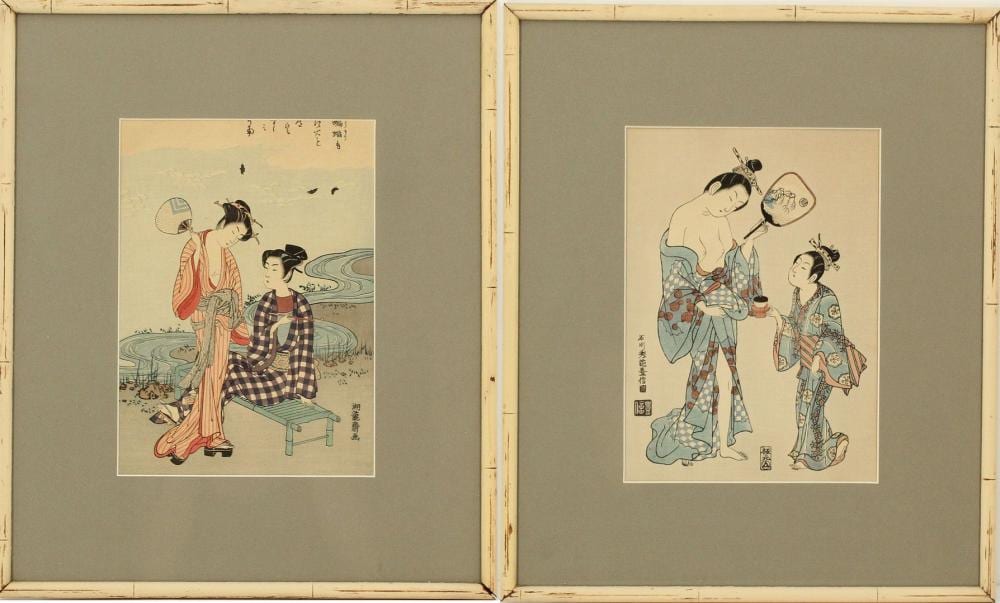
Ishikawa Toyonobu (1711-1785) and Isoda KoryÅ«sai (1735-1790) Japanese, Color Woodblock Prints. Similar look, but different artist, colors, details, and subjects. KoryÅ«sai's shows two women by a river with bats flying above them; this is the "Summer" print of the FÅ«ryÅ«shiki Asobi (Elegant Play in the Four Seasons) series, originally printed around 1774. Toyonobu's shows a woman with her breasts exposed holding a fan, while her kamuro (child helper) offers her tea; originally printed around 1749. Both have prior gallery tags on the back. Both have artist names and some dates written on the back. Overall (both): 17 1/2 x 14 1/2 in. Sight (both): 10 3/8 x 7 1/2 in. #2911 . Ishikawa Toyonobu was born in 1711 in Japan. He is theorized to be the same person as Nishimura Shigenobu, a contemporary ukiyo-e (“floating world”) artist about whom very little is known. A pupil of Nishimura Shigenaga, Toyonobu produced many monochrome urushi-e (“lacquer prints”) of kabuki actors and beautiful women, experimenting with semi-nude forms that were a foundational basis for the future of shunga (“erotica”) as a Japanese art style. Later in his career Toyonobu became the leading producer of color prints, chiefly benizuri-e (“rose prints”), but stopped making ukiyo-e shortly after Suzuki Harunobu pioneered the nishiki-e (“full-color print”) in 1765. He had one notable pupil, Ishikawa Toyomasa, who is known chiefly for his depictions of children at play, and who may have been Toyonobu's son. Today his vibrant depictions of prostitutes and courtesans alike are found all over the world in the Metropolitan Museum of Art, the British Museum, the Museo Nacional del Prado, and countless more exhibitions. He died in July 1785. Isoda KoryÅ«sai was born in 1735 in Japan, and worked as a samurai in the service of the Tsuchiya clan. He became a rÅnin after the death of the head of the clan and moved to Edo (modern-day Tokyo) where he settled near RyÅgoku Bridge in the Yagenbori area, around 1760. He became a pupil of the ukiyo-e master Suzuki Harunobu, taking the art name Haruhiro in 1769 and first making samurai-themed designs. Harunobu died in 1770, and KoryÅ«sai took up his work as a master. KoryÅ«sai became a prolific designer of individual prints and print series, with 2,500 known designs total, an average of four a week during his working life. The series “Hinagata wakana no hatsumoyÅ” (Models for Fashion: New Designs as Fresh Young Leaves) ran for 140 prints, the longest ukiyo-e print series of beauties in history. He designed at least 350 hashira-e pillar prints, numerous kachÅ-e bird-and-flower prints, a great number of shunga erotic prints, and 90 nikuhitsu-ga paintings as well. According to art historian Allen Hockley, “KoryÅ«sai may… have been the most productive artist of the eighteenth century.” In 1782 KoryÅ«sai applied for and received the Buddhist honor hokkyÅ (“Bridge of the Law”) from the imperial court, and used the title as part of his signature from then on. His output slowed after this, however, although he continued to design prints until his death in 1790. His work can be found in dozens of permanent collections in museums worldwide, including the British Museum, the Princeton University Art Museum, and the Suntory Museum of Art.