Have one like this? Check yours freeOr have an appraiser value it
Lot description
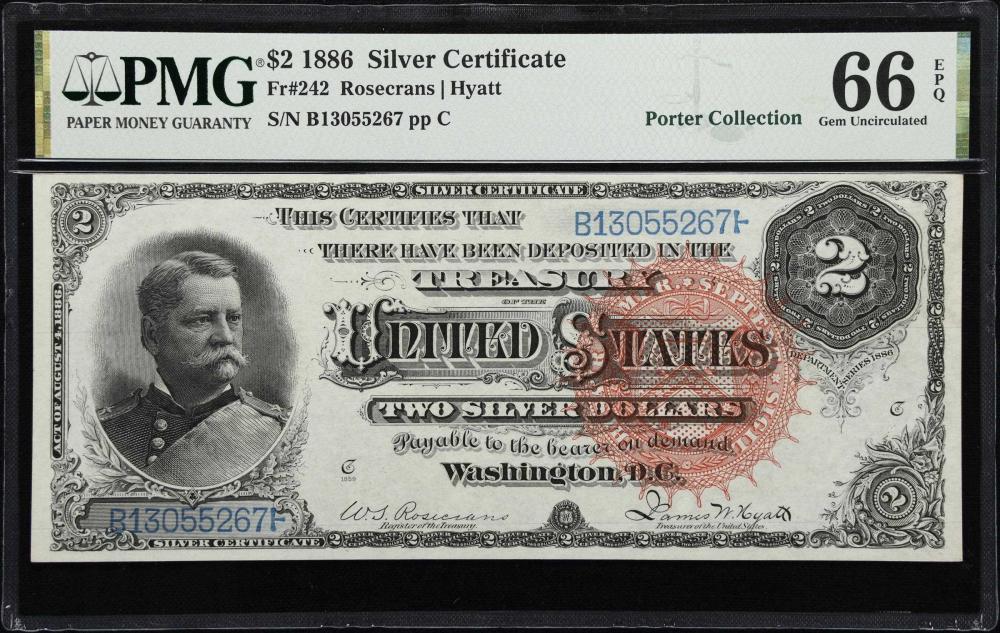
Arguably one of the most excessive and unusual designs to emerge from the 1880s. Featuring a portrait of General Winfield Scott Hancock, Hancock had served with distinction during the American Civil War and later accepted the Democratic nominee for President in 1880 only to narrowly loose to the likes of his fellow general James A. Garfield of Ohio. A short-lived portrait choice, Hancock's depiction would be replaced by a portrait of Treasury Secretary William Windom (a Republican) in 1891. Whether the replacement of Hancock's was driven by politics or a sincere desire to memorialize a departed cabinet official (or both) Hancock's portrait represents a unique entry in the pantheon of American paper money along with the likes of James McPherson, George H. Thomas, Philip H. Sheridan, David Farragut and other Union military personalities whose portraits adorned the likes of notes issued in the decades following the end of the American Civil War in 1865. A large spiked light-red Treasury Seal is seen to the right of Hancock's portrait and leaves a distinct impression amidst a relatively uncrowded face design. Additional elements including a hexagonal denomination can be seen in the upper right corner while the imprint of the Bureau of Engraving & Printing can be found between the engraved signatures of Rosecrans and Hyatt. Of particular note, the back design stands as one of the more unusual in a time when crowded geometric compositions were the norm. The back design is a stunning composition even among its contemporaries. Composed from a multitude of intricate geometric patterns and floral adornments the impression left upon the viewer is undeniable and sure to foster an appreciation of paper money even among the most ignorant or hard-hearted numismatists who would otherwise disparage paper money as an unserious numismatic pursuit under normal circumstances.